For us, it makes
sense to go on a family holiday by car due to travel costs and the
volume of luggage we have to take with us. I have family in Mildura (550
kilometres north-west of Melbourne) so we’ve driven the Calder Highway
to Mildura countless times. Each time, we find some way of refining or
improving our preparation for the trip. With breaks along the way to let
the children run around, this trip can take us anywhere from six to
eight hours. This is a long time for kids to be in a car, so preparation
is the key to ensuring that the trip is a fun experience for everyone.
Before I pack for a long car trip, I write a master checklist of what to take:
• children’s clothing
• food packs
• bedding
• important extras
• miscellaneous
• activity packs.
This list is broken into a number of smaller checklists.
Children’s clothing
We
involve the kids in the packing process and ask them to help choose the
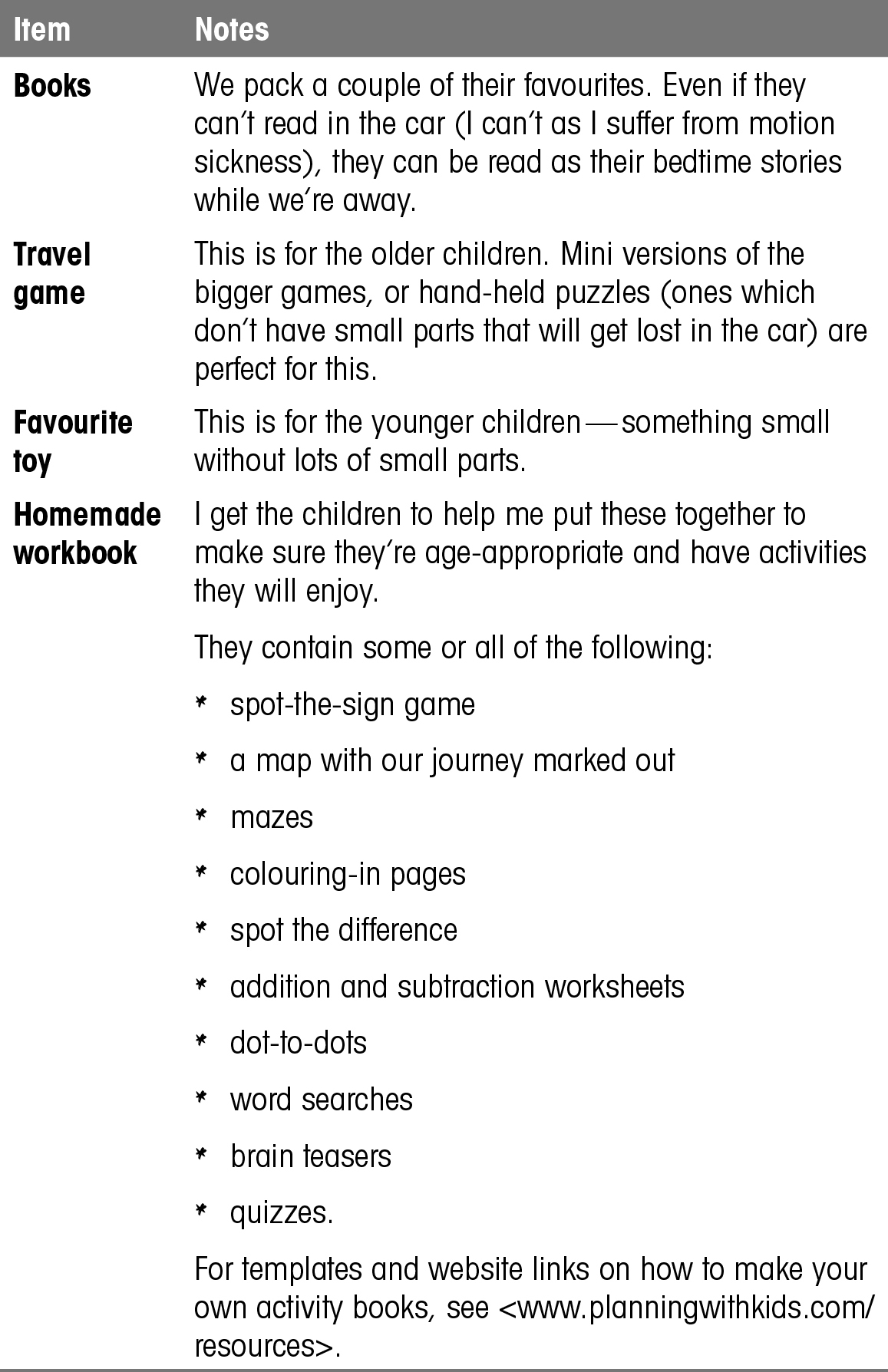
clothes they should take. Once they’ve decided, I draw up a checklist
for them to use when packing (see table 1). As not all the kids can
read yet, the checklist has both words and pictures.
When
we go on short trips, I ensure we take enough clothes so I don’t have
to do laundry while we’re away. However, when we stay with family I do
try to wash so I don’t have to take too many dirty clothes home with us.
Table 1: children’s checklist
Food packs
If
we’re travelling for more than one and a half hours, we definitely have
to take food for the kids. They’ve made it clear to us that they may
starve unless they’re fed bi-hourly! We have a people mover, so for
logistical reasons — and also to encourage independence in the kids — we
make individual food packs. Each child has a backpack in which to store
all their items for the trip. We make it clear that the food has to
last the entire journey, so they need to pace themselves.
Since
we started this a number of years ago, long car trips have been much
more peaceful. There are no complaints of ‘I’m hungry’, ‘What’s to eat?’
or ‘I need a drink’. Each child can access their pack and eat whatever
they like, when they like. The exception, of course, is our toddler. He
hates being left out so we pack him his own backpack as well and the
non-driving parent passes his food and drinks to him as he demands them!
As
I suffer from motion sickness, it also helps me, as I’m not constantly
turning around passing food to the kids, which can often kick off my
nausea. If the kids eat junk food while travelling, their behaviour
worsens, so I try to keep the food as healthy as possible. I also try to
include foods that are low on mess, are filling and are easy for the
younger children to manage independently.
The
additional positives to packing our own food are that it’s cheaper than
buying food along the way and it gives us greater flexibility with
regard to stopping for breaks during the trip. If they’re sleeping, our
little ones tend to wake up if the car stops so we’re happy not to have
to stop. This way our breaks are not dependent on finding a place to buy
food — only somewhere with toilet facilities and space for the kids to
stretch their legs. Table 2 lists a typical food pack.
Table 2: food pack for six-hour road trip
The
kids aren’t the only ones who need refreshments on a long drive. As far
as food goes, my husband and I prepare very similar packs for ourselves
as we do for the kids (only much less). We take water, but I like to
pack some cold drinks as well. We make our own ice packs by placing
ice-cream containers of water in the freezer for a few days beforehand
to use during the trip for keeping the drinks cold. Whenever we’ve
travelled with a baby we also used these ice packs to keep their food
fresh.
Bedding
When
we travel we often stay with family. As there are a few of us, we
usually have to bring along sleeping paraphernalia such as pillows,
sleeping bags, camping stretcher and a port-a-cot. A couple of the kids
also have comforters (blankets) of some description, so it’s important
for my sanity that they’re packed too.
Important extras
If
we’re going away for a particular celebration such as Christmas or
Easter, I prepare a list of everything we need to take for the occasion
(Christmas presents, Easter eggs and so on). If we’re going camping I
list all the gear we’ll need, such as a tent, camping stretchers,
torches, cooking implements and an esky.
Miscellaneous
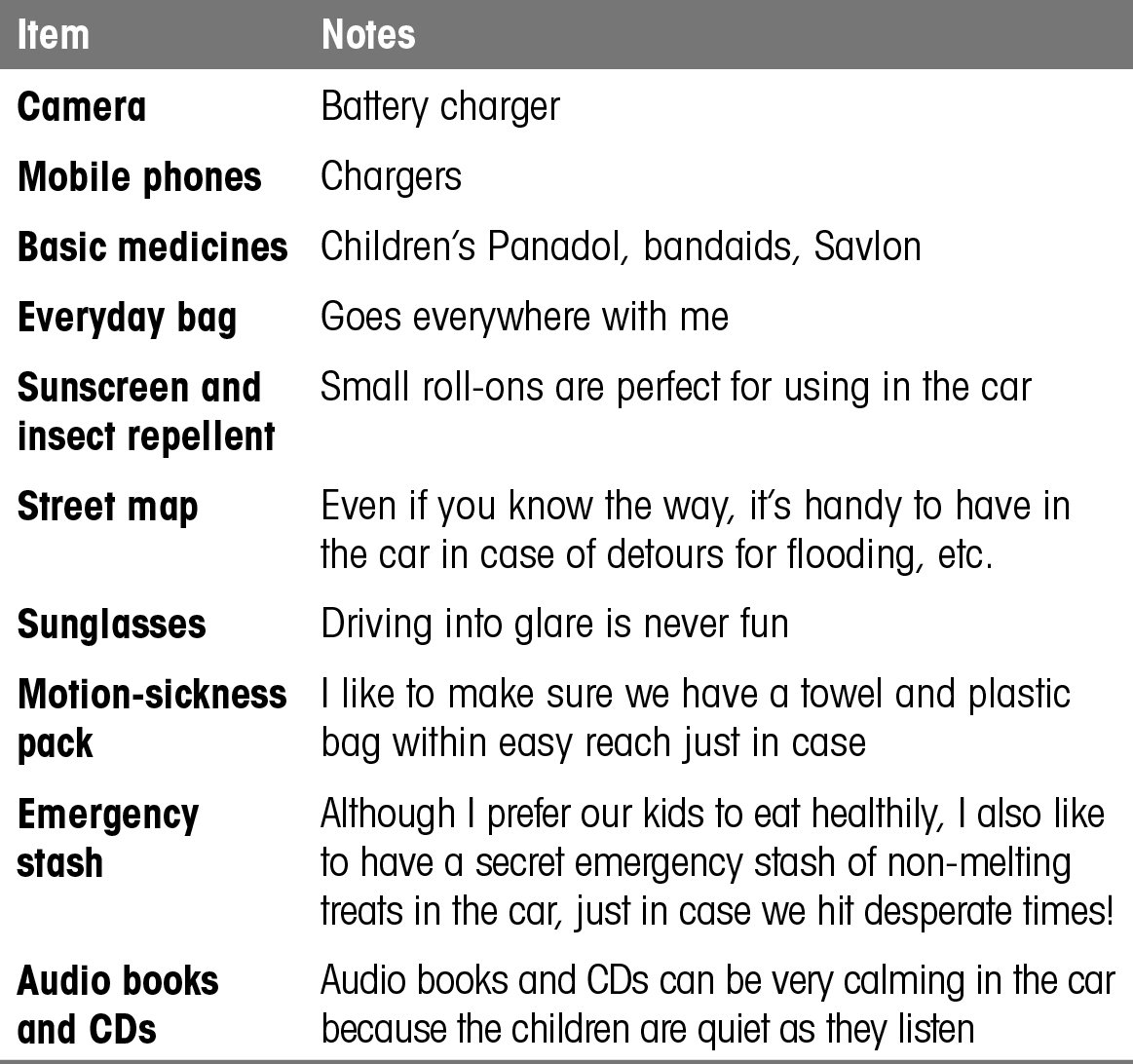
Although
we could survive without the items listed in table 3, they do ensure
that our time away is as stress-free and fun as possible.
Table 3: Miscellaneous items
Activity packs
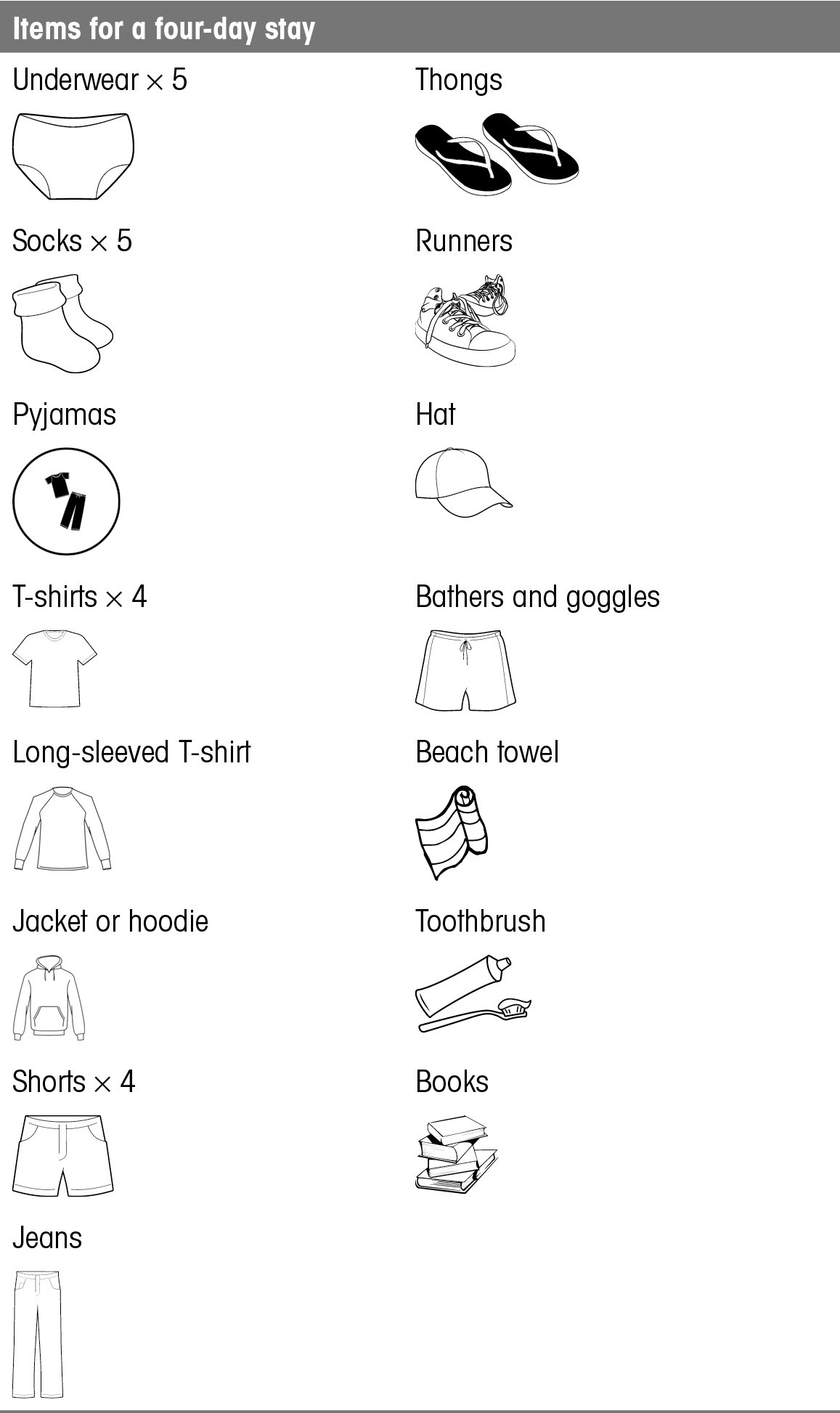
Individual
activity packs (see table 4, overleaf), help children to pass the
time on long journeys. Our kids can access them whenever they want to.
They each choose what goes into their pack so we’re quite sure they
contain plenty of things that will entertain them.
Table 4: children’s activity packs