Routines are like a comfort blanket for kids;
they give them a sense of security. They let kids know what’s coming
up, what’s expected of them and when it’s expected, which helps to place
boundaries around their big wide world.
Routines
are so important for kids! As an early childhood teacher I could
usually tell which students had become accustomed to predictable
routines at home, and were used to being assigned regular jobs. These
children often transitioned much more smoothly [in]to school!
Routines
don’t have to incorporate every waking minute of the day, but it’s
helpful if they cover the key activities that take place in daily life.
For example, on school days there needs to be a more specific routine to
ensure no-one is late, while on weekends and during school holidays
routines can act more as a fluid framework around which to organise your
day.
The best way to develop a routine for your family is to consider these key factors:
• your children’s natural preferences
• regular family activities.
For example, in our
house the kids are early risers, and this can often mean I start my day
at 5 am! Instead of viewing this as a cross to bear, I use it to my
advantage to kickstart our daily routine. In families with young
children, giving yourself plenty of time to prepare the kids and
everything else for school makes the mornings less stressful.
Our early morning
routine also suits the children’s natural preferences. Two of my
school-aged children have a leisurely approach to getting ready. They
like to have time to read or play and take things slowly in the morning
so they get up early. If they got up half an hour before we leave the
house, our mornings would soon become a battleground, with time and
leisure competing fiercely. My other school-aged child is very
different. His priority is to get himself ready and to be organised. He
loves getting to school as early as possible so he has time to play
before the bell rings, and he hates being late. This works beautifully
in my favour as he’s willing to help me and work cooperatively with the
other children to ensure we leave the house on time.
Like most families
with school-aged children, during the school term we have a number of
after-school activities. There are activities such as dance classes,
swimming lessons and footy training sessions to schedule in, and they
help determine our weekly routine. As these activities can change each
term, our routine needs to be modified regularly.
Unavoidable
necessities have also helped shape our family routines. For example,
over the past 11 years I’ve spent more time breastfeeding than not;
therefore, this has been a big factor in determining our daily routine.
As my husband has always worked reasonably long hours, I’ve had to
juggle the bulk of the evening routine on my own. This is not something
I’ve always found easy. There was often a tired toddler wanting
attention or a grizzly baby in need of a calming feed competing for my
time.
About six months
into life with our second child, I decided I could better manage the
baby’s last feed of the day if I allowed our then 2 and a half year old
to have his TV time while I breastfed. This system worked beautifully.
The 30 minutes during which our toddler watched his pre-recorded show of
Playschool
allowed me to calmly give the baby his last feed of the day. I could
then spend time with our toddler reading stories quietly while the baby
was sound asleep.
Morning
and evening routines are only two examples of routines you may have for
your family. You may have a weekend routine where everyone sleeps in
until after 7 am. (Well, to be honest, I added that one in as it sounds
like heaven to me at the moment!) Or you may have a weekend routine where you go to the market to buy the fruit and vegetables for the week, or where you spend family time in the garden.
Whatever additional
routines you have, make sure you have weekday morning and evening
routines for the kids. It is at these busiest times of the day — the
peak-hour periods of morning and evening — that you want your children
to be able to operate with minimal direction and complete their chores
as needed so they can move on to the next stage of their day or night.
As with all aspects of parenting, though, common sense and flexibility
are required when following routines. For example, if our preschooler
has slept in after a late night, expecting him to complete all of his
usual morning chores would be unreasonable. These instances, however,
are the exception and not the rule, and routines can become a natural
part of daily life for kids.
Morning routines
While
getting organised and introducing routines may seem like a bit of work,
the benefits of taking the time to do so are enormous as routines
really do help manage the first rush hour of the day. A calm and happy
start to the day is not only beneficial for the kids; it can set the
tone for the adults’ day too.
Lay out your work clothes and child’s clothes the night prior and pack a bag for childcare [to] leave at the door ready to go.
Kyrstie Barcak, mum of two
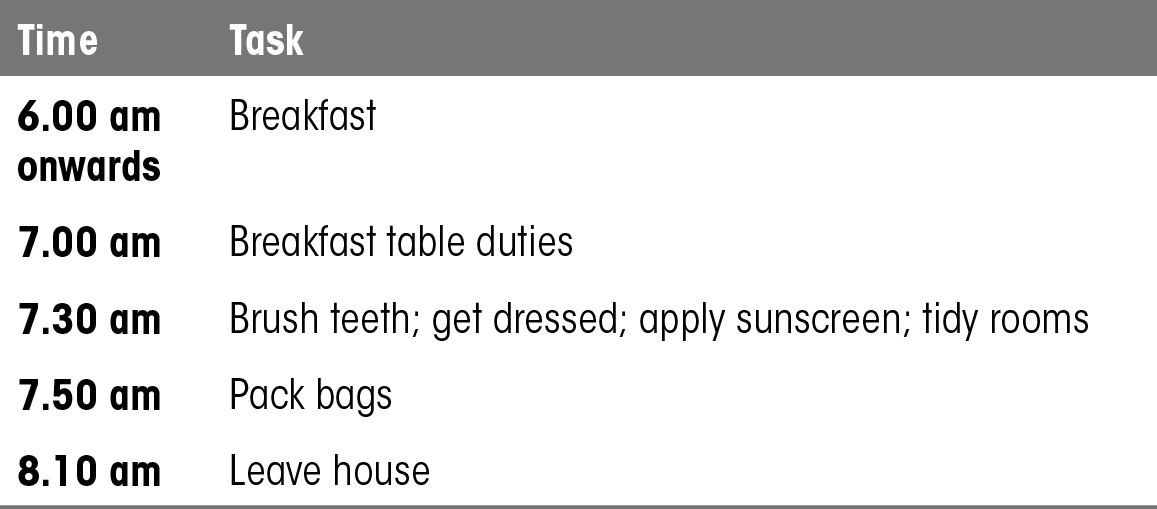
Table 1.1 shows the morning routine my kinder and school-aged kids follow during the school term.
The
younger children need a visual routine, which is a simple chart with
pictures showing the order in which they should complete tasks when
getting ready in the morning.
Table 1.1: school morning routine
Now, as fabulous as it
would be if the kids looked at their routines and worked their way
independently through them, this is not how it works in reality.
However, with age they’ve become more practised at their routines and
are able to complete tasks independently. There are still times when I
need to provide guidance to ensure the kids get organised in the
morning, but I’m not constantly having to nag at them as they know what
they should be doing.
Mornings
can be a very busy time for families, and if parents have to direct all
of their children’s actions, this time of the day can quickly turn into
a nagging session. By creating known and age-appropriate routines for
the kids, you allow them to take on greater responsibility for getting
themselves ready and, best of all, the parents don’t have to nag so
much.
Evening routines
When
our eldest child was still a preschooler, we had the same evening
routine every weekday as there weren’t any after-school activities to
worry about. How all that’s changed now we have three children at
school! Depending on your family’s commitments, the second rush hour can
begin as soon as the kids get home from school: homework to be
completed, listening to reading, driving to and from after-school
activities and trying to cook dinner while consoling an overtired
toddler is a very common scenario at our house.
Our
after-school routine varies greatly from one day to the next. However,
one thing that doesn’t change is having an early evening meal — dinner
now just fits within a larger window than before we had kids at school.
Before
children there are certain things you can’t ever imagine yourself
doing, and for me one of those was eating dinner at 5.30 pm. I had heard
of people doing this and wholeheartedly scoffed at the idea. To me,
5.30 pm was still part of the day! Then, suddenly, I was home all day
with two children, and on some days 5.30 pm seemed like midnight.
When
walking home from school in the afternoon I cut up beautiful apples for
my children, which we eat as we walk. When we arrive home the children
don’t go to the pantry raiding the biscuits and bread as they are no
longer starving and then they eat their dinner.
Georgina Rechner, mum of three
It didn’t take me long to work out the reasons for and benefits of eating dinner at 5.30 pm with the kids.
• Kids are actually hungry at this time.
• Kids
eat better when they’re not overtired, and tiredness really starts to
kick in for babies, toddlers and preschoolers after this time.
• With
this tiredness comes a significant drop in kids’ attention spans and
their ability to sit still at the table, making mealtimes less
enjoyable.
• Meals
are a social time for kids too. Actually sitting down and eating a meal
with them is a wonderful chance to connect and talk about their day.
Having
an evening routine is also one of the best ways of getting children
into bed at a reasonable time with a minimum of fuss, which increases
family harmony: if kids sleep well, they’re more likely to eat well; if
kids are well rested and eat well, they’re more likely to behave
considerately and cooperatively.
At
bedtime, the routine is important (dinner, wash, bed, books). What time
these happen and how long they take is less important. The concept of
time, which is abstract, is not relevant to kids until they are 8+ but
the sequence of events is learnt early.
Julie Holden, mum of two
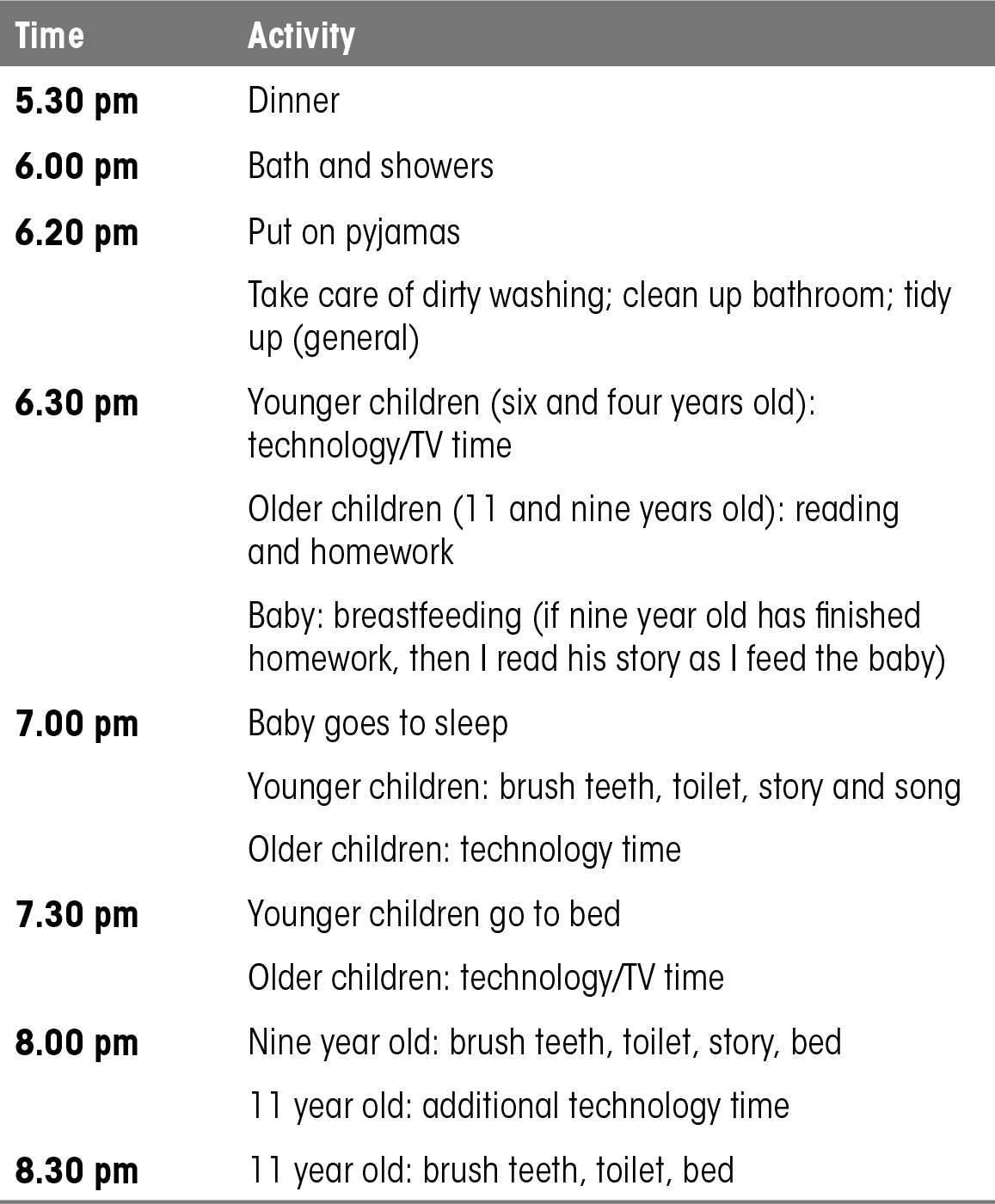
While
our evening routine won’t suit all families (because everyone has
different after-school and work commitments), table 1.2 (overleaf) is
included as an example of the way an evening routine can work. This was
our routine when our youngest child was still a baby.
Table 1.2: evening routine