2. Egg Yolks
If Eskimos have
N words for describing snow, the French and Italians have
N+1 words for describing dishes involving egg yolks. A number of
these dishes use egg yolks to create light, airy foams by trapping air bubbles.
Egg yolks are much more complex than egg whites: ~51% water, ~16% protein, ~32% fat,
and ~1% carbohydrates, while egg whites are only protein (~11%) and water. In their
natural state, egg yolks are an emulsion.
Note:
An emulsion is a mixture of two liquids that are immiscible—that is, unable to mix
(think oil and water). Mayonnaise is the classical culinary example. Egg yolks are an
emulsion, too: the fats and water are held in suspension by some of the proteins, which
act as emulsifiers—compounds that can hold immiscible liquids in suspension.
Like egg-white foams, egg-yolk foams trap air with denatured proteins that form a mesh
around air bubbles. Unlike whites, though, the only way to denature the proteins in the
yolk is with heat; the optimal temperature for egg-yolk foam creation is 162°F / 72°C. Too
hot, though, and the proteins coagulate, leading to a loss of air and affecting the
texture.
Some recipes rely on more than just one method of incorporating air into food. Some
English muffins and Chinese pork buns, for example, use both yeast and baking powder.
Waffle recipes often call for both whipped egg whites and baking powder. And some mousse
recipes call for both whipped egg whites and whipped cream. If you find that a recipe
isn’t turning out as light as you’d like, look to see if other methods of leavening can
be added. If a recipe doesn’t rely on chemical leaveners, adding a small amount of
baking powder is usually a safe bet. Or, if the recipe has eggs, try separating some of
the eggs, whisking the whites, and folding the egg-white foam into the batter.

|
This sauce needs very few
ingredients and not much in the way of equipment—a whisk, a bowl, and a
stovetop—making it an easy impromptu dish even in an unfamiliar kitchen. The only tricky part is preventing the eggs in this sauce from getting too
hot and scrambling. If you have a gas burner, this can be done by moving the saucepan
on and off a flame set to very low heat. Position yourself so that you can hold the
pan with one hand while whisking with the other; you’ll need to move the pan to
regulate the temperature. If you have an electric burner, use a double-boiler instead:
fill a large saucepan with water and place the saucepan with the mixture inside
it. In a saucepan, separate 3 egg yolks, saving the egg whites for some other dish. Add
¼ cup (60g) white wine and whisk to combine. Once you’re ready to start cooking, place the pan over the flame or in the water
bowl bath and whisk continuously until the egg yolks have set and you have a frothy
foam, about two to three times the volume of the original. This can take 5 to 10
minutes; have patience, it’s better to go too slow than too quick. Add 2 to 3 tablespoons (20–30g) freshly grated Parmesan cheese and whisk until
thoroughly combined. Add salt and pepper to taste, and serve on top of an entrée such as
fish with asparagus. Note White wine is quite acidic, with pH levels around 3.4 (Chardonnay) to
2.9 (Riesling). Since acids help prevent egg yolks from coagulating under heat,
the wine actually helps protect against coagulation. (Pour yourself a glass;
that’ll help, too.)
|
This dish is easy, but it does benefit from a few practice runs. Luckily,
the ingredients are cheap! Zabaglione is the dessert equivalent of white wine and cheese sauce, made
by whisking wine, sugar, and egg yolks over low heat; it’s essentially a foamy
custard, but without the milk. And, like the white wine and cheese sauce, this is a
great recipe to have tucked away in the back of your head. Measure out ¼ cup (60g) Marsala wine and set aside.
Note: Marsala—a white wine fortified with extra alcohol—is traditionally used in
zabaglione, but you can use other alcohols, such as Grand Marnier, Prosecco, or
port.
In a saucepan, separate out the yolks from 3 eggs, saving the whites for something
else (meringues!). Add ¼ cup (50g) sugar to the yolks and whisk to combine. Place pan over heat, following the directions for the white wine and cheese sauce.
Pour in a tablespoon of the Marsala and whisk. Continue adding the Marsala a tablespoon
or so at a time, whisking for a minute between each addition. You’re looking for the egg
yolks to froth up and foam; the heat will eventually set the egg yolks to make a stable
foam. If you notice that the egg yolks are scrambling, quickly pour in more of the
Marsala to cool the mixture down; it’s not ideal, but it’ll prevent you from having an
entire dish of sweet scrambled eggs on your hands. Once the sauce begins to show soft
peaks, remove from heat and serve. Traditionally, zabaglione is served with fruit: spoon a small portion into a bowl or
glass and top with fresh berries. You can also store it in the fridge for a day or
two. |
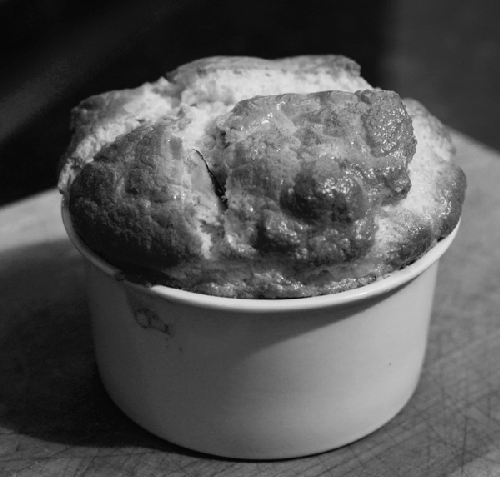
You’re probably wondering what
soufflé is doing in the section on egg yolks, right? After all, it’s the egg whites
that famously give soufflés their rise. I have a confession to make. I make my
fruit-based dessert soufflés by making zabaglione. (I am so never going to win a James
Beard award—the Oscar of the culinary world.)
Preheat your oven to 375°F / 190°C. Prepare a 1 quart / 1 liter soufflé bowl—which
will hold enough soufflé for two to three people—by buttering the inside and then
coating it with sugar (toss in a few spoonfuls, then rotate the dish back and forth to
coat the side walls).
Prepare the fruit:
Fresh strawberries, raspberries, and white peaches work exceptionally well; wet
fruits such as pears can work, but the water may separate while cooking, so start with
berries. Rinse and dry the fruit. If using strawberries, hull them; if using peaches or
other stone fruits, quarter them and remove the pit. Reserve about ½ cup—a small
handful—of the fruit for placing on top of the cooked soufflé. Prepare a second handful
of fruit, again about ½ cup, for cooking by slicing it into small pieces; cut
strawberries into eighths and peaches into very thin slices. (Raspberries will fall
apart on their own.)
Make zabaglione:
Start by making a zabaglione: whisk the 3 egg yolks with ¼ cup (50g) sugar over low
heat and add ¼ cup (50g) of kirsch—cherry-flavored brandy—instead of Marsala. (Save the
egg whites for whisking.) After adding the kirsch, add the fruit that’s been sliced into
small pieces and stir, thoroughly mashing in the fruit. You don’t need to actually cook
the egg yolks until they set; you’re just looking to stir and whisk them until you have
a frothy, warm, soft foam. Set aside while preparing the egg whites.
Whisk egg whites, fold, and bake.
Whisk the egg whites to soft peak stage, adding a pinch of salt for taste. Fold the
egg whites into the fruit base and transfer the mixture to the soufflé bowl. Bake in an
oven until the soufflé has risen and the top is browned, about 15 to 20 minutes. Remove
and place the soufflé dish on a wooden cutting board. Dust with powdered sugar, place
the reserved fruit on top (slice strawberries or peaches into thin slivers), and serve
at once. If you’re in informal company, it’s easiest to just set the soufflé in the
center of the table and hand everyone a fork to dig in.
You can use this same technique with the white wine and cheese sauce
from the previous page to make a savory soufflé.