1.3. Pizza
If there’s one stereotypical geek food,
it would have to be pizza: ubiquitous, cheap, and cheesy. But the stuff sold in your
local strip mall is far inferior to what you can make at home. It’s like the difference
between canned fruit and the fresh thing: both can be good, but the fresh version is
distinctly more nuanced.
Start by making pizza dough. You can also buy pizza dough at your grocery store,
although I find I get better results when I make it from scratch .
Set out a large cutting board and sprinkle a handful of flour in the center area.
Preheat your oven to at least 450°F / 230°C. Take about 1 lb (450g) of the dough and
form it into a ball between your hands, kneading and folding it over. The dough should
be just slightly sticky, but not so much that it actually remains stuck to your hand. If
it’s too sticky, add more flour by dredging it in the flour on the cutting board.
Continue to work the dough until it reaches a firm consistency and has good elasticity
when stretched. Begin to work the dough into a flat, round disc, and then roll it into a
round pizza shape.
Par-bake the pizza dough by baking it on a pizza stone in a hot
oven. You can transfer the pizza dough by carefully picking it up and laying it onto the
stone; don’t burn yourself! If you don’t have a pizza stone ,
you can use a cast iron pan, upside down, to similar effect. Let the pizza bake for
three to five minutes, until the dough has set. If the dough puffs up in one place, use
a chef’s knife to poke a small hole in the bubble and then use the flat side of the
knife blade to push the puffed portion back down. Par-baking the dough isn’t
traditional, but it’ll help avoid soggy, undercooked dough and also makes transferring
the topped pizza into the oven a heck of a lot easier. It simplifies the cooking of the
pizza, too: cook the dough until it’s effectively ready, and then cook the toppings
until they melt and fuse, as opposed to trying to get both to occur at the same
time.
Once the pizza dough has been par-baked, remove it from the oven and place it on
your cutting board. Add sauce and toppings. The sauce can be anything from a thin
coating of olive oil to traditional tomato sauce. For toppings such as onions and
sausage, sauté them before placing them on the pizza. Cooking the dough and toppings
separately removes all the constraints associated with the various ingredients needing
varying cooking times, leaving just three goals: melting the cheese to fuse the
ingredients together, browning the edge of the crust, and browning the top surface of
the toppings. Finish cooking by transferring the dressed pizza into the oven (using a
pizza peel or, in a pinch, a piece of cardboard) and baking it until any cheese is
melted and the pizza has begun to turn golden brown, about 8 to 12 minutes.
Jeff Varasano on PizzaJeff Varasano moved from New York to Atlanta, where a lack of New How did you go from C++ programming to making I moved from New York to Atlanta. Like a lot of people transplanted from the I started experimenting. I did all the flours. I experimented with different I threw up this website (now at http://www.varasanos.com/PizzaRecipe.htm). I really didn’t In the process of learning how to do your pizza, what Well, clearly what mattered less was the flour. Everyone is looking for the piece A lot of geeks who are learning to cook get hung up on the Yeah. I’ve always been an experimenter. But I’ve always had sort of a different So when you get stuck on one of these problems even though That’s an interesting question. Let me deviate from that slightly and then I’ll Art begins where engineering ends. Engineering is about taking what’s known and As an example using pizza, as soon as I switch flour, I can’t just keep the same This makes a lot of sense. I think a lot of geeks out That’s right. And you have to work on the underlying forces and begin to In the first stage of working a problem or trying to master a skill, you find that I am at the middle stage myself, so I don’t quite see how all the pieces fit One of the ingredients I had given pretty minimal thought to—and didn’t realize So now I’m ready to launch the restaurant and I’m going to all my suppliers You don’t realize that there is a difference to be worked on, but that’s when So it sounds like your method for overcoming this is to It really is, and you know it’s funny because I like to say, well, how do you
|
Pizza Dough—No-Knead Method
This makes enough dough for one medium-sized
pizza with the crust rolled thin. You’ll probably want to multiply these quantities by
the number of people you’re cooking for.
Weigh into a large bowl or plastic container:
1 ⅓ cups (170g) flour
1 teaspoon (5g) salt
1 tablespoon (10g) instant yeast
Using a spoon, mix together so that the salt is thoroughly distributed.
Add:
½ cup (120g) water
Mix in the water using the spoon so that the flour and water are
incorporated.
Let rest on counter for at least four hours, preferably longer. You can mix the
ingredients together at breakfast time (for example, before running off to that day
job at Initech or wherever) and the dough will be ready by the time you get home. It’s
the same principle as the no-knead bread: the glutenin and gliadin proteins will
slowly crosslink on their own.
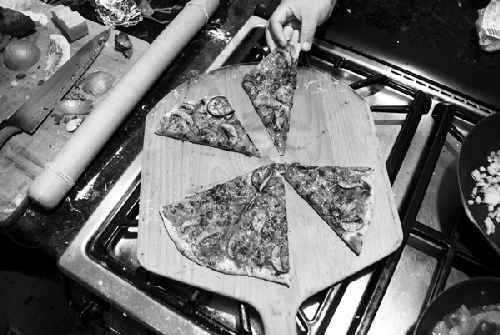
You can cut and serve pizza directly off the peel. If you don’t have
a pizza peel, you can use a piece of cardboard to slip a pizza into and out of
the oven.
Notes
I have a confession to make: when it comes to pizza dough, I’m lazy
and don’t worry about exact hydration levels, proper kneading method, ideal rest
times, and controlling temperature to generate the ideal
flavor.If you want to experiment, order some sourdough yeast culture (which
is actually a culture of both the well-known sourdough strain of yeast and the
bacteria lactobacillus). The ratio of yeast to bacteria in
the dough will impact the flavor. You can control that ratio by letting the
dough mature for some amount of time in the fridge, where yeast will multiply
but bacteria won’t; and some amount of time at room temperature, where the
bacteria will contribute flavors. If you want to explore these variables, read
Jeff Varasano’s web page on pizza—see the interview with
him in Jeff Varasano on Pizza for details.