Cooking “within season” means using only those
ingredients that have good, fresh flavor and are ripe. Restricting yourself to ingredients
that are in season in your region is a great way of creating constant challenges and
exposing yourself to new ingredients. And because in-season ingredients tend to be of higher
quality and pack more of a flavor punch, it’s that much easier to make the resulting dishes
taste good. Next time you’re at the grocery store, take note of what new fruits and
vegetables have arrived and what is in dwindling supply.
Of course, not every ingredient in a dish is a “seasonal” ingredient. Cellar onions,
storage apples, and pantry goods such as rice, flour, and beans are year-round staples and
fair game. What is off-limits with this approach are those foods that are outside their
growing season for where you live. Put another way, don’t try making grilled peaches in
February. Even if you can get a peach in February, it won’t have the same flavor as a
mid-summer peach, so it will invariably taste flat. Even if those peaches shipped from Chile
taste okay, they won’t be as good as the local in-season peaches, because they have to be of
a variety that favors shipping durability and disease resistance over taste and texture.
(Unless you happen to live in Chile.)
One of the perks of using in-season ingredients, besides the quality, is that the
abundance of the in-season produce generally means lower prices, too, as the
supply-and-demand curves change. Grocery stores have to figure out how to sell all those
zucchinis when they come up for harvest, and running specials is one of the standard ways of
moving product. The same challenge applies even more if you’re growing your own fruits and
vegetables, because a home garden can produce an abundance over a short period of time. If
you figure out what to do with the 100 pounds of zucchini that all come ready in late
summer, I know plenty of people who would like to hear it!
Note:
In-season, local foods have the advantage of typically being fresher than their
conventional counterparts, which is especially important for flavor in highly perishable
foods such as heirloom tomatoes and fresh seafood. Local isn’t always better, though. For
example, if you live in a northern climate, you might find that produce such as radishes
from traditional farms located where it gets hotter might taste better.
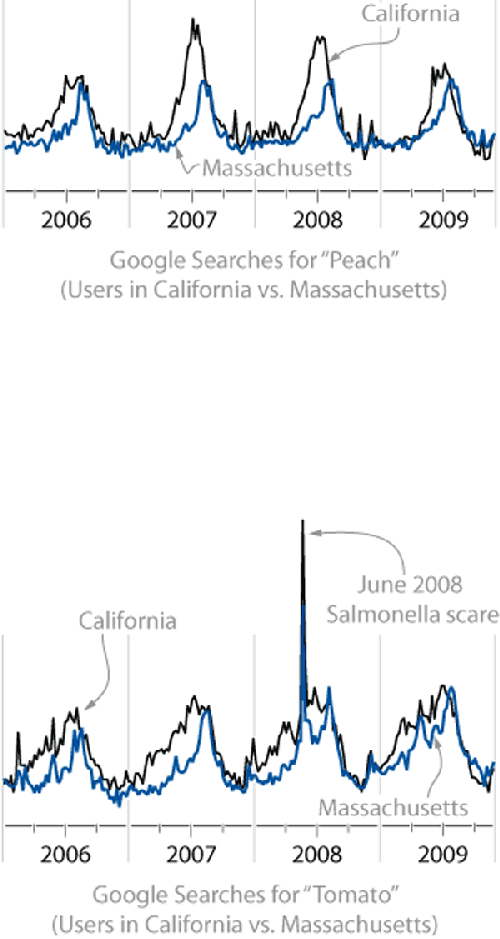
Data from Google Trends showing search volumes for the terms “peach”
(left) and “tomato” (right) for California users and Massachusetts users. The growing
season in Massachusetts starts later and is much shorter than in California. There’s a
tight correlation of this with Google’s search volumes for those
terms.
If it’s the dead of winter and there’s a foot of snow on the ground (incidentally,
not the best time to eat out at restaurants specializing in local,
organic fare), finding produce with “good flavor” can be a real challenge. You will have to
work harder to produce flavors on par with those in summer meals. Working with the seasons
means adapting the menu. There’s a reason why classic French winter dishes like cassoulet
(traditionally made with beans and slow-cooked meats, but that description does
not do this amazing dish justice—I make mine with duck confit, bacon,
sausage, and beans, then slow roast it overnight) and coq au vin (stewed
chicken in wine) use cellar vegetables such as onions, carrots, turnips, and potatoes and
slow, long-cooking simmers to tenderize tougher cuts of meat. I can’t imagine eating
cassoulet mid-summer, let alone venting the heat generated from keeping the oven on for that
long. Yet in the dead of winter, nothing’s better.
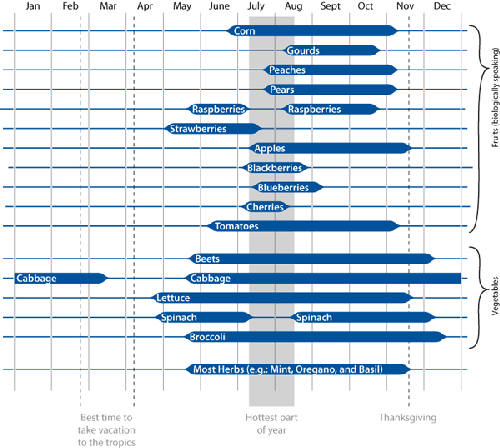
Seasonality chart for fruits and vegetables in New England. Fruits have a
shorter season than vegetables, and only a few vegetables survive past the first
frost. Some plants can’t tolerate the hottest part of the year; others do best during
those times. If you live in the Bay Area or New York, see
http://www.localfoodswheel.com
for a nifty “what’s in season” wheel chart.
Consider the following three soups: gazpacho, butternut squash, and white bean and
garlic. The ingredients used in gazpacho and butternut squash soup are seasonal, so they
tend to be made in the summer and autumn, respectively (of course, modern agricultural
practices have greatly extended the availability of seasonal ingredients, and your climate
might be more temperate than the sources of these traditions). White bean and garlic soup,
on the other hand,
uses pantry goods that can be had at any time of year. Thus, it is traditionally thought of
as a winter soup, because it’s one of the few dishes that can be made that time of
year.