From the elevated site that Pierre L’Enfant described as “a pedestal waiting for a monument,” the dignified Capitol
has stood unwavering as the symbol of American democracy throughout its
200-year history. From the legislative session called by President
Jefferson in 1803 to approve the Louisiana Purchase through to the House
of Representatives’ vote in 1998 to impeach President Clinton, these
halls have witnessed an often rough-and-tumble democratic process. The
Capitol’s frescoes and art collection qualify it as a notable museum,
but its millions of tourists come, above all, to brush shoulders with
history, both remembered and in the making.
Current tours
cover the historic sections in the center of the building, including the
Rotunda, the National Statuary Hall, and the crypt. The Senate gallery
is open only when that body is in session. Guided tours are limited to
40 people per group, and leave every half hour from 9:30am to 3:30pm.
Tickets are distributed on a first-come, first-served basis. Entrance
for the tour is from the Visitor Center. |

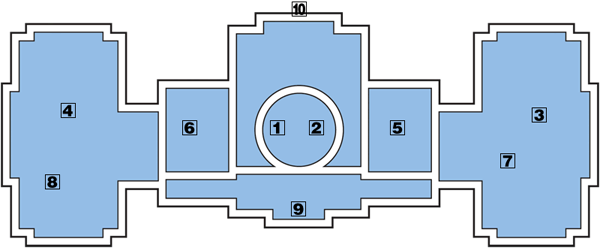
Plan of the US Capitol

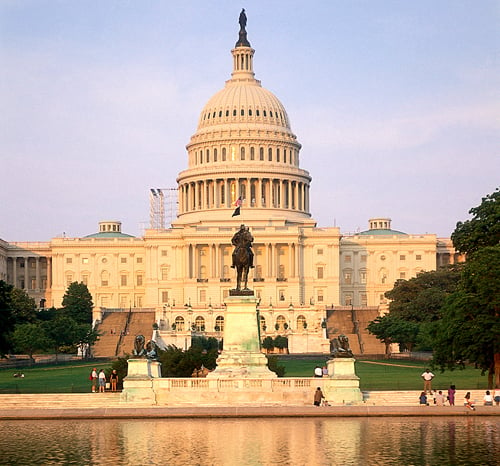
Façade
Timed tickets are distributed on a first-come, first-served basis, beginning at 9am at the Visitor Center on the East Front. |
|
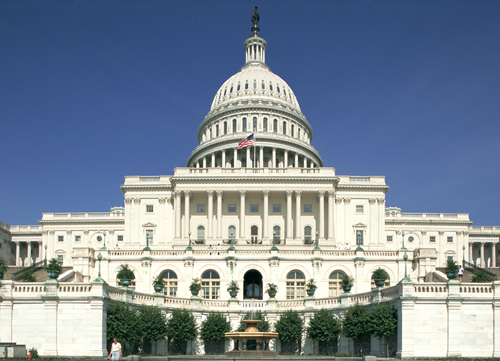
The Capitol is most inspiring when viewed rising up from the Mall. |
|
Top 10 Features
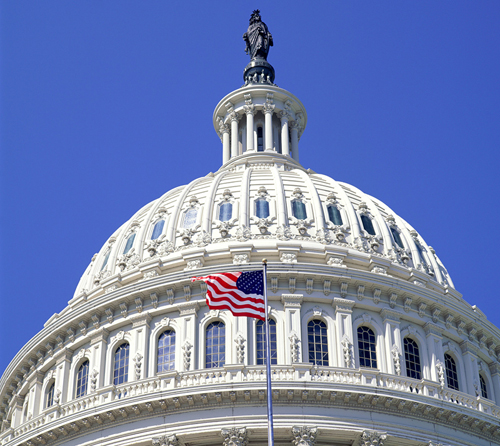
Capitol Dome
The central dome defines the entire city to people worldwide. It was added, with the Statue of Freedom, by 1866.

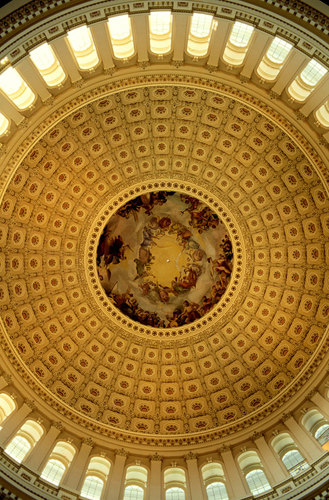
Rotunda
America’s first president ascends into the heavens in this 4,664-sq ft (430-sq m) fresco The Apotheosis of Washington, lining the interior of the dome.

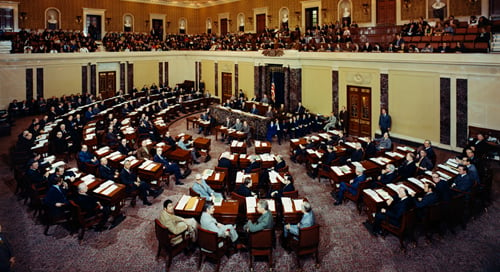
Senate Chamber
A semicircle of 100 desks faces the dais in this eminent assembly room. Democrats sit to the right, Republicans to the left.

House Chamber
The
largest room in the Capitol is used for daily deliberations of the
House of Representatives and for joint meetings of the House and Senate.
Old Senate Chamber
Used by the Senate from 1810 to 1859, this chamber witnessed debates on the core issues of the development of the United States.
National Statuary Hall
The monumental Liberty and the Eagle by Enrico Causici (c.1819) overlooks this hall – the original House Chamber.
Brumidi Corridors
Constantino Brumidi (1805–80) designed these ornate passageways on the lower floor of the Senate wing.
Hall of Columns
This
striking corridor, more than 100 ft (30 m) long with lofty ceilings, is
named after the 28 gracefully fluted white marble columns along its
length. It houses additional items from the collection of the National
Statuary Hall.
Columbus Doors
These
imposing bronze doors, 17 ft (5 m) tall, consist of reliefs picturing
Christopher Columbus’s life and his discovery of America. Designed by
Randolph Rogers, the doors were cast in Munich in 1860.
West Front
The
west front of the Capitol, facing the Mall, is the site of presidential
inaugurations, concerts, and other ceremonial events. Its three-part
Neo-Classical façade is an expression of bicameral legislature.