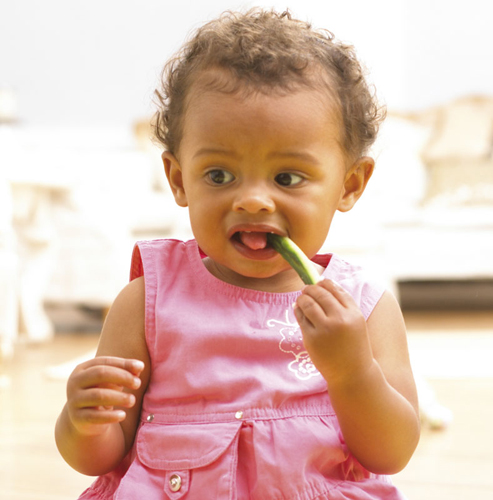
As long as your toddler is a confident eater, with a varied diet full of fresh nutritious food, she’ll continue to grow at the right rate for her. It’s also normal for babies to gain a little extra weight before a growth spurt or to appear thinner following a period of growth or an illness—all is fine so long as she remains healthy and eats well.
| Q: |
How can I tell if my toddler is overweight?
|
| A: |
The very best way to assess your toddler’s weight is to use the
growth charts provided by your health professional when your child is
born. Ideally, she will remain on roughly the same percentile line
through childhood (although there can be blips during periods of
intensive growth). If she suddenly leaps up two percentile lines, there
may be cause for concern.
Doctors will soon be
offering BMI charts as well. BMI stands for body mass index, which is
calculated using height and weight to estimate how much body fat someone
has. It helps determine how appropriate a child’s weight is for a
certain height and age. All charts are there for guidance, and it’s
important to use common sense as well when assessing weight. If your
child has no obvious rolls of fat, and fits the clothing sizes
appropriate for her age, chances are that all is well. |
| Q: |
My toddler seems very thin even though he has a healthy diet. Could he be underweight?
|
| A: |
Some children are naturally slim and slight. If your child is
healthy, has plenty of energy, and is growing normally, there should be
no cause for concern. Continue to plot his weight on his growth chart,
and as long as he is sitting along his usual percentile, there is little
to worry about. If he does appear to be falling below what is normal
for him, then visit your doctor to investigate why.
|
| Q: |
Is it OK to serve my child whole milk?
|
| A: |
Absolutely yes—this is to be encouraged. Unless your child is
overweight and your doctor advises against it, whole milk should be
served to anyone under the age of three. This is because there are
plenty of fat-soluble vitamins in milk, such as vitamin D, which
children need for the development of healthy bones. Also, fat is
important because it is required for brain development (see How much fat does my toddler need, and does it matter what type?).
Milk is a nutritionally dense food, and provides your toddler with the
calories she needs to keep going. Low fat dairy products are encouraged
after the age of three.
|
| Q: |
How much fat does my toddler need, and does it matter what type?
|
| A: |
Fat is one of the six groups of nutrients that are essential for
growth and development (the others are protein, water, vitamins,
carbohydrates, and minerals). During early childhood, fat is extremely
important since little ones grow and develop quickly. Fat is an
important source of energy, and it also carries the fat-soluble vitamins
A, D, E, and K, which are essential for health. Fat is also the only
source of essential fatty acids (EFAs), which are implicated in a whole
host of health benefits, in particular, overall brain development. They
have also been shown to play a role in preventing heart disease in later
life.
Ensure that your
child gets plenty of healthy fats, which include those found in lean
meats, poultry, fish, eggs, dairy products, nuts, and seeds. Avocados
are also a great source of healthy fats, in particular EFAs. Offer some
fat at every meal in one of these forms. It is very important
to avoid giving your little one trans fats, which are used in a wide
number of processed foods and baked goods. If you see the word
“hydrogenated” on any food label, it contains trans fats, so you’ll want
to avoid serving it. |
| Q: |
Is it OK to serve creamy, fatty foods to encourage my toddler to put on some weight?
|
| A: |
If your child is underweight, fatty foods can provide her with
the calories she needs. However, this doesn’t mean you should serve
plates of unhealthy food. The key is to offer nutrient-dense, healthy
foods instead of fatty junk foods, containing trans fats (see How much fat does my toddler need, and does it matter what type?).
Add eggs and full-fat dairy products to your child’s diet, as well as
more seeds and nuts. Stir a little cream and grated cheese into her
scrambled eggs, or make some tempting sauces to add to her pasta or
vegetables. Use olive oil and butter in cooking, and offer full-fat
yogurt or fromage frais with snacks.
It’s important,
however, to find a balance. Ensure your child is eating plenty of other
healthy foods alongside. While creamy, fatty foods can have a pretty
quick impact on weight, they can also be habit-forming, and your child
may develop eating habits that can be hard to shift later on. |
| Q: |
Do portion sizes matter at this age?
|
| A: |
It helps to know that a serving of fruits and vegetables is
roughly what your child can hold in his hand. Also, protein, like
chicken or beef, should be the size of your child’s palm, and fish
should be the size of his hand. So, two peas and a single grape is
unlikely to make the grade, and one bite of chicken will not form a
portion, either. The best advice is to tally up your child’s overall
intake over a day, to work out roughly how many servings of each food
group your child has eaten. For example, he may eat only one bite of
chicken at dinner time, but if he’s had two or three other forms of
protein throughout the day, that’s fine!
|
| Q: |
My toddler seems to graze rather than eat proper meals. Should I cut out snacks?
|
| A: |
The problem is that constant snacking can become a habit, leaving
little ones with no appetite for their main meals. The best advice is
to choose a time—mid-morning, mid-afternoon, and perhaps just before
bed—for snacks. Don’t offer anything else around these snack times, but
do make sure that the snacks you choose are healthy (see Healthy snacks),
as they constitute an important part of your child’s overall diet.
Offer plenty of water throughout the day, too, because thirst is often
mistaken for hunger in little ones. Some toddlers are “little and often”
eaters, and can’t seem to manage an entire meal in a sitting. In this
case, as long as you consider each snack a small meal, and make sure
each is balanced, it’s fine to go with it until he’s able to eat a
little more at one sitting.
|
| Q: |
How many snacks should my toddler be eating?
|
| A: |
One snack between each meal, and perhaps one before bed, should
be adequate for most toddlers. Some don’t manage much in a sitting, in
which case you could, for example, offer a few squares of toast an hour
or so after breakfast, and some cubed fruit or raisins a little later.
As long as you avoid offering a snack at least an hour before mealtime,
your toddler should be hungry enough to eat well. Let your child’s
hunger dictate things to some extent. If she is a healthy weight, very
active, and eating a reasonable amount at mealtimes, she may need more
fuel between stops. The trick is to choose well, with healthy,
nutritious snacks that will enhance rather than detract from her overall
diet.
|
Did you know…
that snacks are important for
toddlers for a number of reasons? The first is that toddlers’ tummies
are not big enough to eat sufficient food during a meal to keep them
going until the next one. What’s more, it takes a very focused toddler
to sit down and eat an entire meal without losing concentration, so even
the healthiest meals may go largely untouched. Well-timed snacks can
help to balance out an uneven diet, and provide energy to keep your
child healthy and happy.

Healthy snacks
These might include the following:
Natural yogurt (not low-fat) mixed with fruit purée or honey
Yogurt-coated rice cakes
Split toasted English muffins topped with sliced tomatoes and grated cheese, and grilled for two minutes
Fruit and oat bars
Cubes of fruit and raisins
Nut butters on whole-grain toast
Mini-sandwiches,
for example, tuna mixed with tomato ketchup and a little mayonnaise;
cream cheese and low-sugar jelly; peanut butter, etc.
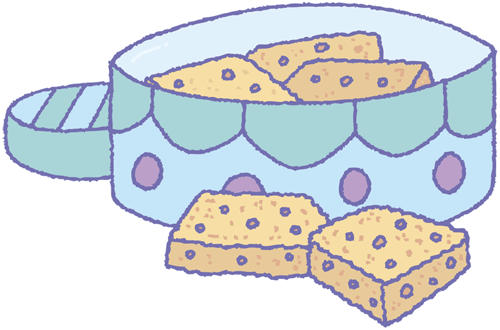
Fruit and Oat Bars
Active children need to have regular snacks, particularly toddlers who can be so busy with life in general that it is often difficult to get them to stop for regular meals. The oats in these bars will provide long-lasting energy. For a plain oat bar, simply leave out the raisins.

10 minutes
25–30 minutes
Preheat the oven to
350°F. Line a 7 x 11in shallow baking pan with wax paper; cut the paper
so it is large enough to extend above the sides of the pan.
Put the butter,
sugar, and syrup in a saucepan and heat gently, stirring occasionally,
until the butter and sugar have melted. Set aside to cool slightly.
Combine the oats,
fruits, and salt in a large bowl. Add the egg, vanilla extract, and
cooled butter mixture and mix together well. Spoon into the prepared pan
and spread out evenly. Press down firmly with a potato masher or the
back of the spoon (or your fingers). Bake until golden brown and firm to
the touch, 25–30 minutes.
Let cool in the pan, then lift out with the help of the wax paper. Cut into bars or squares and store in an airtight container.