Family meals offer a great opportunity to encourage your toddler to try new foods, and to experiment with new tastes. Too many people assume that babies and toddlers want bland, tasteless meals, when, in fact, most of them love to try new flavors, and have sensitive palates right from the word go.
| Q: | What are some good ways to introduce new spices and other tastes? |
| A: | If your toddler is used to plain purées and bland meals, she may be a little more reluctant to try new tastes. Little ones also have an amazing ability to spot anything that looks different, such as a sprig of dill, or a sprinkling of chopped basil, and may pick out the offending items. At the outset, try using herbs and other spices to flavor food while cooking, and then strain them out before serving. Another option is to purée them into a sauce, so they are not immediately obvious. Once your toddler is accustomed to the taste, you can leave in increasingly larger bits of seasoning, until they are accepted. I find that pesto is popular with little ones; see the recipe Pesto Pasta with Chicken and Cherry Tomatoes. There are many ways to |
| Q: | My toddler wants to eat the same food as the rest of the family. Which family meals are appropriate? |
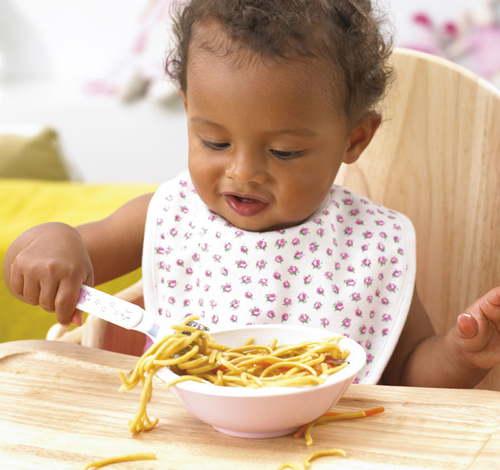
| A: | Good choices include pasta dishes, such as spaghetti bolognese, lasagna, and macaroni and cheese. Consider trying chicken satays with rice, tiny beef burgers, fish cakes with potato wedges, and a fish pie with a cheese sauce. Simply make sure that salt is kept to a minimum, and everything is cut small and cooked well for your toddler to manage without choking. |
Dining out
Eating out with your toddler
can be fun, but it’s a good idea to make sure you arrive at the
restaurant well before her usual dinner time, and to avoid busy periods,
which can result in delays. Bring along a selection of finger foods and
some distractions, such as crayons, to keep her busy while she waits,
and ask for her food to arrive as soon as it’s ready.
Did you know…
that children love to try
food from different cultures? Take your child out and let her try
delicious stir-fries, grilled chicken satays with peanut sauce, mild
curries, thin-crust vegetable-topped pizzas, spaghetti bolognese, lean
chicken kebabs, grilled fish, and breaded fish balls. A word of warning,
though: if your child suffers from food allergies, it is often
difficult to avoid cross-contamination in some restaurants, so when in
doubt, steer clear.
Pesto Pasta with Chicken and Cherry Tomatoes
Children seem to love pesto, even those who shy away from green foods! Making your own is easy and it keeps very well, although you can use 1/3 cup pesto from a jar instead. Vegetarians can replace the chicken with cubed fresh mozzarella.
10 minutes
13–17 minutes
NOTE
A family of 4–5
10oz pasta, such as farfalle, fusilli, or spaghetti
1/2 garlic clove
1/4 cup pine nuts, lightly toasted
1–2 tbsp boiling water
1 cup cherry tomatoes, halved
1 heaping cup cooked chicken, shredded
Cook the pasta in
boiling water according to the package directions. Meanwhile, make the
pesto: Put the basil leaves in a food processor with the garlic. Process
to a purée, then add the pine nuts and process until the nuts are
minced, stopping and scraping down the sides of the processor bowl as
necessary. Keep the motor running and trickle 6 tbsp of the olive oil
into the processor. When all the oil is mixed in, add the Parmesan and
salt and pepper to taste, and pulse three or four times to combine. Add
just enough boiling water to thin slightly.Drain the pasta and
set aside. Put the extra 1 tsp oil in the empty pasta pan and add the
tomatoes. Cook them gently until just softened, 2–3 minutes. Add the
pesto and chicken and heat through for 1–2 minutes (the chicken must be
piping hot). Add the cooked, drained pasta and toss everything together.
Spoon onto serving plates and serve with extra Parmesan.