Ages, stages, and milestones What to expect
Your newborn is
prepared for the most rapid period of development in her life, and
you’ll play a central role as caregiver and teacher. You’ll also witness
her growing relationships, communication, and physical development.
Below are some of the milestones you can expect her to reach in the
coming months.
1. Your newborn may…
Know your voice
and that of your partner and be comforted by them. She’ll thrive on
skin-to-skin contact with you in the hours after she is born. She may
also like to be wrapped in a light, soft blanket, possibly reminding her
of how warm and secure she felt curled up in the womb. If you gently
stroke her cheek she’ll turn toward your touch and suck if anything is
put in her mouth. These reflexes help her take the breast or bottle.Focus
best on objects nine inches (22.5 cm) away. This is the distance
between her face and yours when you are cradling or feeding her; you’re
the center of her attention. She will stare intently at human faces and
black-and-white pictures.Cry
and make faces to communicate with you, although arm waving and kicking
can also get a message across. You’ll quickly tune in to her different
cries, each one telling you what she needs.Appear
to you to be constantly awake and feeding, but she is actually sleeping
the day away; sleep experts have found that newborns need over 16 hours
of sleep per day, having up to four naps and a longer sleep during the
night.
2. In the first few weeks your infant may…
Reward you
with her first smile. She’s becoming more mobile: She’ll turn toward a
noise, kick, and swipe at nearby objects—she really wants to grab those
jangling rattles.Win everyone’s heart by grasping their finger with her tiny hand.
Show
her personality: You’ll know whether your baby is easy to please,
excitable, or even a little grumpy. She may cry about two hours per day.
Three to six weeks is her peak period for crying.
3. By three months your baby may…
Communicate at
every opportunity: She’ll laugh, coo, and make expressions to tell you
just how she feels. She’ll cry loudly when things aren’t to her likingLove to be with you, thrive on cuddles and attention, and benefit from the predictability of a daily routine.
Be
motivated to reach out for her toys, especially those that make a
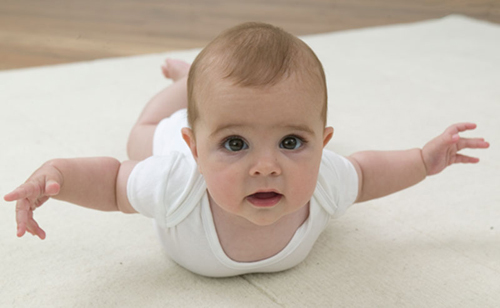
noise. This leads to lifting her head when she’s lying on her tummy.Begin
to roll over in the next few months and put everything in her mouth, so
child-proof your home now to safeguard your young explorer.
4. From six months your baby may…
Want as many
cuddles as ever and squeal with delight at tickles, but may occasionally
push you away when she’s concentrating or practicing her latest skill.Tune in to the emotions of others and respond to your tone of voice.
Begin
to react with distress to strangers and be soothed by your presence.
This is separation anxiety, a normal phase of development which can last
until your child is about three years of age. For some this will be
mild while others will be more difficult to calm.Become a little chatterbox, imitating sounds and combining them, for example “ah-goo” and “ba-ba”.
Realize
things still exist even when she can’t see them. This concept, “object
permanence,” means that if she drops a toy and can’t see it, she will
search for it because she knows it is there to be found.Astound
you with the speed of her physical development as she gains stability
and can sit without support. She may start crawling or bottom-shuffling
and will pull herself up to standing.Cry less, down to about an hour daily (usually in the evening), but more if she is overstimulated or tired.
5. At nine to twelve months your infant may…
Move you with
her first words, usually “mama” and “dada,” and add gestures such as
pointing and waving to her communication skills.Be
curious about other babies. She’ll look at them closely, but she’s not
ready to play with them yet. You’re still the most important person in
her life. She needs your touch, attention, and love as much as ever.Stand
alone and side step along the furniture (“cruising”). Her increased
mobility will delight her, and by 12 months she may be taking her first
steps.Show off how well coordinated she is by picking up small objects between her finger and thumb.
Cry
if she sees others crying. She may find her own emotions overwhelming
and need your calm reaction to show that strong feelings don’t need to
be scary.
Delayed development
There may be
some clear indications that are picked up quickly by your pediatrician,
but some difficulties emerge gradually. If you are unsure about your
child’s development, contact your doctor. Early detection and
intervention are known to work best.
Consult a doctor if your child…
Is having
difficulty lifting her own head by three months; full head control comes
later, but some control is important for many other developmental
tasks.Does not use gestures, such as pointing or waving, by 12 months.
Has not progressed beyond one or two basic words by 18 months.
Is not walking by 18 months.
Hold on tight
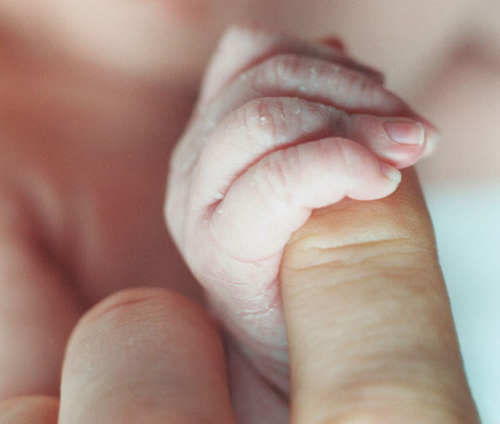
Babies are born with a grasp reflex which they will lose as they progress on to further skills.
Handy
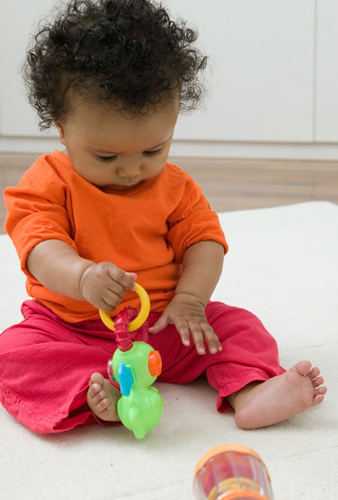
Your child’s coordination gradually develops so that she can pick up smaller objects.
Nearly toddling
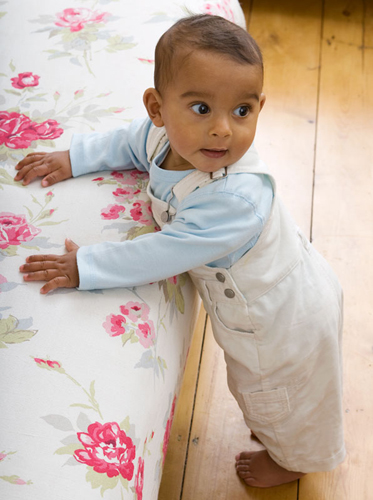
Pulling up on furniture is a sign that your baby will soon be taking his first steps.