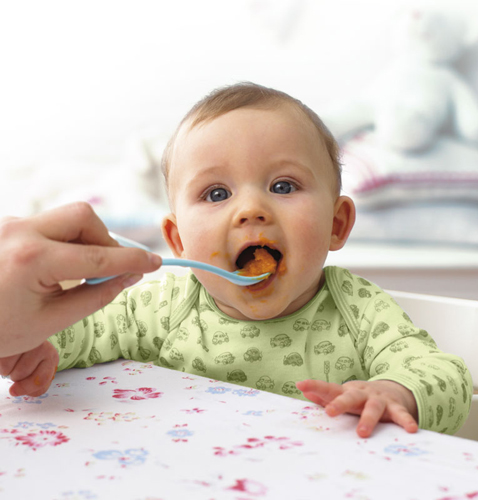
Your baby’s first spoonfuls are exciting milestone for both you and your baby. It’s only natural to approach weaning with some anxiety—there are lots of things to consider as your baby begins his journey on the road to independence, but it’s a process you’ll both enjoy.

| Q: |
How do I know if my baby is ready for solid foods?
|
| A: |
Your baby will start to show some interest in what you are
eating, and perhaps reach out to taste it himself. He will probably be
hungrier than usual, often unsatisfied after his normal milk feed, and
possibly waking in the night for an extra feed, when he has previously
slept through. He should be “mouthing” too—putting his fingers in his
mouth or chewing on his knuckles.
It’s worth noting
that a growth spurt commonly occurs between three and four months of
age, which may cause him to wake more frequently at night, and perhaps
feed much more frequently (sometimes appearing to be nonstop!). This
growth spurt accounts for his hunger, so don’t assume he’s ready for
solids just yet! |
| Q: |
Do I still need to breastfeed when I begin weaning?
|
| A: |
Your baby will need formula or breast milk until she is at least
12 months, when her diet is varied enough to offer the correct balance
of nutrients. Weaning foods offer first tastes rather than proper
nutrition, and as she gradually eats more, her milk feeds will be
replaced by proper meals. Don’t be tempted to give up the milk, though.
Breastfeed as usual, or, if you are bottle-feeding, remember that she
will need at least about 18–20fl oz (500–600ml) per day. If less than
this is consumed, it’s worth discussing with a doctor, as she may need
extra vitamins. Give her a milk feed first thing in the morning and at
bedtime, and other milk feeds during the day. The timing will depend on
the stage of weaning, but you should try to give milk feeds after meals
and limit the amount of milk between meals.
|
| Q: |
Why should I make homemade purées for my baby?
|
| A: |
The healthiest baby foods are the ones you make yourself. You can
be sure of using the best-quality ingredients with no thickeners or
additives, including salt or sugar. The ingredients of most commercial
baby foods are heated to a very high temperature and then cooled to
sterilize them—a process that destroys some nutrients. By using fresh
ingredients, your homemade purées will be that much more nutritious.
Homemade purées
taste much better too, and they’re a great way to introduce your baby to
the delights of fresh, whole foods, with their intrinsic sweetness and
flavors. Put some time in now, and you’ll reap the benefits later.
Giving your baby homemade food will help to make the transition to
family food much easier. |

Cheap, healthy food
Would you believe that
parents in the US fork out millions of dollars every year on
commercially prepared baby food? By making your own, you’ll be saving
money (even taking into consideration the time it takes for you to make
them), and you’ll be giving your child a great start in life.