You can’t realistically expect the planner system you
worked so hard to select and set up to work if you’re sabotaging its
cooperative nature by not using it yourself. How long do you expect your
children to check the schedule when they’re making plans if you aren’t
keeping your part of the schedule up-to-date? How long before your older
children stop entering their plans into your family’s planner if you
never bother to check it before making plans that turn out to conflict
with the information they’ve taken the time to post? If the system is
going to work, everyone must share in its use with the same level of
commitment. As an adult, you are responsible for setting the standard.
It’s also your
responsibility to establish and implement a vision for your family’s
collective life. So, while your teenager might set a long-term goal of
getting a summer job, you must plan more broadly for major changes such
as buying a new car or maybe even a new house. And now that you have
your family’s day-to-day schedule honed, you should feel confident in
your ability to apply the same organizing skills to planning such an
event.
note
The |
Don’t forget to select an individual planning tool—hard copy or electronic—that fits your needs and style.
Perhaps you’re
still conflicted on your choice of a personal organizer because you
prefer to take notes with a pad and pen, but you also feel you need to
manipulate your information electronically. Even this sort of quandary
isn’t a valid excuse in today’s world! Some currently available products
combine input that appeals to a kinesthetic and visual learner with
output that has the flexibility of digital technology. For example, you
can get a ballpoint pen that writes on specially encoded paper so that
when you then place the pen in a dock attached to your computer, it will
transfer information exactly as you wrote or drew it. When you select
different check boxes on the paper, the information automatically will
be entered into your electronic address book, calendar, email, or
wherever else is appropriate.
note
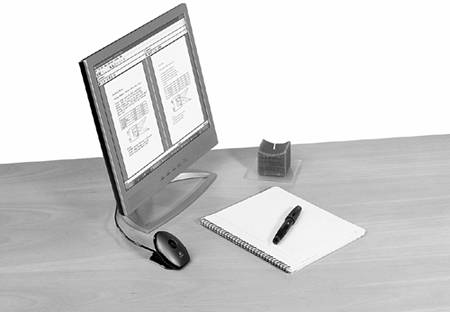
The Logitech io2 Digital Writing System, shown in Figure 1, Figure |
MAKING THE MOST OF THE DAILY COMMUTE

Unless
you belong to one of those rare families in which the adults all work
from home, at least one person in your family has to deal with the time
required to get to and from work every day. In the United States, the
average daily round-trip commute takes 52 minutes; that’s 4 hours and 20
minutes a week.
If you can |
If you drive to work by yourself
Listen to the news on the radio and forgo watching television news or reading news magazines.
Listen to music on the radio; music is known to stimulate important brain activity.
Complete errands that are on your way so that no one has to spend time retracing your route later.
If you carpool to work
Socialize with your colleagues while you’re in the car so you can have a few more minutes of productive work time at the office.
Listen to the news or music, either with everyone else or using earphones.
If you take public transportation to work
Get
your exercise by walking to and from the train/bus stop; walking will
clear your mind and you won’t have to spend time exercising later.Catch a few extra minutes of sleep, if you’re still not getting enough at night.
Read the newspaper, a book, or a magazine for information or pleasure.
Complete errands that are on your way during the walking portion of your trip.