Dear Tanya
Areas of Development
Child development is a
simple term that describes the extraordinary cognitive, motor,
emotional, and psychological journeys that will impact on your toddler
from head to toe. Prepare to be astounded as she grows and learns month
by month.
“Your toddler’s
senses are more heightened than yours, and each new experience enhances
her sensitivity, increases her brain development, and her ability to
interpret the world.”
Young children are
often on the move. Although their growth rate is not as rapid as during
the first year of life, a toddler’s average height by age two is 34 in
(86.4 cm), and average weight gain over the course of a year is 3-5 lb
(1.5-2.5 kg). Their heads also grow larger to accommodate a
fast-developing brain.
The large muscles of the
body develop more rapidly now. These control the big movements a child
makes (gross motor skills), such as sitting, walking, climbing, running,
and jumping. The smaller muscle groups also become stronger. These
control the way your toddler uses her limbs, hands, and feet to achieve
smaller movements (fine motor skills), for more focused or precise
tasks.
Toddlers gradually
learn enough muscular control to make large movements, such as swinging
the arms to throw and kicking with the legs. Smaller-scale movements
involving precise control of the hands and fingers will take longer to
develop, but you will gradually see your toddler learn to point, draw,
use a spoon, and write.
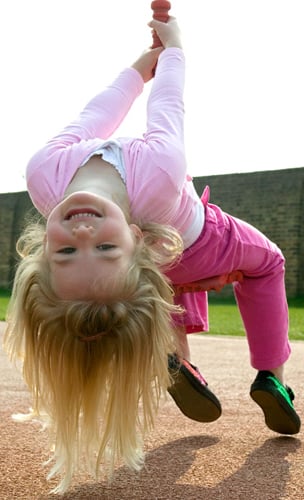
Physical play
Young children are naturally active and become more skilled at physical play as the large muscles of their body develop.
Cognitive skills
The ability to learn and
think is known as cognitive development—this affects the area of the
brain responsible for reasoning and our understanding of the world.
Sensory development and language skills have a major impact on cognitive
development.
Sensory skills
Young children learn by
taking in and understanding the world around them. The senses play a
vital part in this process, through physical development and learning.
Your toddler is alert to new sensations and discoveries and needs to
experience as wide a range of safe sensory experiences as possible. What
your toddler sees, hears, smells, feels, and tastes has an impact on
her memory, and how she perceives the world. Awareness of how big or
small she is, and where she fits physically, in relation to other people
or things, is also important.
Communication skills
Your toddler’s
ability to talk makes a profound difference in the way in which she
relates to her world. Language is the bridge that allows clear
communication of personal needs and enables her to express her
preferences and personality. There are three categories of language
development:
What she says (expression): the words themselves, the phrases, the context, and how the language is used.
How she says it (articulation): the pronunciation and tone of those words.
What she understands (reception): what she takes in, and understands the words to mean—including the individual words and their context.
By the time your baby has
reached 12 months she will probably have developed a style of baby
language that is partially recognizable and may even have said her first
word, such as “dada” or “mama.” “No” will not be far behind. The next
three years will bring profound changes.
Emotional development
The toddler years are
fairly self-centered. Your young toddler’s brain is not yet developed to
a level where she will be aware of the impact that her behavior has on
other people, although she will be very aware of the impact her
environment has on her.
Feelings will emerge gradually:
Early emotional
experiences have a profound impact on brain development. Your child’s
early experiences of joy, fear, excitement, love, security, and comfort
have an impact on the way the brain develops and on behavior shaping.
You will play a vital role in helping her develop a healthy self-image
and learn to manage her emotions. She will crave instant rewards and
gratification, will have little concept of time, and will be driven by
immediate wants and needs. Over time and with guidance she will learn
what is reasonable behavior.
Self-awareness—of personal feelings, and the development of self-esteem and confidence.
Awareness of others—development of feelings for and about other people.
Intuition—sensitivity to mood and atmosphere.
Social skills
Your toddler’s
social skills will develop gradually by watching and mirroring you
through play, hand-in-hand with language and emotional development. The
mechanics of social behavior can be taught when she is old enough,
through learning good manners, but social skills involve mainly
intuition and feelings. Your child’s innate temperament will also have
an impact. By the age of four she will have started to develop personal
beliefs to guide her behavior, based on your example and her own
experiences.