Traditionally one of the most
peaceful areas of Paris, the medicinal herb gardens which give the
quarter its name were established here in 1626. It retained a rural
atmosphere until the 19th century, when the city’s population expanded
and the surrounding streets were built up. Near the gardens is the
Arènes de Lutèce, a well-preserved Roman amphitheatre. The rue
Mouffetard, winding down the hill from the bustling place de la
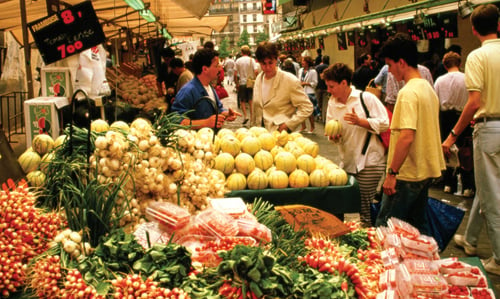
Contrescarpe, dates from medieval times and has one of the best markets
in the city. The area is also home to a sizeable Muslim community,
focused on the Institut du Monde Arabe cultural centre and the Paris
Mosque. In contrast to the striking Islamic architecture are the grey
slab 1960s buildings of Paris University’s Jussieu Campus.
French North AfricaFrance has always had close connections with |
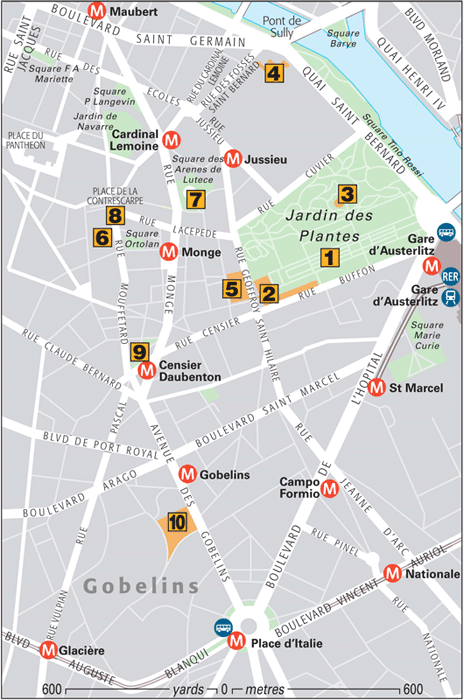
Sights
Jardin des Plantes
The
17th-century royal medicinal herb garden was planted by Jean Hérouard
and Guy de la Brosse, physicians to Louis XIII. Opened to the public in
1640, it flourished under the curatorship of Comte de Buffon. It
contains some 10,000 species, including the first Cedar of Lebanon
planted in a French tropical greenhouse, and Alpine, rose and winter
gardens (see Jardine des Plantes Sights).57 rue Cuvier, 75005
01 40 79 30 00
Open 8am–5:30pm daily, to 6pm summer

Jardin des Plantes
Muséum National d’Histoire Naturelle
Separate pavilions in the Jardin des Plantes house exhibits on anatomy, fossils, geology, mineralogy and insects. The Grande Galerie de l’Evolution is a magnificent collection of stuffed African mammals, a giant whale skeleton and an endangered species exhibit .
57 rue Cuvier, 75005
Pavilions: open 10am–5pm Wed–Mon; Evolution Gallery: open 10am–6pm Wed–Mon
Closed 1 May
Admission charge
Ménagerie
The
country’s oldest public zoo was founded during the Revolution to house
the four surviving animals from the royal menagerie at Versailles. Other
animals were donated from circuses and abroad, but during the Siege of
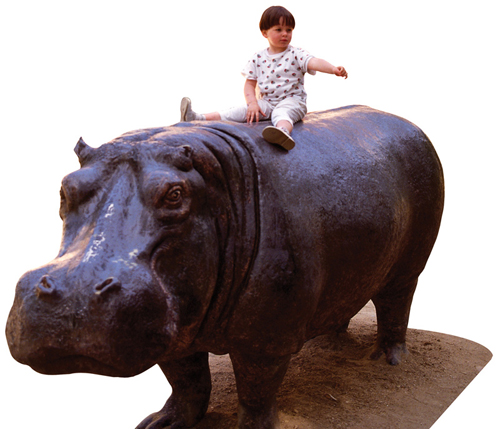
Paris in 1870–71 the unfortunate creatures were eaten by hungry citizens. A favourite with children , the zoo has since been restocked.Jardin des Plantes, 75005
Open 9am–5pm daily
Admission charge

Riding a stone hippopotamus at the Ménagerie
Institut du Monde Arabe
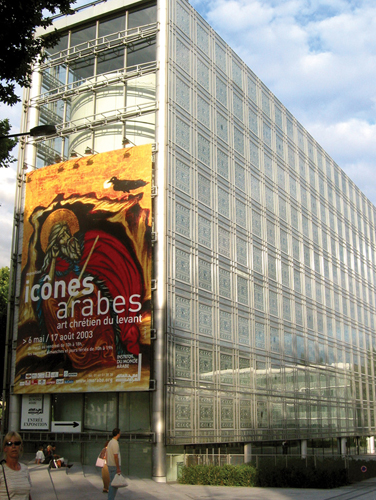
This
institute was founded in 1980 to promote cultural relations between
France and the Arab world. The stunning building (1987) designed by
architect Jean Nouvel eatures a southern wall of 1,600 photo-sensitive metal screens that
open and close like camera apertures to regulate light entering the
building. The design is based on the latticed wooden screens of Islamic
architecture. Inside are seven floors of Islamic artworks, from
9th-century ceramics to contemporary art, and a fine restaurant.1 rue des Fossés-St-Bernard, 75005
01 40 51 38 11
Open 10am– 6pm Tue–Sun
Admission charge

Institut du Monde Arabe
Mosquée de Paris
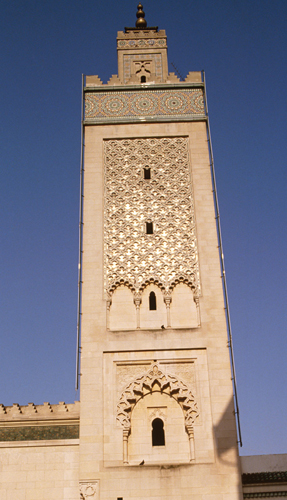
Built in 1922–6, the mosque complex is the spiritual centre for Parisian Muslims.
The beautiful Hispano-Moorish decoration, particularly the grand patio,
was inspired by the Alhambra in Spain. The minaret soars nearly 33 m
(100 ft). There is also an Islamic school, tea room and Turkish baths,
open to men and women on separate days.2 bis pl du Puits-de-l’Ermité, 75005
Tours: 9am– noon, 2– 6pm Sat–Thu
closed Islamic hols
Admission charge

Minaret, Mosquée de Paris
Rue Mouffetard
Although the rue Mouffetard
is famous today for its lively street market held every Tuesday to
Sunday, it has an equally colourful past. In Roman times this was the
main road from Paris to Rome. Some say its name comes from the French
word mouffette (skunk), as a reference
to the odorous River Bièvre (now covered over) where waste was dumped by
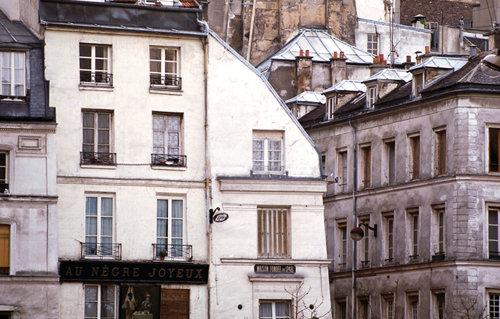
tanners and weavers from the nearby Gobelins tapestry factory. Though
no longer poor or Bohemian, the neighbourhood still has lots of
character, with its 17th-century mansard roofs, old-fashioned painted
shop signs and affordable restaurants. In the market you can buy
everything from Auvergne sausage to horse meat and ripe cheeses.

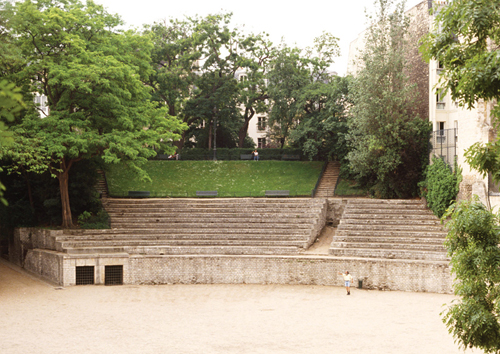
Arènes de Lutèce
The remains of the 2nd-century Roman amphitheatre from the settlement of Lutetia lay buried for centuries and were only discovered in 1869 during
construction of the rue Monge. The novelist Victor Hugo, concerned with
the preservation of his city’s historic buildings, including Notre-Dame ,
led the campaign for the restoration. The original arena would have had
35 tiers and could seat 15,000 spectators for theatrical performances
and gladiator fights.49 rue Monge, 75005
Open 9am–9pm daily (summer); 8am–5pm daily (winter)
Free

Arènes de Lutèce
Place de la Contrescarpe
This
bustling square has a village community feel, with busy cafés and
restaurants and groups of students from the nearby university hanging
out here after dark. In medieval times it lay outside the city walls, a
remnant of which still stands. Notice the memorial plaque above the
butcher’s at No. 1, which marks the site of the old Pine Cone Club, a
café where François Rabelais and other writers gathered in the 16th
century.

St-Médard
The
church at the bottom of rue Mouffetard dates back to the 9th century,
when it was a parish church dedicated to St Médard, counsellor to the
Merovingian kings. The present church, completed in 1655, is a mixture
of Flamboyant Gothic and Renaissance styles. Among the fine paintings
inside is the 17th-century St Joseph Walking with the Christ Child by Francisco de Zurbarán. The churchyard was the scene of hysterical fits in the 18th century, when a cult of “convulsionnaires” sought miracle cures at the grave of a Jansenist deacon.141 rue Mouffetard, 75005
Open 9am–noon, 2:30–7pm Tue–Sat, 9am–noon Sun
Free
Manufacture des Gobelins
This
internationally renowned tapestry factory was originally a dyeing
workshop, founded by the Gobelin brothers in the mid-15th century. In
1662, Louis XIV’s minister Colbert set up a royal factory here and
gathered the greatest craftsmen of the day to make furnishings for the
palace at Versailles.You can see the traditional weaving process on a guided tour.
42 ave des Gobelins, 75013
Metro Gobelins
Tours: 2pm and 3pm Tue–Thu (arrive 30 minutes prior), open for temporary exhibitions only noon–6pm Tue–Sun
Tickets must be bought prior to the visit at a branch of FNAC