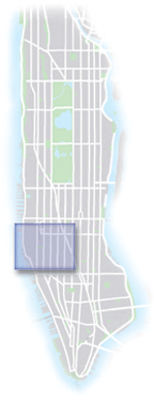
A neighborhood that has seen a
great deal of recent change, Chelsea was a quiet enclave of
19th-century brownstones that never made it as a fashionable address.
Now it is a hub for gay New Yorkers and center for the city’s
avant-garde art galleries and nightclubs. Buildings along 6th Avenue are
now occupied by superstores and discount outlets, and to the west,
Chelsea Piers has transformed the waterfront. Uptown, the Garment
District begins around 27th Street, with Herald Square and Macy’s at the
heart of the city’s busiest shopping area.
The World’s Largest StoreMacy’s is more than a store to most New Yorkers. |
Sights
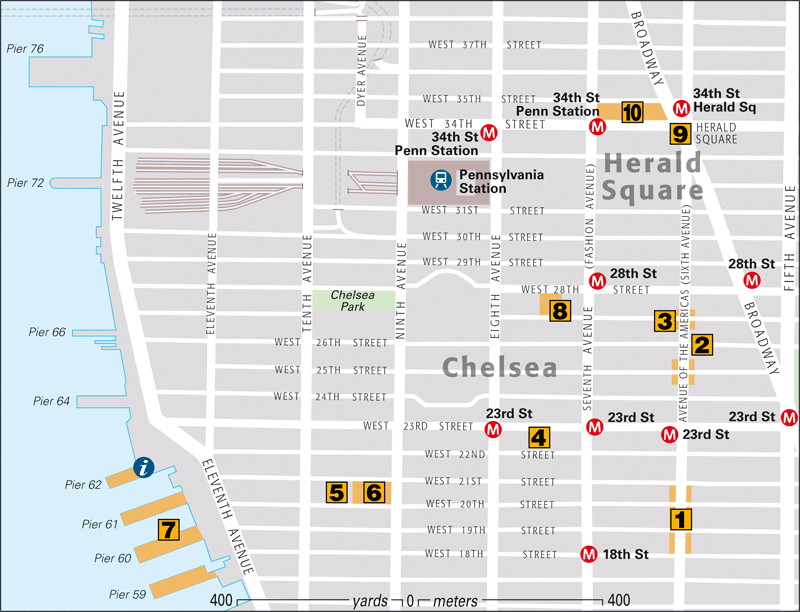
6th Avenue Shopping
This
was once a popular district known as “Fashion Row”. The 1876 cast-iron
façade of the Hugh O’Neill Dry Goods Store at Nos. 655–71 exemplifies
the era, when the arrival of the 6th Avenue elevated line provided easy
access to the area. As Manhattan’s commercial center moved northward,
these cast-iron palaces were left deserted until the 1990s, when they
found new life as bargain fashion outlets and superstores.6th Ave, 18th to 23rd Sts
West 25th Street Market and Antiques Garage
On
weekends, year-round, an empty parking lot becomes one of the city’s
most popular outdoor markets. A tradition for more than 30 years, some
100 vendors, from Maine to Maryland, set up booths selling clothing,
silver, jewelry, furniture, art, and “junktiques” from old tools to
vintage eyeglasses. Many prize antiques can be discovered at The
Antiques Garage, an indoor market just around the corner at 112 West
25th Street, and at The Showplace, 40 West 25th Street, with over 60
dealers on three floors.West 25th St between Broadway and 7th Ave
Open sunrise to sunset
Admission charge
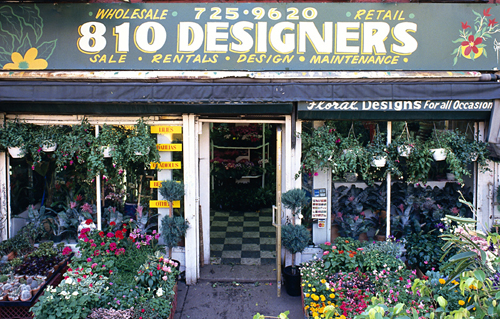
Flower District
Here,
at the heart of the city’s wholesale flower district, you can hardly
see the sidewalk for the masses of greenery, shrubs, and flowers.
Manhattan’s largest concentration of shops selling house plants, trees,
blooming plants, and all manner of flowers, fresh, dried, and artificial
can be found here; if you can’t find what you want, it probably doesn’t
exist. The district extends along 6th Avenue roughly from 25th to 30th
streets.6th Ave at 27th St

The Flower District
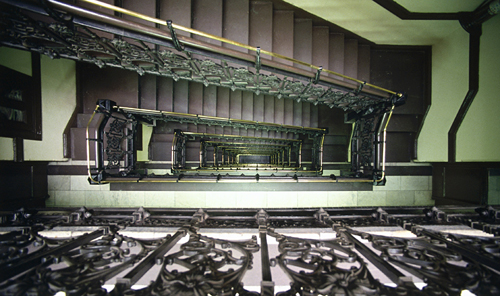
Chelsea Hotel
Seedy
it is, yet there’s a definite mystique to this 1884 building bedecked
with wrought-iron balconies. Once a fancy apartment, it became a hotel
favored by musicians, artists, and writers. Former guests, commemorated
on brass plaques outside, include Tennessee Williams, Mark Twain, Jack
Kerouac, and Brendan Behan. Dylan Thomas spent his last years here.
Notoriously, it was also the place where punk rocker Sid Vicious killed
his girlfriend Nancy Spungen in 1978. Step into the lobby and take a
look at the wild artwork. The bar downstairs is now called the Star
Lounge.222 West 23rd St, between 7th & 8th Aves

Chelsea Hotel, cast-iron stairwell
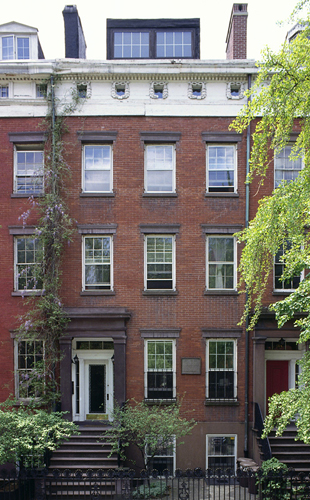
Chelsea Historic District
Clement Moore, author of A Visit from St. Nicholas,
developed this land in the 1830s. The finest of the town houses built
here are the seven known as “Cushman Row,” Nos. 406–18 West 20th Street,
which are among the city’s best examples of Greek Revival architecture.
Houses at Nos. 446–50 West 20th are in the Italianate style, for which
Chelsea is also known.Between 9th & 10th Aves, 20th & 21st Sts

“Cushman Row”, Chelsea Historic District
General Theological Seminary
America’s
oldest Episcopal seminary was founded in 1819. This campus was built
around two quadrangles in the 1830s, on a site donated by Clement Moore,
who taught at the seminary. The main building, added in 1960, includes a
library with the largest collection of Latin Bibles in the world. There
are lovely inner gardens (9th Avenue entrance).20th to 21st Sts
Open 10am–3pm Mon–Sat
Free
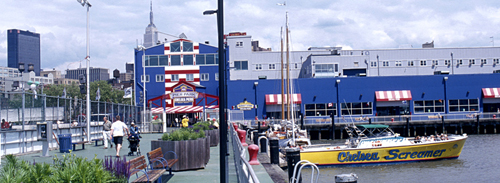
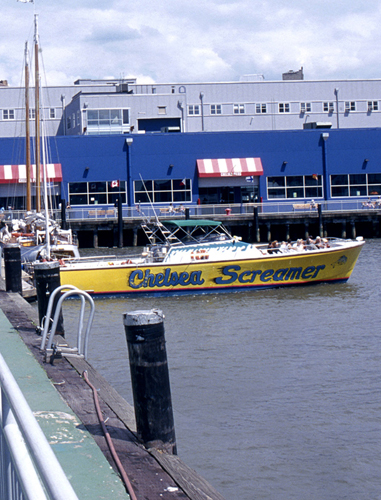
Chelsea Piers
Four
neglected piers have been turned into a 30-acre sports and recreation
complex, and Manhattan’s largest venue for film and TV production.
Sports facilities include ice skating, inline skating and skateboarding,
batting cages, playing fields, a basketball court, bowling alley, golf
driving ranges, and a marina offering harbor cruises and sailing
instruction. Pier Park is a place to relax with a water view.23rd St at the Hudson River
Open 6:30am–11pm Oct–Mar (to midnight Apr–Sep)
Admission charge

Chelsea Piers

Chelsea Piers
Fashion Institute of Technology (F.I.T.)
Founded
in 1944 and now a branch of the State University of New York, the
Fashion Institute of Technology is a prestigious school teaching art,
fashion design, and marketing, and boasts famous alumni, including
Calvin Klein, Norma Kamali, and David Chu. Students benefit from
internships with New York’s leading stores and designers. Of greatest
interest to the public is the gallery, which has changing exhibits,
often from their clothing and textile collections.7th Ave at West 27th St
Museum open noon–8pm Tue-Fri, 10am–5pm Sat
Free
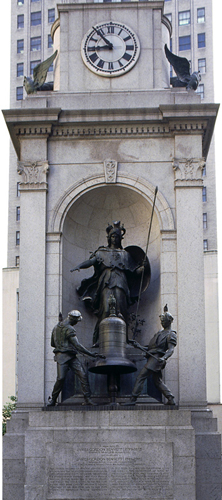
Herald Square
The
center of a rowdy theater district known as the Tenderloin in the 1870s
and 80s, until it was reformed. The Manhattan Opera House was razed in
1901 to make way for Macy’s, and other stores soon followed. The clock
on the island where Broadway meets 6th Avenue is all that is left of the
building that was occupied by the New York Herald until 1921.Broadway at 6th Ave

Ornamental clock, Herald Square
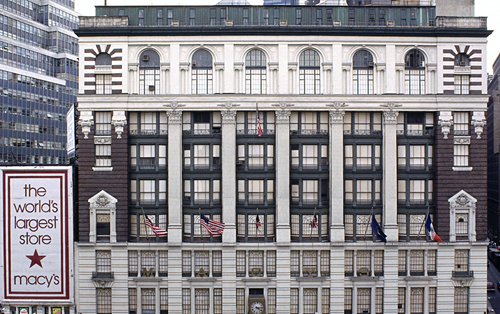
Macy’s
Former
whaler R. H. Macy founded the store in 1858 on 6th Avenue and 14th
Street; the red star logo was from his tattoo, a souvenir of sailing
days. Innovations included pricing goods a few cents below a full dollar
and offering a money-back guarantee. The store was sold in 1888 and
moved to the present building.151 West 34th St, between Broadway & 7th Ave

Macy’s façade