In ancient times the largest
of Rome’s seven hills was almost entirely residential, consisting mostly
of upper-class villas. The western slope of the quarter, just behind
the Imperial Fora
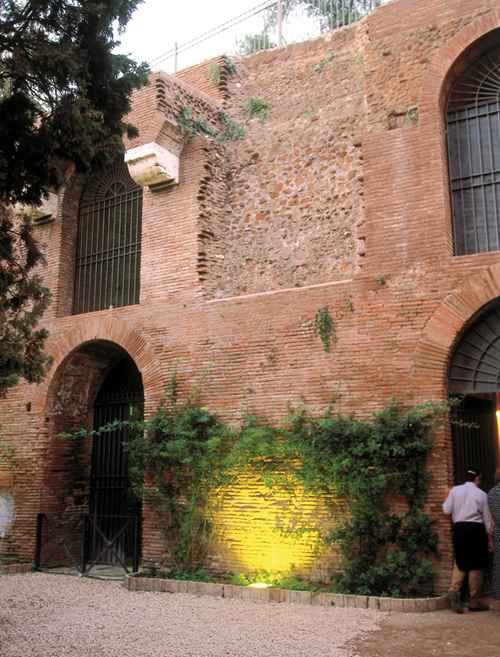
was considered rather unhealthy as it was densely populated – the
massive wall at the back of the Fora was intended to keep the squalid
slum out. However, in the 4th century, this zone became central to the
development of Christianity. In setting up the religion as the official
faith, Constantine did not dare step on too many pagan toes, so he
established Christian centres outside of town, on the sites of holy
tombs. The main one was what is now San Giovanni in Laterano (Saint John
in Lateran). Other churches quickly followed, culminating in the
striking Santa Maria Maggiore, built in the 5th century. The district
remains steeped in history and religious mystique.
Establishment of the ChurchThis area played a central role in early |
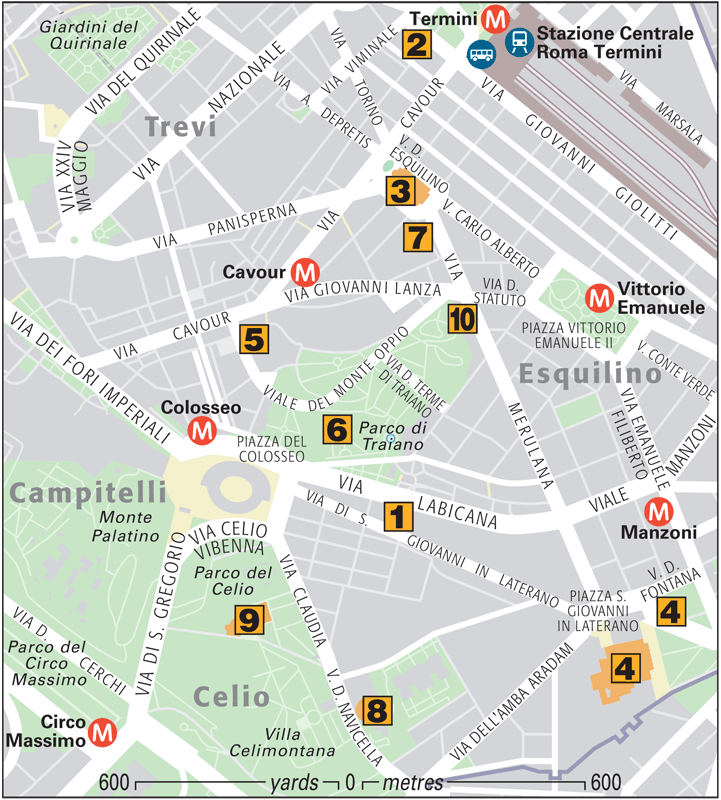
|
Sights
Palazzo Massimo alle Terme
Housing
an extraordinary collection of ancient frescoes, mosaics and sculpture,
this branch of the Museo Nazionale Romano is perhaps the most
inspiring. The building itself was erected by the Massimo family at the
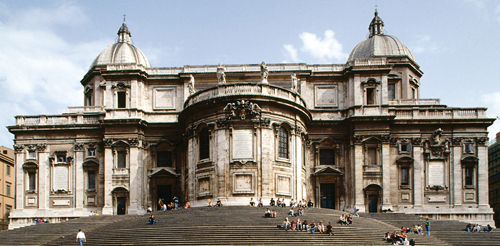
end of the 19th century and later served as a Jesuit college .Santa Maria Maggiore
This
church is a unique blend of architectural styles. The nave and its
mosaics are original 5th-century; the Cosmatesque work, the apse mosaics
and the Romanesque bell tower are medieval; the coffered ceiling (of
New-World gold) is Renaissance; and the twin domes and front and back
façades are Baroque. Pope Sixtus V erected the Egyptian obelisk in 1587
as part of his overall town-planning, to provide landmarks for pilgrims.
The column in front was taken from the Basilica of Maxentius and
Constantine in 1615 .Piazza di S Maria Maggiore
Open 7am–7pm daily
Free

Façade, Santa Maria Maggiore
San Giovanni in Laterano and Scala Santa
Besides
its grandiose Baroque bulk, visible from all over Rome, this former
papal complex boasts the world’s
first baptistry, its octagonal shape the model for all those to
come. A building on the piazza houses the Scala Santa, claimed to be the
staircase from Pontius Pilate’s house that Jesus ascended to face his
trial – the devout climb the 28 steps on their knees. Tradition says
that the stairs were brought from Jerusalem by St Helena, mother of
Emperor Constantine .Piazza di S Giovanni in Laterano
Open 7am–7pm daily (cloisters 7am–9pm; baptistry 7am–12:30pm, 3–6:30pm)
Adm to cloisters

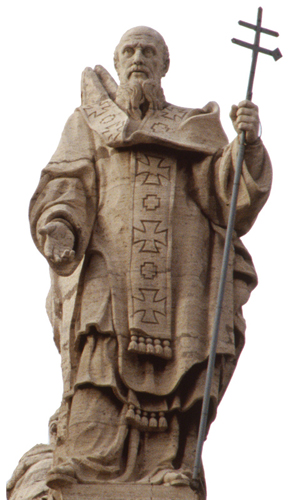
Statue, San Giovanni in Laterano
San Pietro in Vincoli
Michelangelo’s Moses
is the unmissable experience here. Weirdly horned and glaring, the
righteously indignant patriarch is about to smash the tablets down in
outrage at his people’s idolatry. This powerful sculpture was just one
of 40 the artist planned, but never finished, for the tomb of Pope
Julius II.
It has recently been restored. The original shrine was built in the 4th
century to house the chains supposedly used to bind St Peter in prison.
It has been rebuilt since, first in the 8th century and again in the
15th century.Piazza di S Pietro in Vincoli 4A
Open 8am– 12:30pm, 3:30–7pm daily (until 6pm Oct–May)
Free
DA

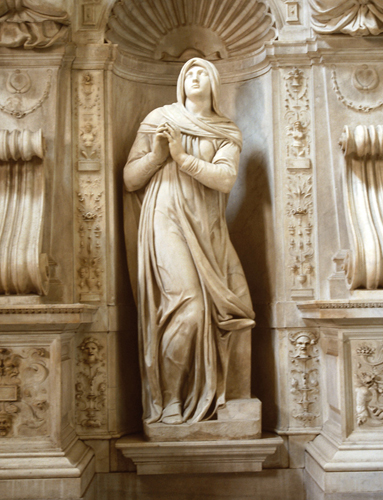
Statuary, San Pietro in Vincoli
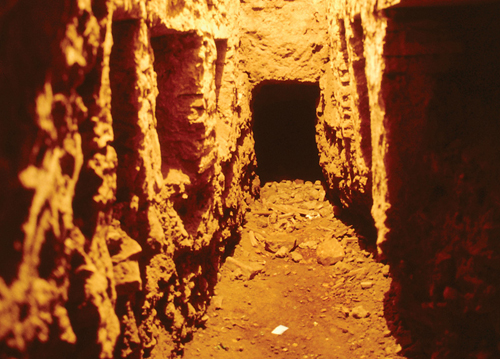
Nero’s Golden House
Subsequent
emperors were so embarrassed by Nero’s gargantuan profligacy that they
went to great lengths to undo as much of it as they could. One way was
to give some of the land Nero took for himself back to the use of the
Roman people. The Flavians drained his lake and built the Colosseum,
to provide the citizenry with a suitable place for their gladiatorial
spectacles. Then Trajan built Rome’s first great bath complex by cutting
through Nero’s original house and building right over it .Viale della Domus Aurea
Ticket reservation 06 3996 7700Adm
DA

Santa Prassede
Built
in the 9th century over a 2nd-century oratory, the original design is
still discernible despite restorations. In the central nave, a stone
slab covers the well where St Prassede is said to have buried 2,000
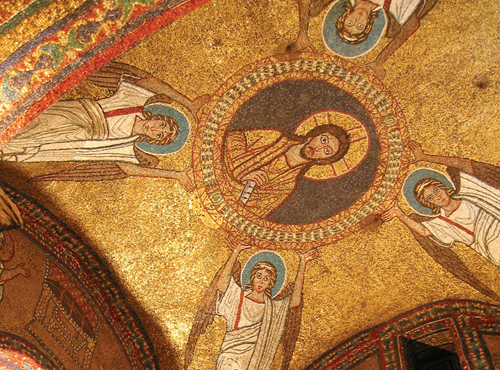
martyrs. Byzantine artists decorated the apse with mosaics depicting
saints, lambs, palm trees and poppies. The walls and vaults of the
Chapel of St Zeno also have mosaics from the same period, and there is a
fragment of the column Christ was bound to when he was flogged.Via S Prassede 9A
Open 7:30am–noon and 4–6:30pm daily (from 8am in winter)
Free
DA

Mosaic, Santa Prassede
Santo Stefano Rotondo
The unusual shape of this early church (468–83) may mean it was built over Nero’s round Macellum Magnum
(meat market). Or perhaps its form was inspired by Jerusalem’s Church
of the Holy Sepulchre. Whatever the case, recent digs have found a Mithraeum
underneath. The structure is a peaceful, delightful sanctuary, situated
far from urban uproar, although 16th-century frescoes by Niccolò
Pomarancio depict martyrdoms in sadistic fashion.Via di S Stefano Rotondo 7
Open 9:30am–12:30pm, 3–6pm Tue–Sun (to 5pm in winter)
Free

Santi Giovanni e Paolo
The
eponymous saints were 4th-century martyrs and their home is still seen
under the 5th-century structure. They were beheaded here in 361 on
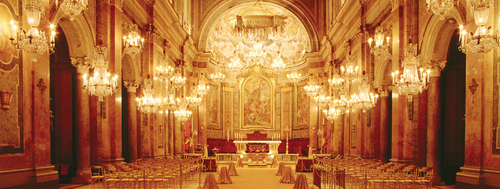
orders from Emperor Julian. Except for the Late Baroque interior, much
of the church is pure medieval. The base of the bell tower is that of
the 1st-century Temple of Claudius that once stood here.Piazza SS Giovanni e Paolo 13
Open 8:30am–noon, 3:30–6pm daily
Free

Nave, Santi Giovanni e Paolo
Oriental Art Museum
A
fine, though small collection of Middle and Far Eastern art, ranging
from prehistoric Persian ceramics to 18th-century Tibetan paintings. The
most fascinating works are the Ghandharan. These 3rd-century BC to
10th-century AD Indian Buddhist works display both Asian and Greek
influences, due to the conquest of the area that is now Pakistan by
Alexander the Great.Via Merulana 248
Open 9am–2pm Tue, Wed, Fri; 9am–7:30pm Thu, Sat, Sun
Adm
DA