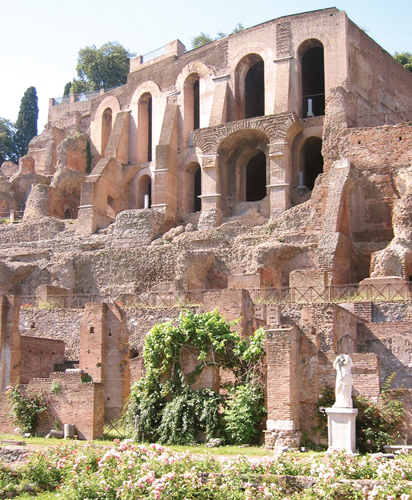
This area has always been a
contrasting mix of the highest and the lowest, from the most extravagant
luxury to the toughest work-a-day world. In ancient times, the
emperor’s lavish palaces were built on the Palatine, but they weren’t
far from the docks, where roustabouts heaved the tons of goods that were
imported to the wealthy city from around the world. There are three
hills in the zone: the Palatine and the Aventine are two of the original
seven, but Monte Testaccio is entirely man-made. Legend has it that the
Aventine was where Remus formed a populist settlement, to rival his
twin brother Romulus’s dictatorial encampment .
Over the centuries it has been an area inhabited by poor workers and
religious institutions. Today, it has returned to being an enclave of
greenery and smart dwellings, studded with hidden art treasures and some
of the world’s finest ancient monuments and priceless archaeological
finds.
Class Divisions and Power StrugglesThe ceaseless struggle between the governing and |
|
|
NOTE
Sights
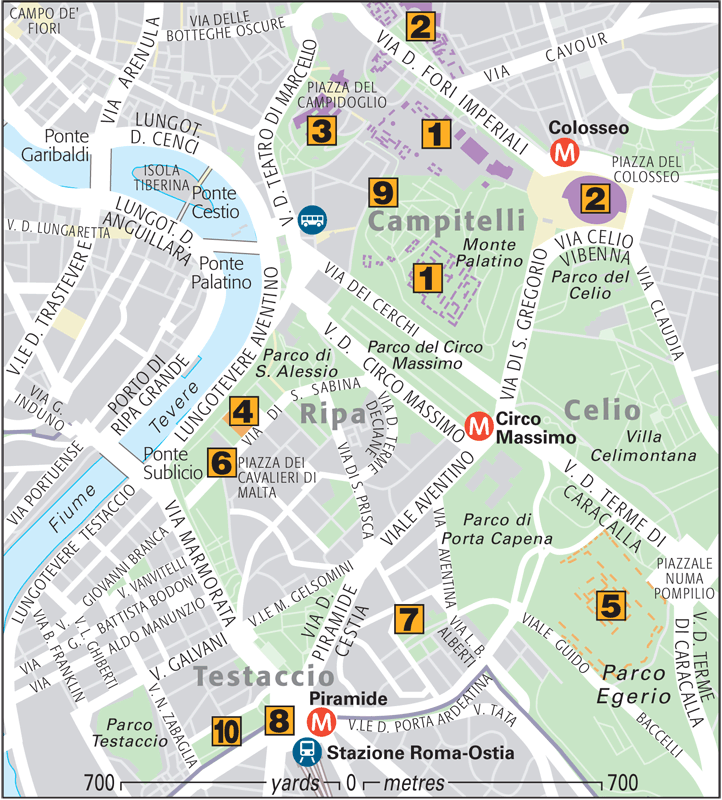
Colosseum and Imperial Fora
These
monuments memorialize Imperial supremacy. The Forum of Trajan was
declared a Wonder of the World by contemporaries; the only remnant is
Trajan’s Column, considered to represent Roman sculptural art at its
peak. The Colosseum embodies the Romans’ passion for brutal
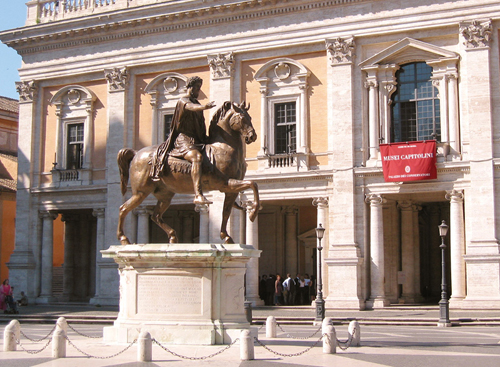
entertainment .Musei Capitolini
Notwithstanding
their great beauty, the original motivation for these museums was
purely political. When the popes started the first museum here in 1471,
it laid claim to Rome’s hopes for civic autonomy – the Palazzo dei
Conservatori was the seat of hated papal counsellors, who ran the city
by “advising” the Senators. Today the museums are home to a spectacular
collection of art .

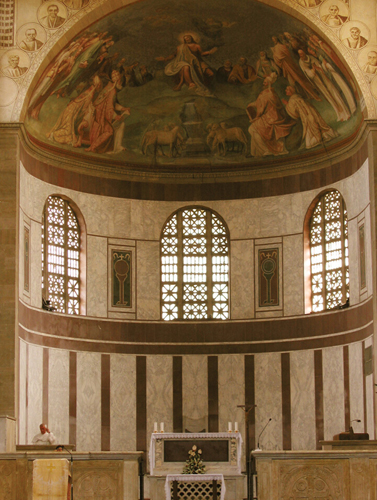
Santa Sabina
This
church was built over the Temple of Juno Regina in about 425 to honour a
martyred Roman matron. In 1936–8 it was restored almost to its original
condition, while retaining 9th-century additions such as the
Cosmatesque work and the bell tower. Twenty-four perfectly matched
Corinthian columns are surmounted by arcades with marble friezes and
light filters through the selenite window panes. The doors are
5th-century carved cypress, with 18 panels of biblical scenes, including
the earliest known Crucifixion – strangely without any crosses.Piazza Pietro d’Illiria 1
Open 6:30am–1pm, 3:30–7pm daily
Free
DA

Santa Sabina
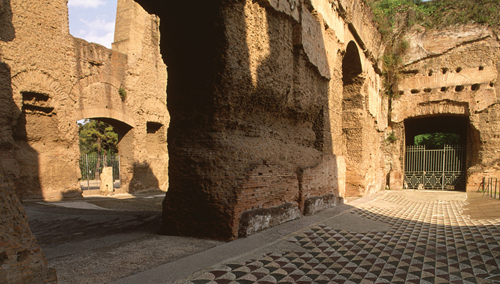
Baths of Caracalla
Inaugurated
in 217 and used until 546, when invading Goths destroyed the aqueducts.
Up to 2,000 people at a time could use these luxurious thermae. In general, Roman baths included social centres, art galleries, libraries, brothels and palestrae
(exercise areas). Bathing involved taking a sweat bath, a steam bath, a
cool-down, then a cold plunge. The Farnese family’s ancient sculpture
collection was found here, including Hercules, a signed Greek original. Today, ruins of individual rooms can be seen.Via delle Terme di Caracalla 52
Open 9am–2pm Mon, 9am–1 hr before sunset Tue–Sun
Adm
DA

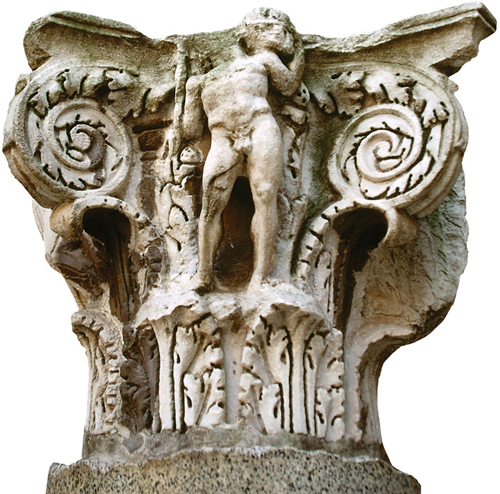
Capital, Baths of Caracalla

Gymnasia, Baths of Caracalla
Piazza of the Knights of Malta
Everyone
comes here for the famous bronze keyhole view of St Peter’s Basilica,
ideally framed by an arbour of perfect trees .
However, it’s also worth a look for the piazza’s wonderful 18th-century
decoration by Giambattista Piranesi, otherwise renowned for his
powerful engravings of fantasy-antiquity scenes. To honour the ancient
order of crusading knights (founded in 1080), the architect chose to
adorn the walls with dwarf obelisks and trophy armour, in the ancient
style. Originally based on the island of Rhodes, then Malta, the knights
are now centred in Rome.San Saba
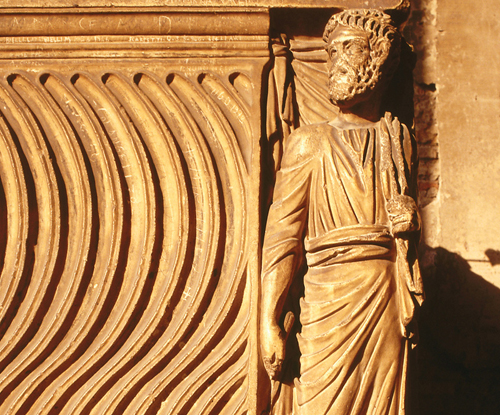
Originally
a 7th-century oratory for Palestinian monks fleeing their homeland, the
present church is a 10th-century renovation, with many additions. The
portico of the beautiful 15th-century loggia houses a wealth of
archaeological fragments. Greek style in floorplan, with three apses,
the interior decoration is mostly Cosmatesque.
The greatest oddity is a 13th-century fresco showing St Nicholas about
to toss a bag of gold to three naked girls lying on a bed, thus saving
them from prostitution.Piazza Gian Lorenzo Bernini 20
Open 8am–noon, 4–7pm Mon–Sat, 9:30am–1pm, 4–7:30pm Sun
Free

Portico carving, San Saba
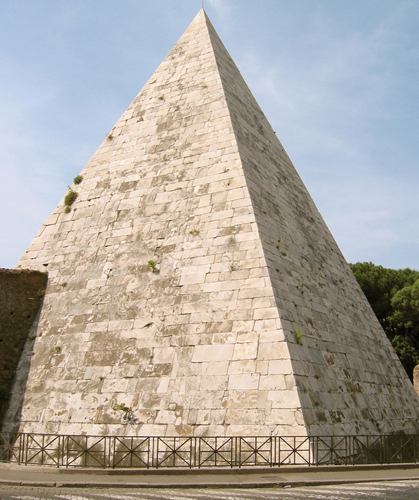
Pyramid of Caius Cestius
This
12 BC edifice remains a truly imposing monument to the wealthy Tribune
of the People for whom it was built. It stands 36 m (118 ft) high and
took 330 days to erect, according to an inscription carved into its
stones. Unlike Egyptian originals, however, it was built of brick then
covered with marble, which was the typically pragmatic, Roman way of
doing things.Piazzale Ostiense

Pyramid of Caius Cestius
San Teodoro
At
the foot of the Palatine, this small, circular, 6th-century church is
one of Rome’s hidden treasures. St Theodore was martyred on this spot,
and his church was built into the ruins of a great horrea
(grain warehouse) that stood here. The apse mosaic showing Christ
seated upon an orb is original, but the Florentine cupola (1454) and
other treatments are mostly 15th-century restorations ordered by Pope
Nicholas V. The courtyard was designed by Carlo Fontana in 1705.Via di San Teodoro
Protestant Cemetery
Also
called the Acattolica (Non-Catholic) Cemetery, people of many faiths
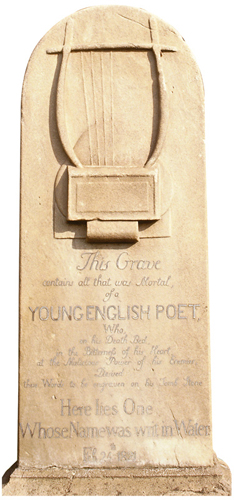
have been sepulchred here since 1738. The most famous denizens are the
English poets Keats and Shelley . Until 1870, crosses and references to salvation were forbidden.Via Caio Cestio 6
Open 9am–4:30pm Tue–Sat, 9am–1pm Sun
Donation

Keats’ tombstone