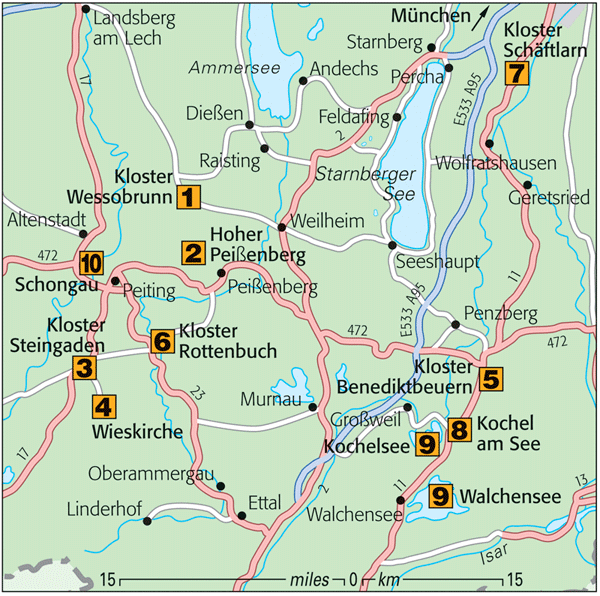
Pfaffenwinkel is a classic
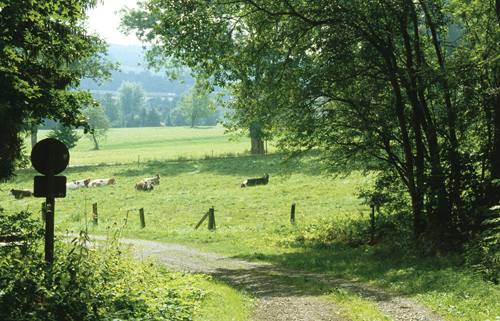
alpine foothill region. Gently sloping hills and verdant pastures
alternate with forests, fens, and small lakes. Geographically, the
region is bounded by the Lech, Ammer, and Loisach rivers, and by the
southern end of Ammersee and Starnberger See, reaching all the way to
the Ammergauer mountains. It is known for its abundance of Baroque
monasteries and Rococo churches, such as Benediktbeuern and Wieskirche,
characterized by the style developed at the world-renowned stucco school
at Wessobrunn. The name of the region comes from the words “Pfaffen,”
which is local dialect for priest, and “Winkel” for corner. Natural
beauty abounds in Pfaffenwinkel, with its gorges such as Ammerschlucht,
romantic mountain lakes such as the deep, dark blue Walchensee, high
mountains with lovely vistas, and lonely fens. By car, the region is
reached from Munich via motorway A95 or regional roads B2 and B11. There
are also excellent rail and bus links.
Wessobrunn StuccoworkIn the 17th and 18th centuries, the most |
Freilichtmuseum GlentleitenUpper Bavaria’s largest open-air museum opened in
|
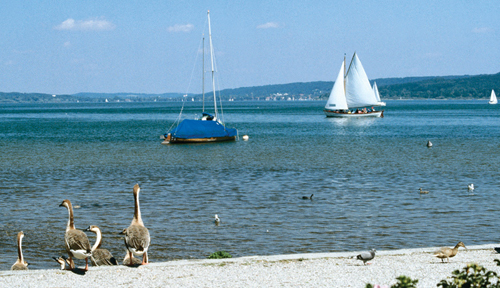
Dießen, Ammersee
|
|
|
|
Sights
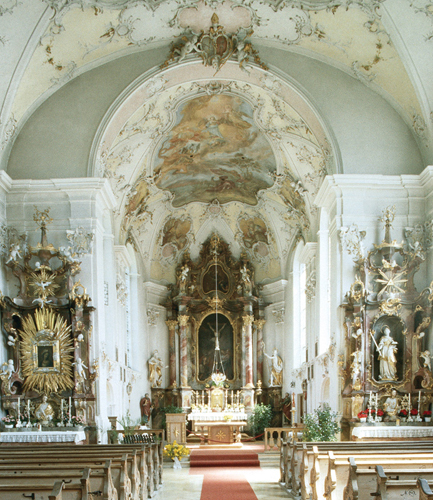
Kloster Wessobrunn
In
the 17th and 18th centuries, Wessobrunn was the centre of the art of
stuccowork. Masterbuilders of monasteries and master stuccoworkers
trained here, including Joseph Schmuzer (1683–1752) and Dominikus
Zimmermann (1685–1766), who went on to build and decorate many of the
monasteries and churches in southern Germany in the Baroque manner.
Wessobrunn stucco became famous around the world through the work of the
Schmuzer and Zimmermann families. Part of the monastery, including the
gallery in the Fürstentrakt and Tassilo hall, is open to the public.
One of the oldest German-language manuscripts, the Wessobrunner Prayer,
dating to around 800, was once held in the monastery’s library. It is
now part of the Bayerische Staatsbibliothek’s collection in Munich.0 88 09 9 21 10
Open Mar–Oct: 10am–3pm & 4pm Tue–Sat, 3–4pm Sun; Nov–Feb: 3pm Tue–Sat, 3pm & 4pm Sun
free

Rococo interior, Kloster Wessobrunn
Hoher Peißenberg
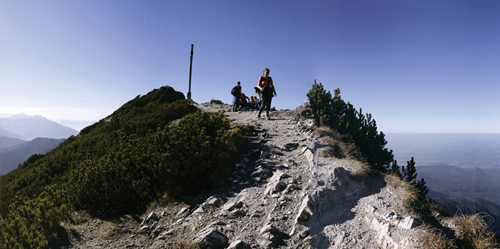
At
an elevation of nearly 1,000 m (3,300 ft), the Hohe Peißenberg is not
only the geographical centre of Pfaffenwinkel, it also affords one of
the most beautiful panoramic vistas in the Alpine foothills – the entire
mountain range and the gently rolling hills and sparkling lakes at the
foot of the Alps lie before you. Meteorological data have been recorded
on the Hohe Peißenberg since 1781 – at first by Augustine choirmasters
from nearby Rottenbach monastery (see Kloster Rottenbuch). Refreshments are available at the Bayerischer Rigi café, which features a large terrace.Kloster Steingaden
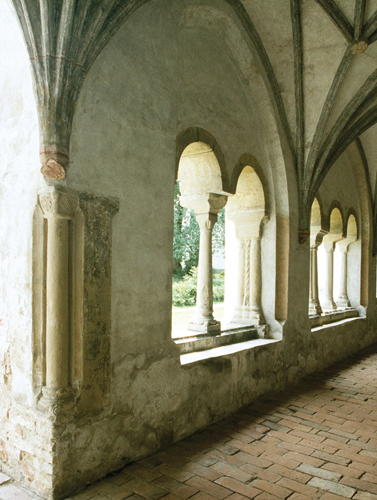
In
1147, the Premonstratensians built this monastery and abbey under Duke
Welf VI. It was the most important centre of monastic life in Bavaria
during that era. Surviving elements include the Romanesque cloisters
with late Gothic vaulting and a Romanesque basilica, whose exterior form
has been preserved. The abbey’s interior is highly ornamented in the
Rococo style.0 88 62 2 34
Open 8am–6pm daily in summer, 8am–5pm daily in winter)
free

Romanesque cloister, Kloster Steingaden
Wieskirche
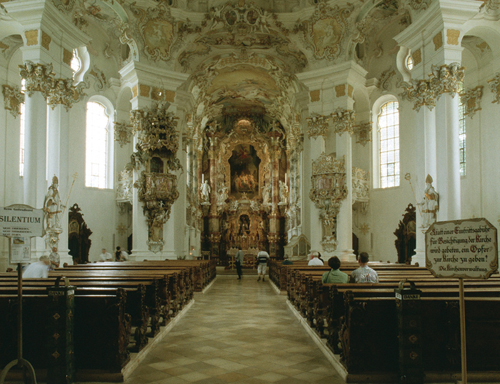
Known
simply as the Wieskirche, the pilgrimage church Zum Gegeißelten Heiland
in der Wiese near Steingaden (1746–54) is renowned as a prime example
of German Rococo. It represents the work of Dominikus Zimmermann, the
famous architect and stuccowork master from Wessobrunn, at his peak.
UNESCO listed the church as a World Heritage Site in 1984.0 88 62 93 29 30
Open in summer 8am–7pm daily, in winter 8am–5pm daily
free

Ornate Rococo interior of Wieskirche
Kloster Benediktbeuern
Benediktbeueren
(739) is one of the oldest monasteries in the foothills of the Alps.
Karl the Great’s acquisition of the arm relic of St Boniface elevated
the monastery to the most important cult site of the saint in
German-speaking countries. Built between 1669 and 1679, the Baroque
monastery is still intact today. Kaspar Feichtmayr of Weilheim built the
church with twin towers in the Italian late Baroque style. Famous in
its time, the holdings at the monastery library included the Carmina
Burana – the most important collection of medieval minstrel songs. The
manuscript dates back to the 13th century and is now housed at the
Bayerische Staatsbibliothek.Following
secularization, the monastery complex was used for a time as a
glassworks. At the beginning of the 19th century, it housed an institute
for optics led by the famous optician and physician Joseph von
Fraunhofer (1787–1826), who discovered the waves in the solar spectrum
that were named after him. Today, the monastery accommodates institutes
of pedagogy and theology of the Silesian Order.Kloster
0 88 57 880
Open 9am–5pm daily
Glashütte
Open 9am–6pm daily
free
Kloster Rottenbuch
Founded
in 1073 by Duke Welf IV, this monastery for Augustine Canons survives
to this day. It features a rare blend of Romanesque, Gothic, and Rococo
architectural styles. In the mid-18th century, Joseph Schmuzer and his
son decorated the interior with lavish stuccowork.0 88 67 10 08
Open 8am–6pm daily (to 7pm in summer)
free
Kloster Schäftlarn
Benedictine
monks founded a monastery at this site as far back as 762. The
buildings seen at Schäftlarn today were built in 1702–07 after designs
by Giovanni A Viscardi. Consecrated in 1760, the abbey is considered a
masterpiece of Bavarian Rococo. Much of the stucco decoration is the
work of the famous Zimmermann family. The beautiful beer garden attached
to the monastery is perfect for a small repast.Kochel am See
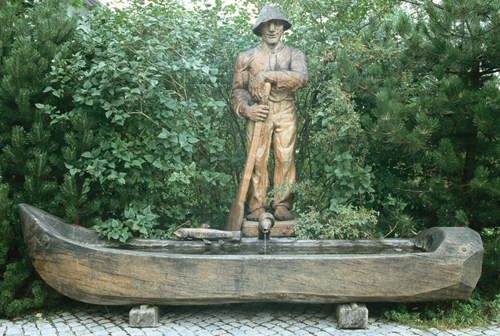
At
the centre of this popular lakeside resort stands a monument to the
legendary blacksmith Balthes, a hero of the Bavarian peasant uprising
against Austria in 1705. This was also where the painter Franz Marc
lived and worked in the early 20th century. His home has been converted
into a museum of his works and those of his friends in the Blue Rider
group.0 88 51 71 14
Mar–mid-Jan: 2pm–6pm Tue–Sun
Adm

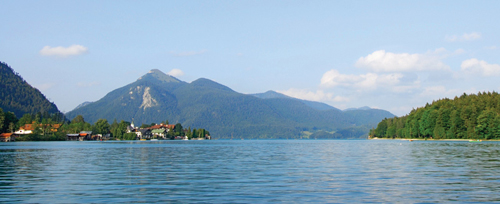
View of Walchensee near Kochel am See

Kochelsee & Walchensee
About
half of Kochelsee is surrounded by steep hills. Covering an area of
just under 6 sq km (2.5 sq miles), the lake is 66 m (215 ft) deep in
some parts. Excellent hiking paths run along its shores. A short
distance to the south, and some 200 m (655 ft) higher, lies the
blue-green Walchensee. Covering 16 sq km (6.5 sq miles) and with a depth
of up to 190 m (650 ft), it is the largest and deepest mountain lake in
Germany and, in summer, a windsurfer’s paradise. A cable car affording a
glorious view of both lakes runs up to Herzogstand (1,750 m/5,700 ft).Herzogstandbahn (cable car): Walchensee
0 88 58 2 36

Herzogstand and Kochelsee
Schongau
This
picturesque town is located on a hill on the river Lech. A historic
town wall with walkways, towers, and gates gives Schongau a medieval
air. Altenstadt, 3 km (2 miles) to the north, was previously Schongau’s
old centre before the town spread. It boasts the Michaelskirche, the
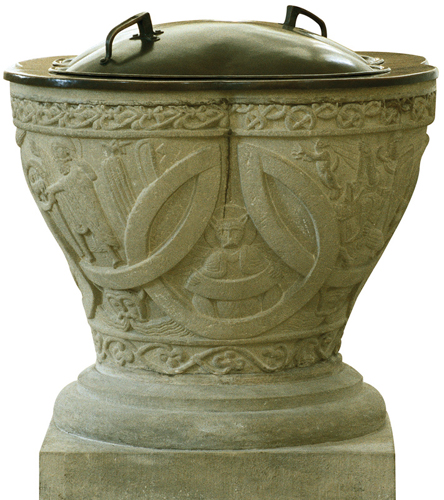
finest Romanesque vaulted basilica in Upper Bavaria. Containing, among
other treasures, a carved Romanesque font, the church was built in 1200.

Romanesque font, Michaelskirche