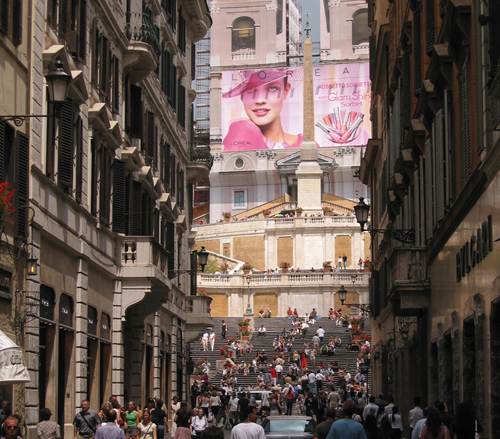
Here is Rome at its most
orderly and elegant, carefully laid out under 16th-century papal urban
planning schemes. Baroque popes such as Leo X and Sixtus V redeveloped
the all but abandoned area around the Corso, the extension of the
ancient Via Flaminia from northern Italy, for their rapidly growing
city. Romans now call it the Tridente after the trident of streets –
Corso, Ripetta and Babuino – diverging from Piazza del Popolo. It’s an
area stamped by a love of theatricality: the beautifully symmetrical
Piazza del Popolo; long vistas that stretch down arrow-straight roads;
the carefully landscaped Pincio gardens and the lush expanse of Villa
Borghese; the stage-set backdrop of the Spanish Steps; the oversized and
overwrought Trevi Fountain. It’s also Rome’s most stylishly
self-conscious district, famous for its boutiques hawking frighteningly
expensive high fashion. Artists have long made their home along Via
Margutta, as numerous galleries and antiques shops attest, and Rome’s
most elegant passeggiata (the traditional early evening see-and-be-seen stroll) unfolds down the length of Via del Corso.
Sights
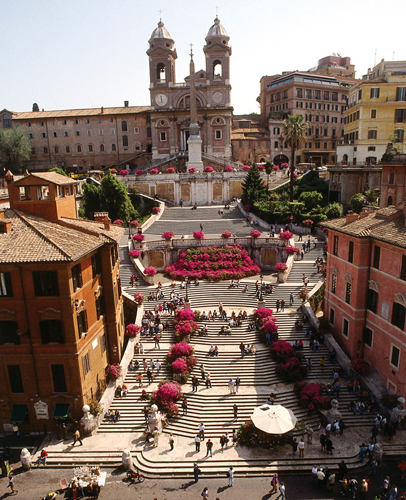
The Spanish Steps and Piazza di Spagna
This
elegant, off-centre sweep of a staircase is Rome’s most beloved Rococo
monument. It is at its most memorable in May, when it is covered in
azaleas, but all year round it is littered with people drinking in la dolce vita
(sweet life) and musicians strumming guitars until late into the night.
Francesco De Sanctis designed the steps in 1723–6 for King Louis XV,
and their true name in Italian is Scalinata della Trinità dei Monti,
after the church at the top. The hourglass-shaped Piazza di Spagna, with
its Bernini Barcaccia fountain and milling tourists, was named after
the Spanish Embassy to the Vatican located nearby.

The Spanish Steps and Piazza di Spagna
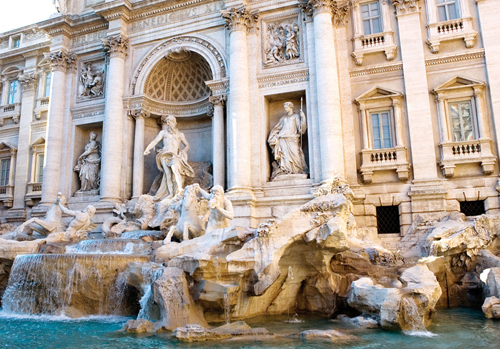
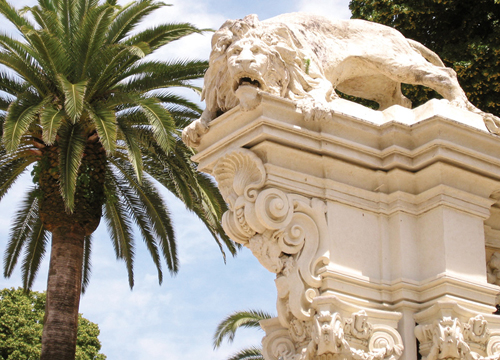
Trevi Fountain
Anita Ekberg bathed in it in La Dolce Vita; Three Coins in a Fountain
taught us to throw coins backwards over our shoulder to ensure a return
visit to Rome (healthier than the original tradition of drinking the
water for luck) – thanks to the world of cinema this beautiful fountain
is one of the most familiar sights of Rome. The right relief shows a
virgin discovering the spring from which Augustus (left relief) built
the Acqua Vergine aqueduct, which still feeds the fountain. Nicola Salvi
paid homage to these ancient origins by grafting his exuberant Baroque
confection onto the Classical architectural framework of a triumphal
arch .

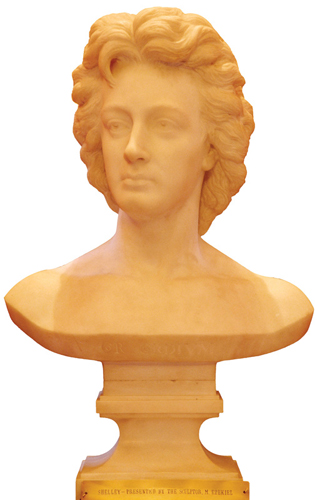
Keats-Shelley Memorial
The
pink-stuccoed apartment overlooking the Spanish Steps, where
25-year-old John Keats breathed his last, consumptive breath in 1821,
has been turned into a modest little museum dedicated to the
Romantic-era British poets who lived part of their lives in Rome .
Main displays include documents, letters, copies of publications, and
Keats’ death mask. Companion Joseph Severn cradled Keats’ head as he
died; his resultant drawing of Keats on his Deathbed is also on exhibit.Piazza di Spagna 26
06 678 4235
Open 10am–1pm, 3–6pm Mon–Fri, 11am–2pm, 3–6pm Sat
Adm

Bust, Keats-Shelley Memorial
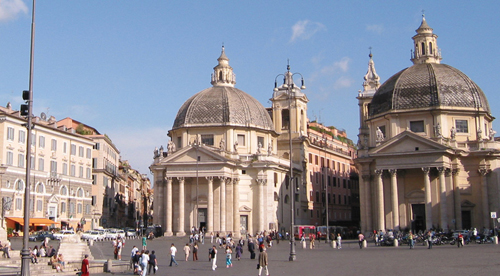
Piazza del Popolo
Rome’s
elegant public living room started as a trapezoidal piazza in 1538. In
1589, Sixtus V had Domenico Fontana build a fountain crowned with a
3,200-year-old obelisk – the 25-m (82-ft) megalith from Heliopolis,
honouring Ramses II, was brought to Rome by Augustus. Napoleon’s man in
Rome hired Giuseppe Valadier to overhaul the piazza to its current
Neo-Classical look in 1811–24, a giant oval that grades up the steep
slope of the Pincio via a winding road. Valadier also added the
fountain’s Egyptian-style lions .

Piazza del Popolo
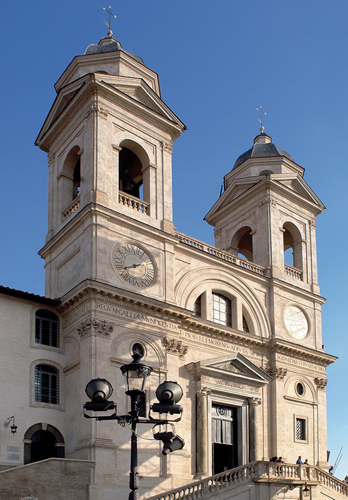
Trinità dei Monti
This
church, crowning the French-commissioned Spanish Steps, was part of a
convent founded by Louis XII in 1503. The twin-towered façade (1584) is
by Giacomo della Porta; the double staircase (1587) by Domenico Fontana.
The Baroque interior has three chapels. Daniele da Volterra frescoed
the third chapel on the right and painted the Assumption altarpiece (which includes a portrait of his teacher Michelangelo as the far right figure), as well as the Deposition
in the second chapel on the left. The nearby 16th-century Villa Medici
(open for special exhibits) has housed the French Academy since 1803.Piazza Trinità dei Monti
Open 7am–1pm, 3–7pm Tue–Sun
Free

Trinità dei Monti
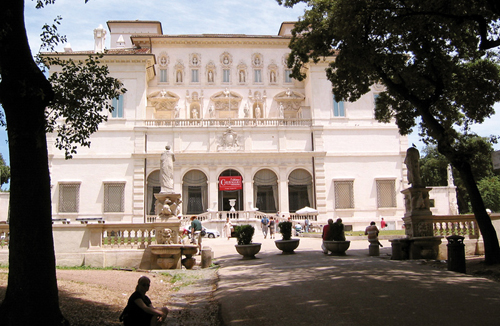
Villa Borghese
Rome’s
largest green space is made up of 688 ha (1,700 acres) of public park,
landscaped gardens, statuary, fountains, groves, pathways, pavilions and
a water clock. There are also three world-class museums: Renaissance
and Baroque art at Galleria Borghese, ancient Etruscan artifacts at Villa Giulia, and modern art at the Galleria Nazionale d’Arte Moderna.
In addition, the Museo Carlo Bilotti, which opened in 2006, houses a
permanent collection of contemporary works by the Italian artist Giorgio
de Chirico (1888–1978). It’s all thanks to Cardinal Scipione Borghese,
who in 1608 turned these vast family lands just outside the Aurelian
walls into a private pleasure park, opened to the public in 1901. In
1809–14, Giuseppe Valadier had turned the adjacent space within the city
walls into the terraced Pincio gardens, a favourite passeggiata
destination studded with statues of great Italians. There’s an
elaborate tea house and an obelisk commissioned by Hadrian to honour his
lover.