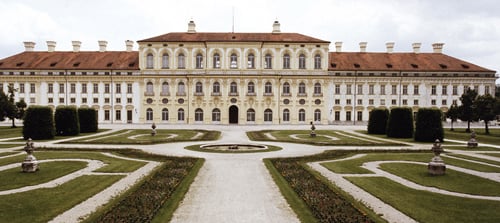
In 1957, Stanley Kubrick shot scenes for his film Paths of Glory in Schloss Schleißheim. |
|
Schloss Schleißheim
Maximilian
II Emanuel, the Elector, wanted to rival Versailles with the Neues
Schloss (New Palace). Begun in 1701 based on plans by Enrico Zuccalli
and completed in 1719 by Joseph Effner, the complex includes a hunting
lodge and Schloss Lustheim, a small summer palace on the eastern edge of
the Baroque park ,
also designed by Zuccalli. The latter houses an important collection of
early Meißner porcelain. Oberschleißheim is home to the Flugwerft
Schleißheim.Open Apr–Sep: 9am–6pm Tue–Sun; Oct–Mar: 10am–4pm Tue–Sun (both castles)
Adm

Neues Schloss, Schloss Schleißheim
Freising
The
historic seat of a bishopric, the town is dominated by the cathedral
and the bishop’s residence, situated on a hill known as the Mons Doctus –
Learned Mount. Designed as a Roman basilica with five aisles, the
cathedral was completed in 1205 and embellished from 1723 to 1724 by the
Asam brothers, with stucco and stained-glass windows. Not to be missed
are the Romanesque crypt and its famous Bestiensäule, a column
elaborately carved with fabled beasts. Near the cathedral lies the
former Benedictine monastery, Weihenstephan. Today, it is a brewery –
arguably the oldest in the world – with a wonderful beer garden.

Dachau
Set
in the foothills along the Amper River, some 15 km (9 miles) north of
Munich, Dachau is a small town built around a prominent palace – part
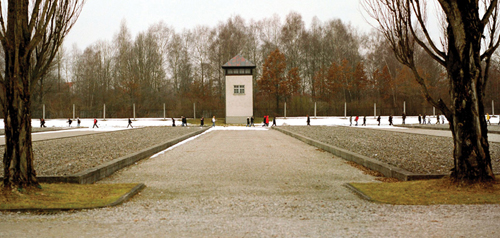
Renaissance, part Baroque – which has an excellent restaurant. In 1933,
the first Nazi concentration camp was set up here, now a place of
remembrance – the KZ Gedenkstätte – one of the most frequented in Europe
today. Refurbishment of the exhibition at the adjacent museum was
completed in 2003.Schloss Dachau
081 31 879 23
Open Apr–Sep: 9am–6pm daily; Oct–Mar: 10am–4pm Tue–Sun
Adm
KZ-Gedenkstätte Dachau, Alte Römerstr.
75, 081 31 66 99 70
Open 9am–5pm Tue–Sun
free

Dachau concentration camp
Herrmannsdorfer Landwerkstätten
Near
Glonn, 30 km (19 miles) southeast of Munich, the Hermannsdorfer
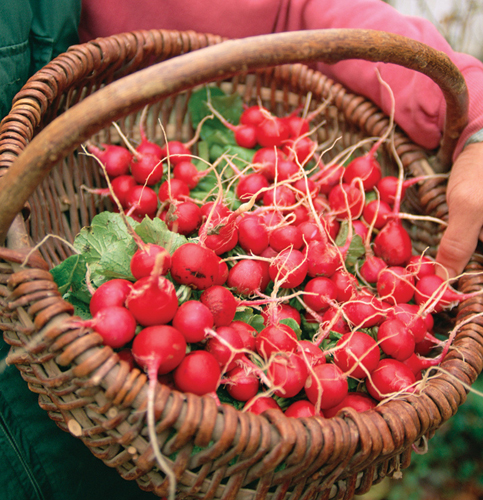
Landwerkstätten complex was completed in 1986. The centre produces,
processes, and sells organic food products, and features a gourmet
restaurant and beer garden. Take the time for a walk to view works of
art such as chimes and sculptures placed throughout the grounds.

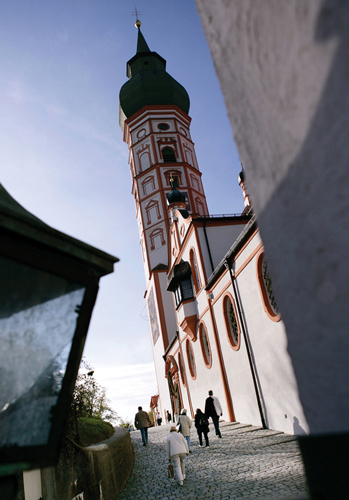
Kloster Andechs
Situated
on the eastern shore of Ammersee on a hill rising to a height of 200 m
(650 ft), this monastery with its lovely Rococo church is one of the
most important pilgrimage sites in Germany. Many, however, journey here
to sample the famous monastery beer, served in the beer garden and pub.

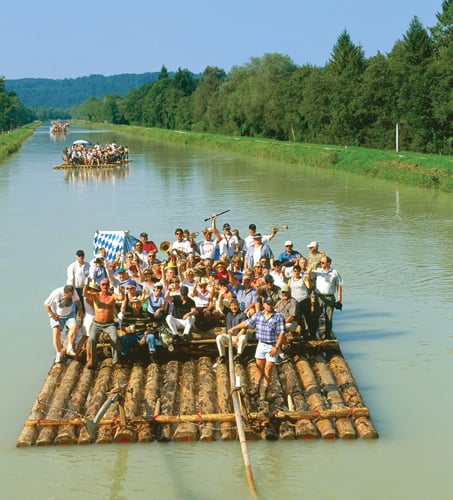
Wolfratshausen & Rafting on the Isar
Wolfratshausen
lies some 30 km (19 miles) south of Munich on the River Loisach and has
a long central market street flanked by 17th- to 18th-century Upper
Bavarian gabled town houses. This small town is the starting point for
river-rafting tours to Munich, which launch at the Loisach bridge. These
are cheerful excursions accompanied by music, picnics, and beer, down
the rafting chutes of the Isar to the central landing area near Tierpark
Hellabrunn. During the six-hour ride, passengers experience the largest
chute in Europe with an 18-m- (60-ft-) drop in altitude.

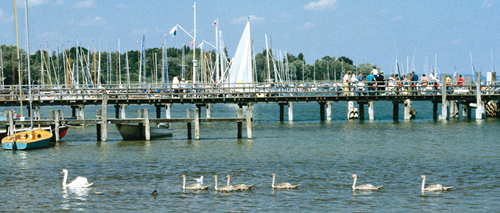
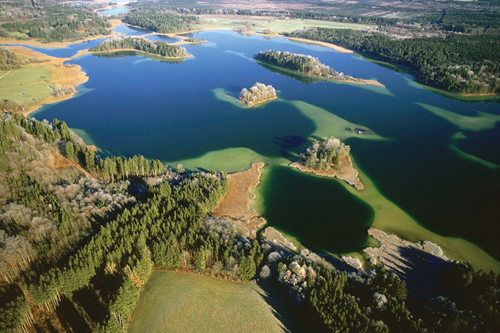
Ammersee
Bavaria’s
third-largest lake, Ammersee lies in a glacial basin from the Ice Age
surrounded by forested moraines. Under clear skies, there is a glorious
view of the Alps. Its shoreline is studded with many small towns,
offering activities such as sailing, rowing, surfing, cycling, hiking,
and much more.

Ammersee
Landsberg am Lech
This
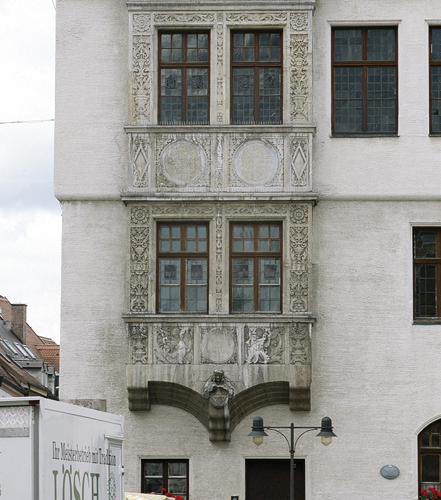
is a city straight out of a picture book. Lining the triangular market
square are beautiful town houses and a stunning stucco town hall. It was
built around 1700 by the famous building master Dominikus Zimmermann,
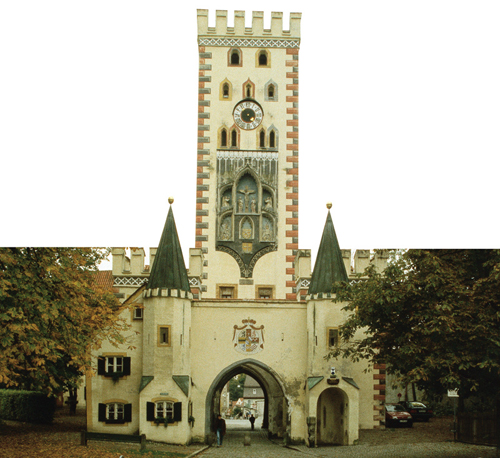
who also served as mayor of Landsberg (1749–54). The 36-m- (125-ft-)
high Bayertor, dating from around 1425, is one of the most impressive
medieval city gates in Bavaria.Town Hall: Open 8am–8pm in summer, 9am–4pm in winter

Bayertor, Landsberg