Most visitors to Berlin
regard the magnificent boulevard of Unter den Linden as the heart of the
small historic Mitte district. Many of Berlin’s sights are concentrated
along the grand avenue and around Bebelplatz, creating an impressive
picture of Prussian and German history from the early 18th century until
the present day. South of Unter den Linden is Gendarmenmarkt, one of
Europe’s most attractive squares. In recent years, many varied and
elegant restaurants and cafés have appeared around the Neo-Classical
square. Not far away, chic Friedrichstraße is lined with luxury shops
and department stores as well as modern offices and apartments.
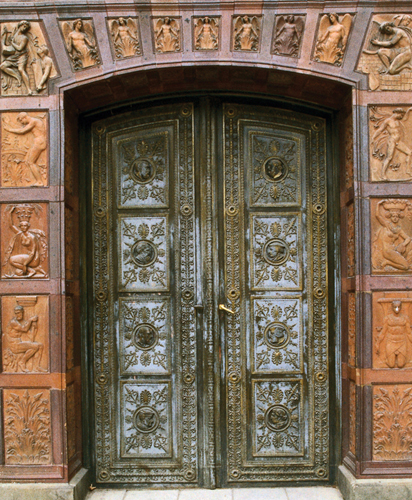
Portal of Kronprinzenpalais
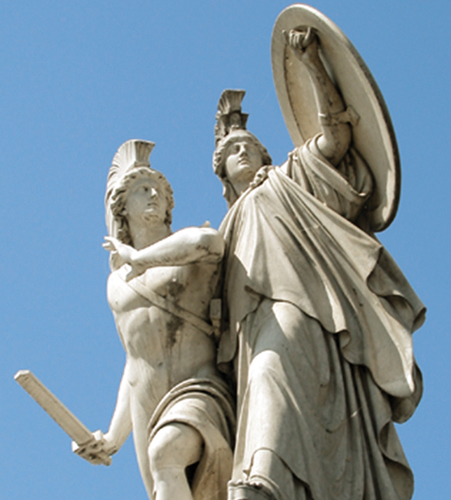
Sculpture on Schlossbrücke
Top 10 Sights
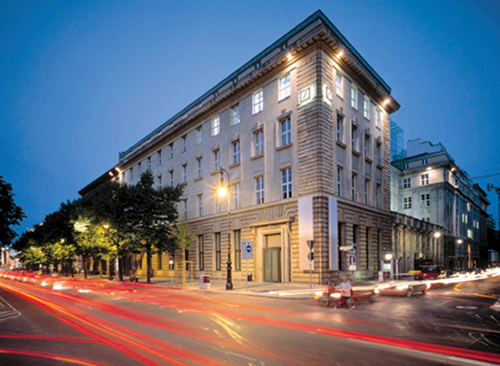
Deutsche Guggenheim
This
branch of the American Guggenheim museum, together with the Deutsche
Bank branch Unter den Linden, show changing exhibitions of modern art of
the highest standard from the US. During recent years, Deutsche
Guggenheim has thus managed to become one of the most successful and
popular art venues in the city, with an emphasis placed on
installations. In 2008, Anish Kapoor’s Memory
was a particular highlight. Treasures from the Deutsche Bank archives
are also shown here. Pop into the small museum shop and refresh yourself
with a coffee from the museum café.Unter den Linden 13–15
10am–8pm Fri–Wed, 10am–10pm Thu
030 202 09 30
Admission charge, free on Mon

Deutsche Guggenheim, Unter den Linden
Forum Fridericianum
The
historic structures of this architectural complex in Unter den Linden
are among the finest attractions in Berlin. From 1740, Frederick the
Great commissioned the prestigious Early-Neo-Classical buildings for the
area around today’s Bebelplatz, and personally influenced their design:
Deutsche Staatsoper, the first free-standing opera house in Europe;
Catholic St Hedwigskathedrale, Alte Bibliothek and
Prinz-Heinrich-Palais, later the Humboldt University. Bebelplatz itself
is particularly interesting. A memorial set into the ground reminds of
its dark past – in 1933, it was the venue for the Nazi book burning.
Frederick’s successors commissioned Altes Palais and a memorial statue
of “the old Fritz”, surrounded by “his” buildings. Christian Daniel
Rauch created the 13.5-m (44-ft) high equestrian bronze figure in 1840.
It portrays Frederick the Great wearing his trademark tricorn hat and
coronation mantle and carrying a walking stick. The statue has always
turned its back to the east – but wags claim that the East German
government mistakenly set up the figure the wrong way around.Unter den Linden and Bebelplatz

Altes Palais at Forum Fridericianum
Gendarmenmarkt
This square, whose strict layout is reminiscent of an Italian Renaissance piazza,
is probably the most beautiful in Berlin. To the left and right of
Schauspielhaus – today’s Konzerthaus – stand the twin towers of
Deutscher and Französischer Dom (German and French cathedrals), dating
back to the late 18th century. Gendarmenmarkt, named after a regiment of
gens d’armes
stationed nearby, was built at the end of the 17th century, as a market
square. The Schauspielhaus (theatre) on the north side of the square,
built by Schinkel in 1818–21, was used as a theatre until 1945. Damaged
in World War II, it was reopened as Konzerthaus (concert hall) in 1984. A
statue of the playwright Friedrich Schiller stands in front of the
building. Französischer Dom, to its right, is a prestigious Late-Baroque
building; concealed behind it is the French Friedrichstadtkirche, a
church serving Berlin’s Huguenot community. The Deutscher Dom opposite,
built in 1708 on the south side of the square for the Reformed
Protestant Church, did not receive its first tower until 1785. Today it
has an exhibition on democracy in Germany.Mitte
Museumsinsel
Museum
Island, a UNESCO World Heritage Sight, is one of the most important
complexes of museums in the world, holding major arts collections and
imposing full-scale ancient structures. Based here are the
Pergamonmuseum, the Alte Nationalgalerie (the old national gallery),
Bode-Museum and Altes and Neues Museum. The Neues Museum will reopen in
late 2009 .Pergamonmuseum, Bodestr. 1–3
10am–6pm daily, till 10pm Thu
030 20 90 55 77
Alte Nationalgalerie
Bodestr.1–3
10–6pm Tue–Sun, until 10pm Thu
030 20 905 801
Admission charge
Friedrichstraße
Friedrichstraße
has risen to some of the glamour and vibrancy it possessed before World
War II. Today, Berlin’s Fifth Avenue once again boasts elegant shops,
and some upmarket restaurants and cafés, which have opened here in
recent years. Especially worth visiting are the three Quartiers 205, 206
and 207 within the Friedrichstadtpassagen, containing the Galeries
Lafayette store and Department Store 206 respectively. At the northern
end of the street is the famous Dussmann store (books, music, events),
S-Bahn station Friedrichstraße, as well as the former entertainment
district with the Friedrichstadtpalast and Admiralspalast.Mitte
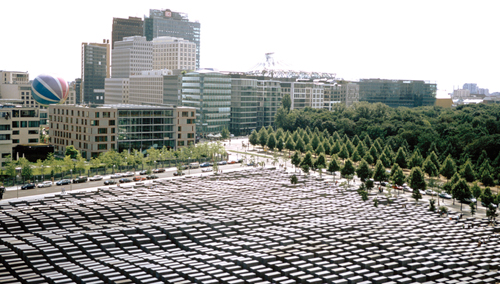
Holocaust-Denkmal
This
memorial, officially called “Memorial to the Killed Jews of Europe”,
serves as Germany’s national Holocaust memorial. After years of debate,
US star architect Peter Eisenman completed the memorial in 2005. It is
comprised of a large field with dark grey steles of varying heights up
to 2 m (6 ft) high, which symbolize the six million Jews and others
murdered by the Nazis in their concentration camps between 1933 and
1945. Underneath the memorial there is an information centre which
explains the causes and history of the genocide.Ebertstr.

Wilhelmstraße
In
imperial Berlin, the centre of the German Empire’s governmental power
was based in Wilhelmstraße. Around 100 years later, nothing remains of
the prestigious historic buildings which represented the equivalent of
No. 10 Downing Street in London or Quai d’Orsay in Paris. All political
decisions were made at Wilhelmstraße: both Chancellor (No. 77) and
President (No. 73) of the German Reich lived here in old town houses.
Their gardens became known as “ministerial gardens”. Adolf Hitler had
the street systematically developed into the nerve centre of Nazi power.
The Neue Reichskanzlei (the Chancellor’s office) was built in 1937–9 to
plans by Albert Speer, at the corner of Vossstraße and Wilhelmstraße.
It was blown up in 1945. Behind the Reichskanzlei was the so-called
“Führerbunker” where Adolf Hitler committed suicide on 30 April 1945
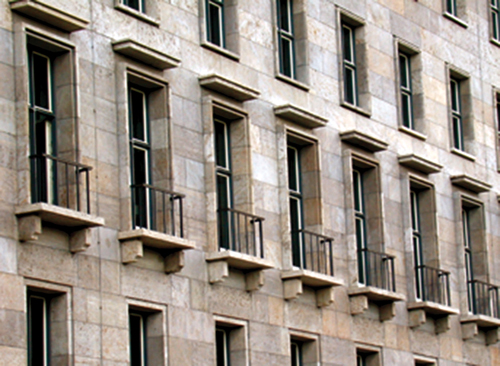
(today it is a car park). Of the historic buildings, only the former
Reichsluftfahrtministerium (Ministry of Aviation) remains. Today,
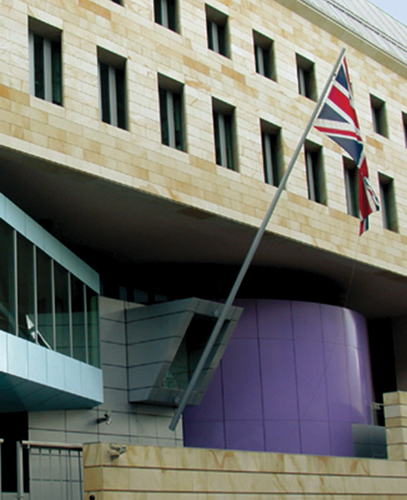
Wilhelmstraße is lined by modern office buildings; and the British
Embassy, built in 2000 by Michael Wilford, creates a link with the
international importance of this street.Between Unter den Linden and Leipziger Str.
The former Ministry of Aviation, Wilhelmstraße

British Embassy, Wilhelmstraße
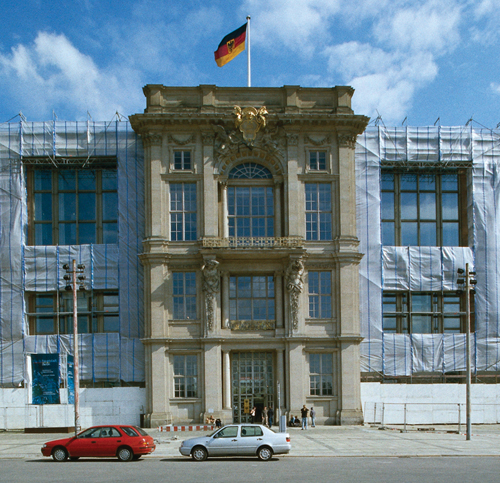
Schlossplatz
Today
Schlossplatz seems deserted, but once the Stadtschloss (town residence)
of the Hohenzollerns stood here. It was blown up by the East German
government in 1950–51, and today just a few historic fragments of the
original can be seen.
Remains include the façade of the doorway where Karl Liebknecht
supposedly proclaimed the Socialist Republic in 1918. The portal has
been incorporated into the former Staatsratsgebäude on the south side of
the square. On its eastern side, Schlossplatz used to be bordered by
the Palast der Republik (palace of the republic), the former seat of the
East German parliament demolished in 2008. Development of the
Humboldt-Forum cultural centre will be complete in 2015. It will have a
façade reminiscent of the old Hohenzollern Palace, a library and the
non-European collections of the Dahlem Museums. A temporary “White Cube” building will show modern art exhibits until then.Mitte

Portal of the Staatsratsgebäude
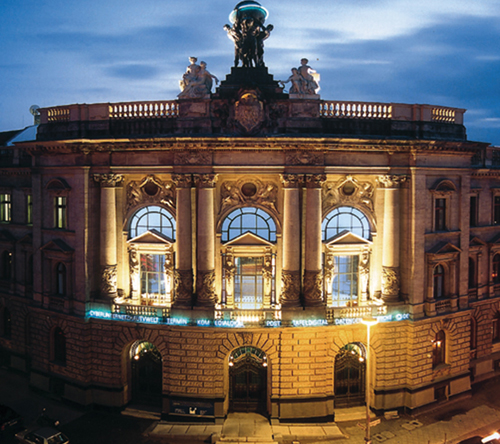
Museum für Kommunikation
The
world’s largest Post Office Museum was opened as early as 1872. Its
excellent displays document the history of communication from the Middle
Ages via the first postage stamps to today’s satellite technology.
Particularly worth seeing are a blue and a red Mauritius stamp, one of
the first telephone installations (dating back to the year 1863) and
three talking robots who interact with the visitors. Children – young
and old – always enjoy the Computer-galerie, where they can learn and
gain new insights while playing.

Museum für Kommunikation at night