With magnificent
architecture, interesting ethnic enclaves, and stand-out museums,
Chicago’s Far South encompasses districts such as Hyde Park and Kenwood
that merit a journey off the beaten tourist track – despite being
bordered to the south by some less-than-welcoming neighborhoods. Hyde
Park and Kenwood began life as suburbs for the wealthy escaping the
dirty city; today, this part of town is a fascinating melting pot of
University of Chicago students and Mexican, Asian, African-American, and
Indian residents. Recreation and leisure opportunities abound on
spectacular tracts of green space, including the University of Chicago’s
Midway Plaisance and Jackson Park, site of the 1893 World’s Columbian
Exposition .
DuSable Museum of African-American History
Located
on the eastern edge of the beautiful Washington Park, this museum is
named after Chicago’s first non-native settler, Jean Baptiste Point du
Sable. The permanent exhibits here celebrate other firsts, such as the
first black US astronaut, Major Robert Lawrence, and Chicago’s first and
only African-American mayor, Harold Washington. Thought-provoking
exhibits include rusted slave shackles and the “Freedom Now” mural,
depicting 400 years of African-American history from the early days of
slavery to Civil Rights marches.740 E. 56th Pl
Open 10am–5pm Tue–Sat, noon–5pm Sun
Adm. (free Sun)
DA
South Shore Cultural Center
How
ironic that this bustling arts and community center, which serves a
largely African-American demographic, began in 1905 as an exclusive
country club that barred minority members. Designed by the team who
later worked on the elegant Drake
Hotel, this grand Mediterranean-style structure was bought and lovingly
restored by the Chicago Park District when the country club fizzled out
in the 1970s. Extravagant landscaping and flower beds complete the
pretty picture, making it a popular spot for weddings and festivals, as
well as for all kinds of performances and classes. Its golf course,
nature park, and the public beach behind it add to its many draws.7059 S. Shore Dr
Open 9am–6pm Mon–Fri, 9am–5pm Sat
Free (except classes)
DA
Oriental Institute
Learn
about the origins of agriculture, the invention of writing, the birth
of civilization, and the beginning of the study of arts, science,
politics, and religion at this University of Chicago departmental
museum. Its five galleries showcase ancient Near Eastern civilizations
from about 3500 BC to AD 100, and the exhibits were largely unearthed
during the department’s own excavations.1155 E. 58th St.
10am–6pm Tue–Sat (to 8:30pm Wed), noon–6pm Sun
Free

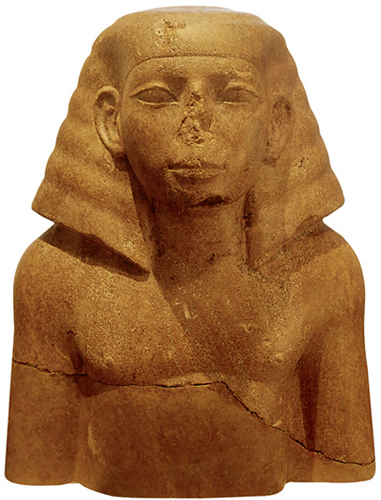
Bust (c. 1840 BC), Oriental Institute
Robie House
This
splendid 1909 residence by Frank Lloyd Wright is easily spotted by its
steel-beam roof, which overhangs the building by 20 ft (6 m) at each
end. Take a tour through its low-ceilinged interior, and past more than
170 art-glass windows and doors, to gain insight into the ongoing,
extensive ten-year restoration program. The building was a private home
until 1926, when it became a dormitory for the Chicago Theological
Seminary. It was later bought by a development firm, who donated it to
the University of Chicago in 1963, the same year it was designated a
National Historic Landmark.

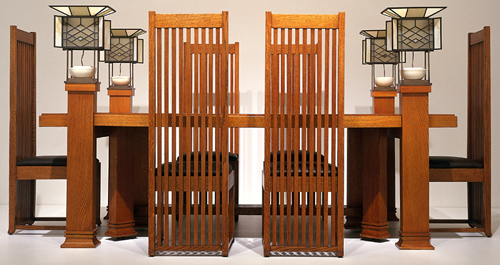
Frank Lloyd Wright tables and chairs in Robie House
Kenwood Historic District
A
world apart from some of the Far South’s dicier areas, this wealthy
enclave within Kenwood, founded by John A. Kennicott in 1856, has
mansions that must be seen to be believed. In the late 19th century this
area was an upscale Chicago suburb, where wealthy residents built
majestic homes on spacious lots, a rarity in the quickly booming city. A
stroll around the district uncovers architectural styles ranging from
Italianate and Colonial Revival to Prairie style, by influential figures
such as Howard Van Doren Shaw and Frank Lloyd Wright .Boundaries
E. 43rd St. (north), E. 51st St. (south), S. Blackstone Ave. (east), and S. Drexel Blvd. (west)
Washington Park
Frederick
Law Olmsted and Calvert Vaux, the designers of New York’s Central Park,
also created this 371-acre (150-ha) green space for Chicago residents
in the early 1870s. It originally attracted mainly wealthy city dwellers
who enjoyed parading around the scenic space. Today, it’s a beautiful
and widely used park with recreational programs, the DuSable Museum of
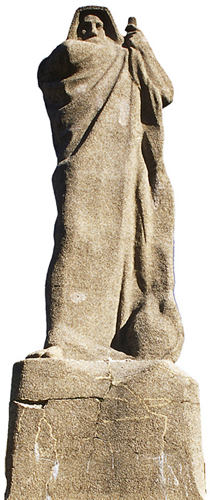
African-American History, and Lorado Taft’s striking 110-ft (34-m) long
sculpture, Fountain of Time, which took him 14 years to build. It is unwise to venture into the park after dark.Open dawn–11pm (approx)
Free
DA

Detail of Taft’s Fountain of Time, Washington Park
Osaka Japanese Gardens
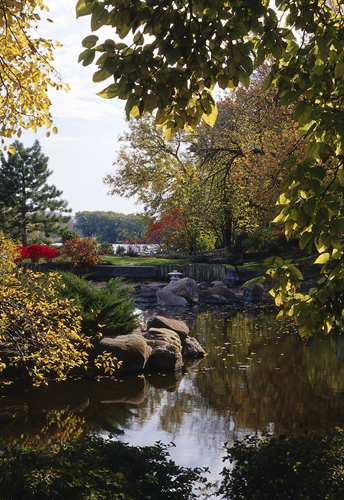
At
the north end of Jackson Park’s serene Wooded Island (which is
excellent for bird-watching), lies this hushed retreat, complete with
meandering paths, lagoons, and fountains. The extraordinary garden is a
partial re-creation of the one formed in 1934 around the beautiful
Japanese Pavilion that had been built for the 1893 Expo, but which sadly
burned down in 1946. The gardens were renamed in 1993 for one of
Chicago’s sister cities, Osaka, which donated the Japanese gate seen
here.Jackson Park
58th St. & Lake Shore Dr.
Open dawn–dusk
Free
DA

Osaka Japanese Gardens
University of Chicago Sculptures
Strolling
around the University of Chicago campus, there’s more of visual
interest than its buildings alone. Over the years, the university has
acquired around 12 outdoor sculptures, including Wolf Vostell’s
whimsical 1970 Concrete Traffic, a car embedded in concrete at the southwest end of the Midway Plaisance and the sobering Nuclear Energy, a bronze by Henry Moore that resembles a mushroom cloud. Set within a reflecting pool at 60th Street and University Avenue is Construction in Space in the Third and Fourth Dimension,
a soaring abstract piece created in the 1950s by Constructivist Antoine
Pevsner, which visually depicts the space-time continuum .