As with every quadrant of San
Francisco, diversity is the keynote here. This area encompasses the
oldest money and the highest society of the city’s founding families, as
well as some of the poorest of citizens. It takes in the staunchest
pillars of the politically savvy – though true conservatives are a
rarity in this progressive city – as well as the wildest
let-it-all-hang-out free-thinkers. Then, too, there’s a considerable
swathe of the comfortably middle-class who, like all San Franciscans,
are simply intent on enjoying the beauties and pleasures of their great
city.
Sights and Neighborhoods
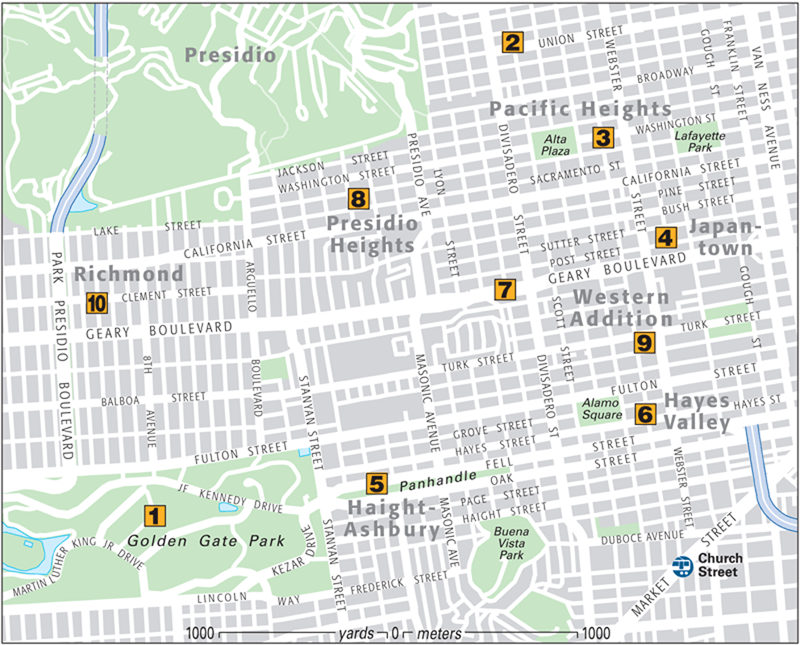
Union Street
A
neighborhood shopping street loaded with tradition, Union Street is
noted for its sidewalk cafés, antiques shops, bookstores, and designer
boutiques, housed in converted Victorian charmers. The street is at the
heart of the Cow Hollow neighborhood, whose name invokes its antecedent
as a dairy pasture .Pacific Heights
A
grander, more exclusive residential area is hard to imagine. Commanding
as it does heights up to 300 ft (100 m) overlooking the magnificent
Bay, everything about it proclaims power and wealth. The blocks between
Alta Plaza and Lafayette Park are the very heart of the area, but the
grandeur extends from Gough to Divisadero and beyond. On a sunny day,
there’s nothing more exhilarating than scaling its hills and taking in
the perfectly manicured streets, the to-die-for views, and the palatial
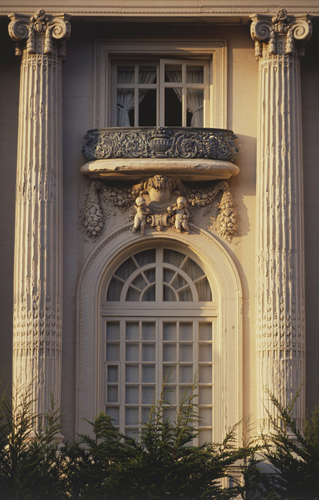
dwellings. The Spreckels Mansion, a limestone palace in the Beaux-Arts
tradition, on Washington and Octavia streets, is the brightest gem of
the lot, now owned by novelist Danielle Steele.

Spreckels Mansion

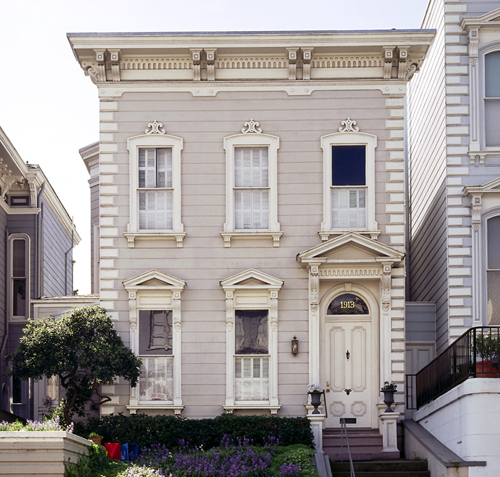
Typical house, Pacific Heights
Japantown
The
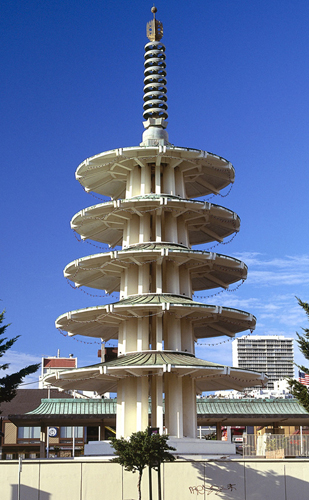
Japan Center was built as part of an ambitious 1960s plan to revitalize
the Fillmore District. Blocks of aging Victorians were demolished and
replaced by the Geary Expressway and this Japanese-style shopping
complex, with a five-tiered, 75-ft (22-m) Peace Pagoda at its heart.
Taiko drummers perform here during the Cherry Blossom Festival
each April. The extensive malls are lined with authentic Japanese shops
and restaurants, plus an eight-screen cinema, and the Kabuki Springs
and Spa. More shops and restaurants are found along the outdoor mall
across Post Street. This neighborhood has been the focus of the Japanese
community for some 75 years.

Japantown
Haight-Ashbury
This
anarchic quarter is one of the most scintillating and unconventional in
the city, resting firmly on its laurels as ground zero for the
worldwide Flower-Power explosion of the 1960s.
Admire the beautiful old Queen Anne-style houses, a few of them still
painted in the psychedelic pigments of that hippie era. There are still
some tripping freaks and neo-Flower Children here, along with far-out
shops and the venerable Haight Ashbury Free Clinic. Groove along the
street and recreate your own “Summer of Love.” The Lower Haight is noted
for its edgy clubs and bars.

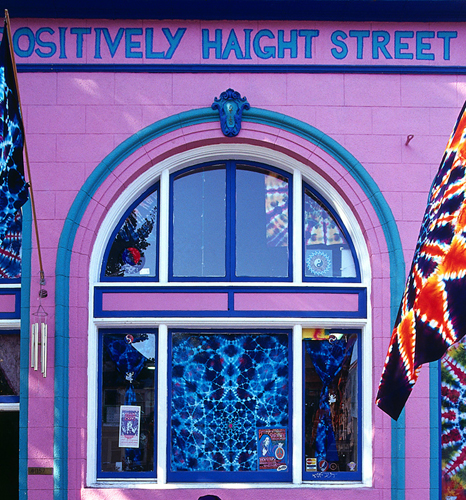
Positively Haight Street, Haight-Ashbury
Rising
like a phoenix from the ashes of racial unrest in what used to be a
very rundown African-American slum, this small area has now become one
of San Francisco’s hipper shopping and dining districts. The dismantling
of an ugly freeway overpass following the 1989 earthquake helped turn
the tide, along with the razing of a housing project nearby. The result
is a chic area that hasn’t lost its edge. Hayes Valley festivals occur
at midsummer and Christmas, when the streets are thronged with revelers.Geary Boulevard
One
of the city’s main traffic arteries, sweeping from Van Ness all the way
out to Cliff House, is a typically unprepossessing urban thoroughfare,
but functional. It begins its journey at Market Street, sweeps past
Union Square, and then forms the heart of the Theater District, before
venturing into the notorious Tenderloin, home to seedy clubs and
sex-workers. After it crosses Van Ness, it zips past Japantown and the
funky Fillmore District. Soon you’re in the Richmond District and before
you know it, there’s the Pacific Ocean.Presidio Heights
Originally
part of the “Great Sand Waste” to the west, this neighborhood is now
one of the most élite. The zone centers on Sacramento Street as its
discreet shopping area. It’s worth a stroll, primarily for the
architecture. Of interest are the Swedenborgian Church at 2107 Lyon
Street, the Roos House at 3500 Jackson Street, and Temple Emanu-El at 2
Lake Street.Western Addition
This
area, too, was once sandy waste, but after World War II the district
became populated by Southern African-Americans who came west for work.
For a short time, it was famous for jazz and blues clubs, as embodied,
until his death in 2001, by John Lee Hooker and his Boom Boom Room.
Today, it is still largely African-American in character and rather
rundown, although it does comprise architecturally odd St Mary’s Cathedral and photogenic Alamo Square.The Richmond District
This
flat district of row houses begins at Masonic Street, sandwiched
between Golden Gate Park and California Street. It ultimately extends
all the way to the Pacific Ocean, being more and more prone to stay
fog-bound the farther west you go. The district is very ethnically
diverse and resoundingly middle class. Over the decades, it has been
settled by White Russians, East European Jews, and most recently
Chinese-Americans and another wave of Russians.

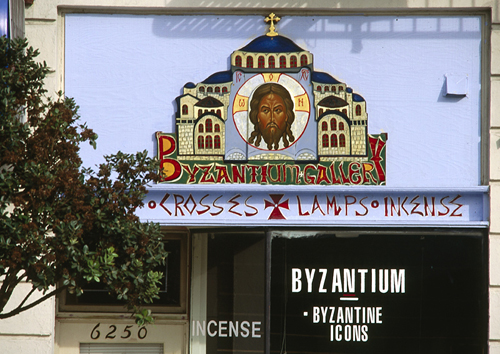
Russian shop, Richmond District