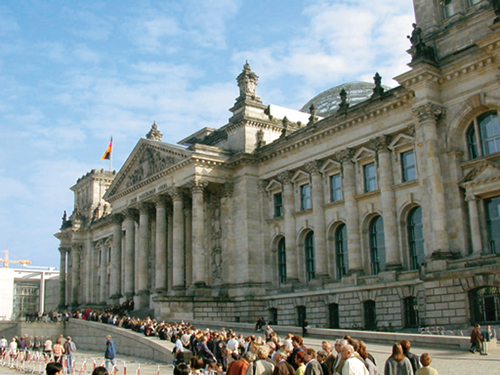
In 1999, Berlin’s green
centre became the government district. Around Tiergarten, Berlin’s
largest and most popular park, stand the Reichstag, the Bundeskanzleramt
and Schloss Bellevue, seat of the President of the Federal Republic of
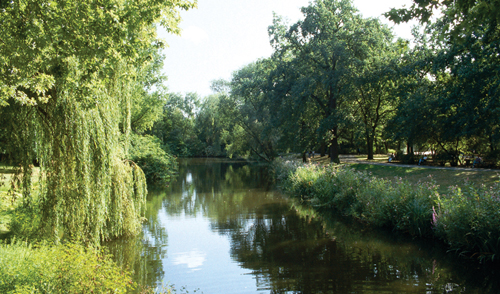
Germany. Tiergarten itself is a great place for strolling and cycling,
and it also boasts the Neuer See, the Spree River and Berlin’s Zoo. In
summer, its lawns are used for soccer games and barbecue parties.
Top 10 Sights
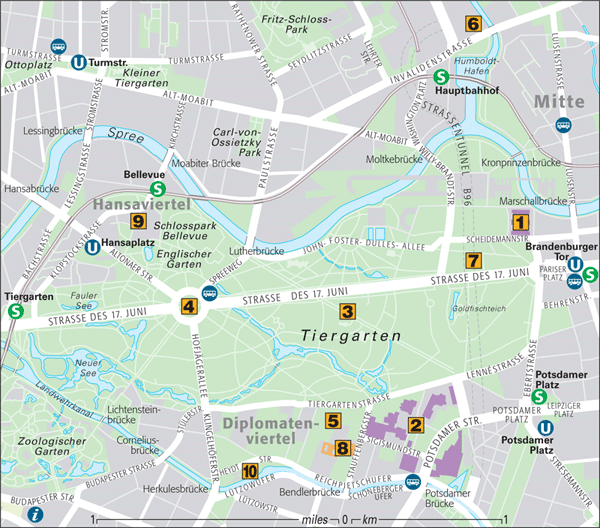
Großer Tiergarten
The
Großer Tiergarten is Berlin’s largest park, straddling an area of 200
hectares (494 acres) between the eastern and western halves of the town.
Formerly the Elector’s hunting grounds, it was redesigned in the 1830s
as a park by Peter Joseph Lenné. At the end of the 19th century, the
Siegesallee was established in the east of the park, more than 500 m
(1640 ft) in length, lined by the statues of monarchs and politicians.
After World War II, the starving and freezing population chopped down
nearly all the trees for firewood and dug up the lawns to grow food.
Thanks to reforestation work since the 1950s, Tiergarten today has
become Berlin’s favourite green space and the lungs of the city.Tiergarten

In Tiergarten
Siegessäule
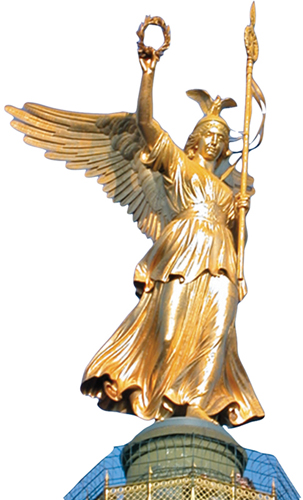
In
the middle of Tiergarten stands the 62-m (203-ft) high Victory Column,
erected to commemorate Prussian victory against Denmark in the war of
1864. After victory over Austria in 1866 and France 1871, the structure
was crowned by a 35-ton gilded statue of the goddess Victoria. There are
excellent views from the viewing platform .Großer Stern
Closed for renovation until 2011
Admission charge

Statue on Siegessäule
Diplomatenviertel
In
the late 19th century, an embassy district sprang up. Its extent is
still marked today by two pompous Fascist buildings (Italian and
Japanese embassies of 1938 and 1943 respectively). Most structures were
destroyed during World War II, and until the reunification of Germany
the diplomatic buildings were left to decay. Since 1999, new life has
been breathed into the diplomats’ quarter and, thanks to its adventurous
architecture, it has been transformed into one of the most interesting
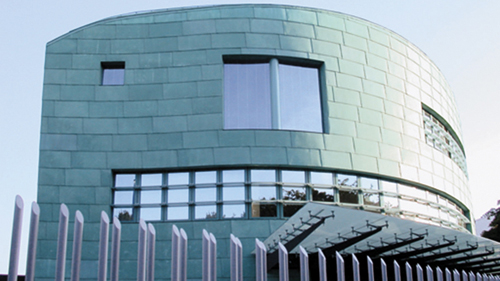
parts of Berlin. Especially worth seeing are the Austrian and Indian
embassies on Tiergartenstraße as well as, on Klingelhöferstraße, the
embassies of the Nordic countries and of Mexico.

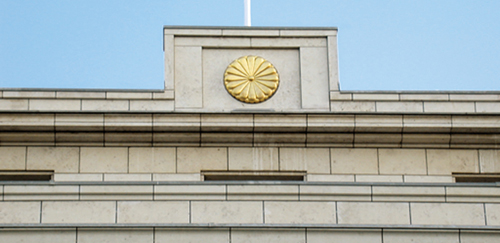
Roof of the Japanese Embassy

The Austrian Embassy
Hamburger Bahnhof
The
former Hamburg railway station, now the “Museum of the Present Day”,
holds a cross-section of contemporary paintings and the latest
multi-media works of art and installations. One of the highlights is the
private collection of Erich Marx, including works by Beuys and others.
Apart from well-known artists such as Andy Warhol, Jeff Koons and Robert
Rauschenberg, it also shows works by Anselm Kiefer and Sandro Chiao.Invalidenstr. 50–51
10am–6pm Tue–Fri, 11am–8pm Sat, 11am–6pm Sun
Admission charge
Sowjetisches Ehrenmal
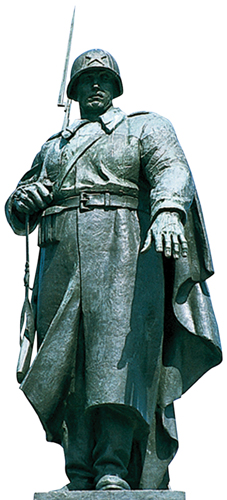
The
giant Soviet Memorial near Brandenburg Gate was officially opened on 7
November 1945, the anniversary of the Russian October Revolution. It is
flanked by two tanks, supposedly the first ones to reach Berlin. The
memorial commemorates 300,000 Red Army soldiers who died during World
War II in the struggle to liberate Berlin. The large column was
constructed from marble blocks from Hitler’s Reich Chancellery, which
had just been torn down. The column itself, designed by Nicolai
Sergijevski, is crowned by the huge bronze statue by Lev Kerbel. Behind
the memorial, 2,500 Russian soldiers are buried.Straße des 17. Juni

Sowjetisches Ehrenmal
Gedenkstätte Deutscher Widerstand
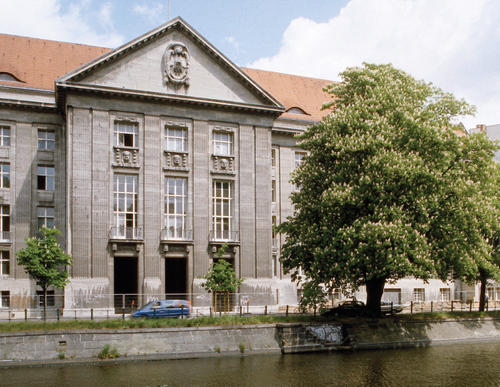
The
1930s complex, which is today known as Bendlerblock, lies behind the
former Prussian Ministry of War. During World War II it served as army
headquarters. It was here that a group of officers planned the
assassination of Adolf Hitler. When the attempt failed on 20 July 1944,
Claus Schenk Count von Stauffenberg and the others involved were
arrested in the Bendlerblock, and many of them were shot in the
courtyard during the night. A memorial, created by Richard Scheibe in
1953, commemorates these events. On the upper floor is a small
exhibition documenting the German resistance against the Nazi regime.
Today, the Bendlerblock has been incorporated into the Berlin branch of
the Federal Ministry of Defence.Stauffenbergstr. 13–14
9am–6pm Mon–Wed, Fri, 9am–8pm Thu, 10am–6pm Sat, Sun
030 26 99 50 00

Main entrance Bendlerblock
Hansa-Viertel
The
Hansa estate west of Schloss Bellveue was built for the “Interbau”
trade fair in 1957. World War II bombs had flattened Tiergarten, and 36
residential complexes were erected in the park, designed by
distinguished architects from around the world, including Walter Gropius
(Händelallee 3–9), Alvar Aalto (Klopstockstr. 30–32) and Oscar Niemeyer
(Altonaer Str. 4–14).Tiergarten, Hanseatenweg
Villa von der Heydt
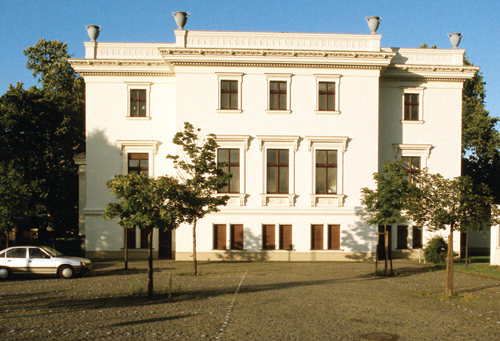
The
late-Neo-Classical Villa von der Heydt is one of the few surviving
examples of the architectural villa style typical of Tiergarten. It was
built in 1860–61, according to plans by Hermann Ende and G.A. Linke, for
one of the most elegant residential areas in Berlin at the time. Since
1980, the Prussian Heritage Foundation has had its headquarters here.Von-der-Heydt-Str. 18

Villa von der Heydt