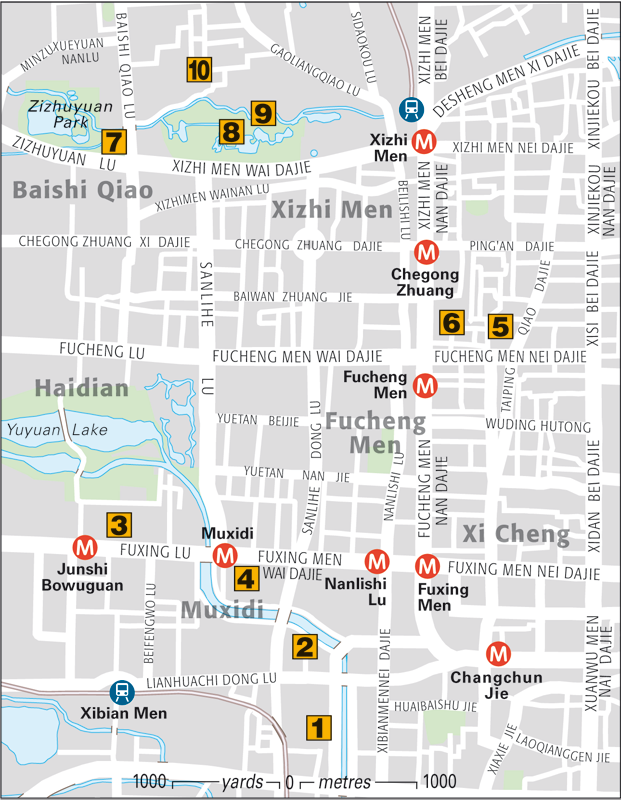
Xicheng, which in Chinese
means “West City”, is the central district west of the Forbidden City
and the lakes. Beijingers think of this area mostly as a seat of money
and learning – both the Financial District and the Haidian University
are located here. Western Beijing is best experienced as a series of
half-day expeditions: a visit to the Military Museum with a look at the
Millennium Monument afterwards and a walk through Yuyuan Tan Park, or a
trip to the zoo and aquarium followed by the Temple of the Five Pagodas.
Expect to make liberal use of taxis and the subway.
Top 10 Sights
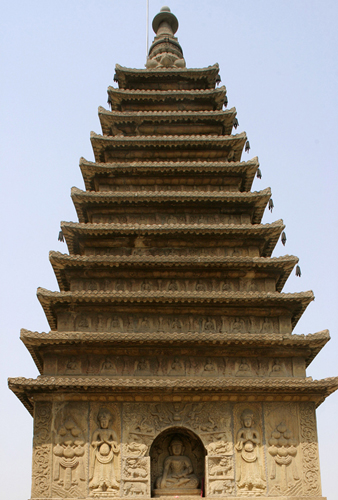
Temple of Heavenly Tranquility
Home
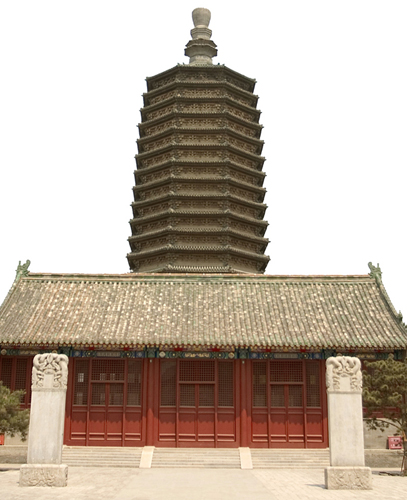
to Beijing’s most striking pagoda, the temple (Tianning Si) was built
during the 5th century AD, making it one of the city’s oldest. The
196-ft (60-m) octagonal pagoda was added in the early 12th century. The
bottom of the pagoda is in the form of a huge pedestal decorated with
carved arch patterns, symbolizing Sumeru, the mountain of the gods.
Above are thirteen levels of eaves, very close together, with no doors
or windows – the pagoda is with-out stairs inside or outside and is, in
fact, solid.

Temple of Heavenly Tranquility
Guanng’an Men Nanbinhe Lu
Subway: Nanlishi Lu, then taxi
White Cloud Temple
The
first temple on this site was founded in AD 739 and burnt down in 1166.
Since that time, it has been repeatedly destroyed and rebuilt. It even
survived being used as a factory during the Cultural Revolution. The
shrines, pavilions, and courtyards that make up the compound today date
mainly from the Ming and Qing dynasties. Monks here are followers of
Daoism and sport distinctive top-knots. Each Chinese New Year this is
the venue for one of the city’s most popular temple fairs, with
performers, artisans, and traders.

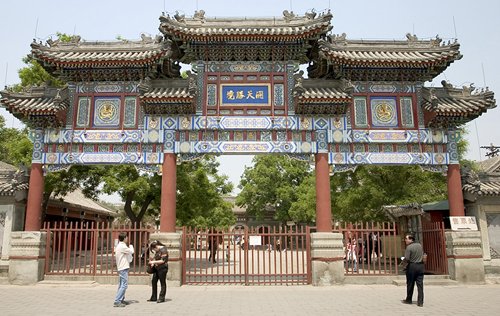
Gateway at the White Cloud Temple
6 Baiyun Guan Jie, off Lianhuachi Dong Lu
6340 4812
Subway: Nanlishi Lu
Open 8:30am–4:30pm daily (Oct 8–Apr: to 4pm)
¥10
Military Museum of the Chinese People’s Revolution
Vast
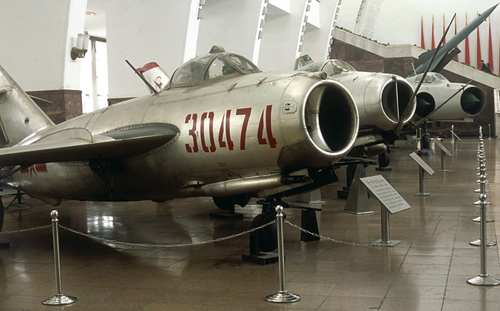
halls of Cold War-era hardware, including lots of silvery fighter
planes and tanks, fill the ground floor. Upstairs has exhibitions on
historic conflicts, including the Opium Wars and Boxer Rebellion.
Unfortunately, there is little labeling in English. What is not
mentioned is that the museum is close to the Muxidi intersection, scene
of a massacre of civilians by the Chinese army during the 1989 democracy
protests.9 Fuxing Lu
6686 6244
Subway: Junshi Bowuguan
Open 8am–5pm daily
¥20 (ID required)

Military Museum of the Chinese People’s Revolution
Capital Museum
The
Capital Museum celebrates China’s civilization in general and Beijing’s
history in particular. The five-story building is easily recognizable
thanks to its huge bronze cylinder. Exhibits include examples of
porcelain art and calligraphy, Buddha statues, furniture, and crafts.
Entrance is free, so the museum is a popular destination.9 Yuyuan Tan Nan Lu
6337 0491
Subway: Muxidi
Open 9am–5pm Tue–Sun
Miaoying Temple White Dagoba (Bantaisi)
Celebrated for its Tibetan-styled, 167-ft (51-m) white dagoba
(stupa), said to have been designed by a Nepalese architect, the temple
dates to 1271, when Beijing was under Mongol rule. The temple is also
noted for its fascinating collection of thousands of Tibetan Buddhist
statues.171 Fucheng Men Nei Dajie
6616 0211
Subway: Fucheng Men
Open 9am–4:30pm daily
¥20
Lu Xun Museum
Lu
Xun is regarded as the father of modern Chinese literature, responsible
for ground-breaking works such as “Diary of a Madman” and “The True
Story of Ah Q”. This is the house in which he lived from 1924 to 1926.
The rooms display artifacts relating to his life and there’s also an
adjacent exhibition hall with more than 10,000 letters, journals,
photographs, and other personal objects.National Library of China
One
of the five biggest libraries in the world, the National Library of
China was recently expanded to accommodate its collection of
approximately 12 million books. The building’s floating roof houses the
Digital Library. Most books are reference only, but visitors can request
a reader’s pass.33 Zhongguancun Nandajie
8854 5426
Open 9am–9pm Mon–Fri, 9am–5pm Sat, Sun (except pub hols)
Beijing Zoo
Visit
for the pandas, the rare bears that are native to China and nowhere
else. The zoo has several, housed in a new “panda house.” However, most
of the other 2,000 animals here are not so lucky; their cages are tiny.137 Xizhi Men Wai Dajie
6831 4411
Subway: Xizhi Men
Open 7:30am–6pm daily
¥20
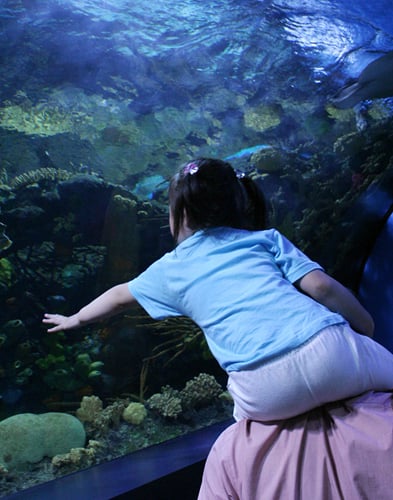
Beijing Aquarium
Located
in the northeastern corner of the zoo is this conch shell-shaped
building. It’s reputedly the largest inland aquarium in the world, with
massive tanks containing thousands of weird and wonderful fish, plus a
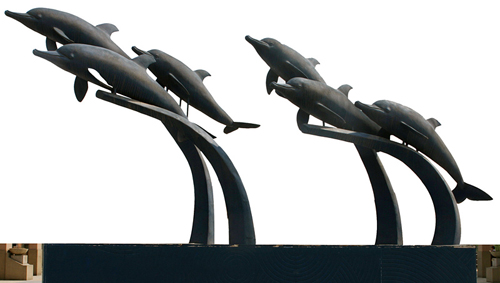
shark tank, coral reefs and an “Amazon rainforest.” There are also
several dolphin and seal shows held daily at 11am and 3pm.108 Gao Liang Qiao Xijie
6217 6655
Open 9am–5pm daily
¥100 adults, ¥50 children

Beijing Aquarium

Beijing Aquarium
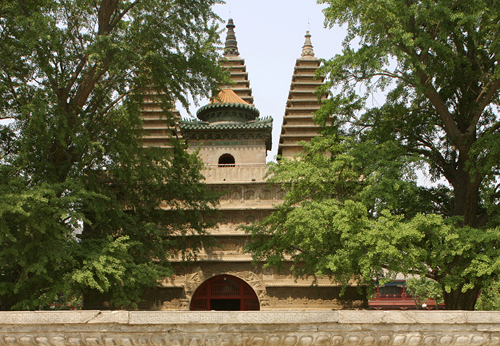
Temple of the Five Pagodas
Just
north of the zoo, this temple displays obvious Indian influences. It
was built in the early 15th century in honor of an Indian monk who came
to China and presented the emperor with five golden Buddhas. The pagodas
sport elaborate carvings of curvaceous females, as well as the
customary Buddhas. Also here is the Beijing Art Museum of Stone
Carvings, with 2,000 decorative stelae.24 Wuta Si Cun
6217 3836
Subway: Xizhi Men
Open 8:30am–4:30pm daily
¥15

Temple of the Five Pagodas

Temple of the Five Pagodas
War and peace
Morning
Even if you’re no big fan of mechanized heavy armor, the Military Museum of the Chinese People’s Revolution
is a fascinating place. Exhibits begin with the technology that made
China one of the world’s first military superpowers, including the
“Flying Dragon,” an early form of missile launcher. There’s one room
devoted to the wonderfully tacky gifts that have been bestowed on
China’s army chiefs and leaders, such as a pistol presented to Chairman
Mao by Fidel Castro. Mao’s limousine is displayed on the ground floor
and there’s one hall devoted to statues and assorted representations of
the Communist Party’s great and good. It all makes for a fascinating
insight into the mentality of late 20th-century China.
Afternoon
Leaving the museum, walk west along Fuxing Lu and take the first right.You will see the
Millennium Monument and, behind it, Yuyuan Tan Park,
with a large lake at its center. The vast park is a relaxing place for a
stroll. Afterwards, for some refreshments, walk east to the pleasant
Hong Hao Ge Teahouse
before continuing on Fuxing Men Wai Dajie toward Muxidi and the Capital Museum.
Audio self-guided tours in Chinese and English are available at the
entrance. Don’t miss the Peking Opera exhibition on the top floor, or
the short film on Beijing’s urban development, screened in the
auditorium on the ground floor.