Fremont declared itself an
“artists’ republic” in the 1960s, when a community of students, artists,
and bohemians moved in, attracted by low rents. The name crystallizes
the unflagging spirit of independence, eccentricity, and most of all,
nonconformity. In retrospect, what may have begun as an idealistic
artists’ enclave was more accurately an early sign of fast advancing
gentrification. The scenic Lake Washington Ship Canal and part of Lake
Union create its southern border, and passing boats of all sizes
continually refresh the view. The drawbridge on busy Fremont Avenue
rises and falls deliriously umpteen times a day, snarling traffic that
backs up the hill for blocks. The quaint neighborhood spawns new
boutiques, clubs, and restaurants that keep changing the face and
identity of this town. As Seattle grows and its population overflows,
more and more professionals seek homes in Fremont, only minutes away
from downtown by car or bus.
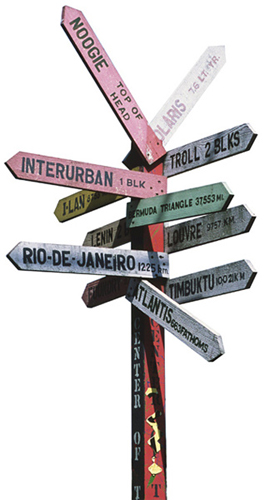
Center of the Universe signpost
|
|
|
NOTE
Sights
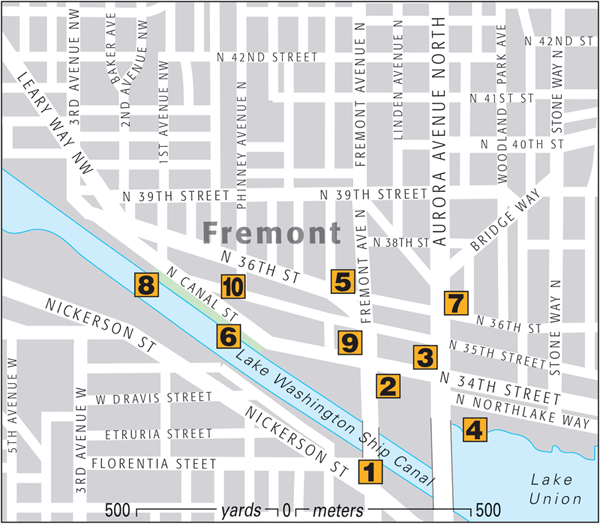
Fremont Bridge
The
lowest of four bridges spanning the Lake Washington Ship Canal, this
connects Fremont to residential Queen Anne and two main arterials to
downtown. Because of the bridge’s low clearance, it faces frequent
openings from sailboat, motor yacht, or industrial vessels. Neon art
adorns a portion of the span, in the form of a golden-haired Rapunzel
and her locks cascading down from the bridgeman’s tower.3020 Westlake Ave N
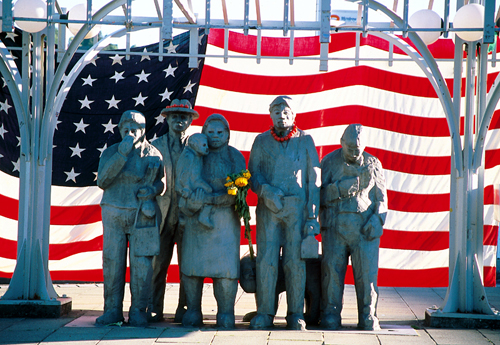
Waiting for the Interurban
Frozen
in time, Richard Beyer’s celebrated 1979 cast aluminum sculpture – five
human forms and a dog with a human face – preside at Fremont’s busiest
intersection where a community trolley once stopped. Legend has it that
the dog’s likeness belongs to Arman Napoleon Stepanian, an activist-hero
who sparked the recycling movement 30 years ago. The work pokes fun at
modern humanity’s ennui. It also represents one of Seattle’s earliest
public art installations.N 34th St, Fremont Ave N

People Waiting for the Interurban
History House
Seattle’s
colorful past is on view at History House where historians interpret
and preserve the heritage of the city’s distinct neighborhoods. Exhibits
in the main gallery complement a three-sided, sepiatone wall mural that
depicts 100 years of Seattle history, encompassing the arts,
technology, and industry. Peruse rotating displays of various Seattle
neighborhoods. Other features include a sculpture garden and a gift
shop.790 N 34th St
206 675 8875
Adm $1 as donation
Fremont Ferry
A
boater’s dream, the small passenger-only steamer plies the waters of
Lake Union from its north shore in Fremont to the grounds along the
southern shore near downtown during the July Wooden Boat Festival. A
labor of love for captain, Larry Kezner, the ferry is strictly for
sightseeing cruises along Seattle’s Ship Canal and adjacent lakes.206 713 8446
seattleferrysvc@cs.com for private charters or schedule information
Lenin Statue
Slovakian
sculptor Emil Venkov found little interest in his 7 ton (6,350-kg),
25-ft (8-m) likeness of Russian revolutionary V.I. Lenin after the
collapse of the Soviet Union. A visiting American, Lewis Carpenter, paid
$13,000 for the work and had it shipped through the Panama Canal to his
hometown near Seattle. After Carpenter died in 1994, Fremont artist and
foundry owner Peter Bevis managed to have the bronze Lenin statue
installed in the neighborhood. The incongruity of a Communist icon
amidst flourishing shops and capitalist businesses is not lost on
anyone. The statue remains a striking symbol that strives to put art
before politics.Dinosaur Topiaries
Two ivy-covered dinosaur topiaries, which had formerly decorated the lawn near the Pacific Science Center
at Seattle Center, now grace Fremont’s narrow Ship Canal Park. To save
them from extinction, History House and a group of Fremont artists
purchased these in 1999 for $1. The mother, 66-ft (20-m) long, and young
apatosauri are now sanctioned by the city and fully integrated into the
crazy quilt of what is virtually a neighborhood-wide sculpture garden.Intersection of Phinney Ave & 34th
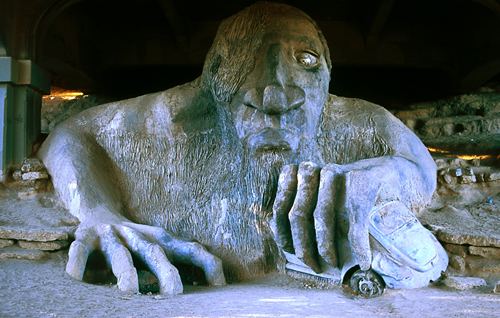
Fremont Troll
An
icon of Fremont’s free spirit is a 15-ft (4.5-m) tall Volkswagen-eating
troll created by Steve Badanes, Will Martin, Donna Walter, and Ross
Whitehead, after winning a national competition sponsored by the Fremont Arts Council,
that in 1989 decided that public art was the best use for a dark space
beneath a highway bridge. Though ugly, the troll’s location under the
north end of Aurora Bridge means that it remains on the route of almost
every visitor who walks or takes a tour bus.Intersection of Aurora Ave (Hwy 99) & N 36th St

Fremont Troll
Ship Canal Park
A lovely landscaped strip not much wider than a stretch of the Burke-Gilman Trail
attracts tourists all year round. Today, the park creates viewpoints
along the Canal and several places to sit, play chess, picnic, and watch
the world go by. Pedestrians don’t need to dodge speeding bicycles,
however, since there is a separate gravel path for bi-peds.Phinney Ave & 2nd Ave NW
Sunday Street Market
Rain
or shine, the Fremont Sunday Market has withstood the test of time,
real estate development, and even lawsuits from neighboring businesses.
Begun in 1990 to foster a pedestrian-friendly community and provide an
outlet for artists and independent vendors to sell whatever they had to
offer, the market hosts up to 200 booths of crafts, imported goods,
furniture, food, and knick-knacks that defy description.34th St
206 781 6776
Every Sunday
Open 10am–5pm
Outdoor Cinema
The trompe d’oeuil
screen and curtains on a factory wall attract hundreds of attendees for
campy feature films. It grew from a sparsely attended free affair to a
popular summer weekend event that charges admission. Part old-fashioned
American drive-in, part Fremont irreverence, people bring their own
chairs or sofas and occasionally compete in film-related games between
reels. The shows begin after sundown, but audiences begin arriving for
the best seats by mid-afternoon.Saturday:
35th & Phinney Ave
N 34th & Stoneway
206 781 4230
$5 donation