Some of New York’s finest architecture is found at
its Civic Center, the headquarters for city government. Buildings here
span the centuries, from the 18th-century St. Paul’s Chapel to the
pioneering 20th-century Woolworth Building. Nearby is the famous
Brooklyn Bridge, and the old maritime center of the city, South Street
Seaport, its piers and buildings now restored as a lively hub of cafés,
restaurants, and museums.
Sights
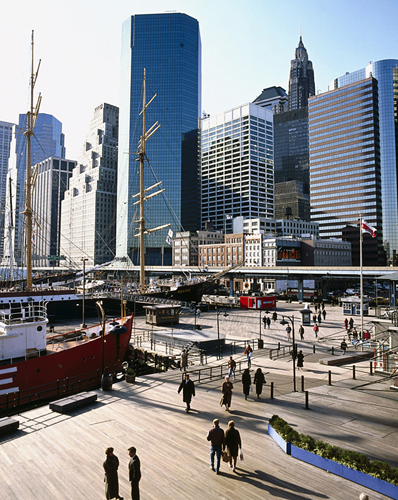
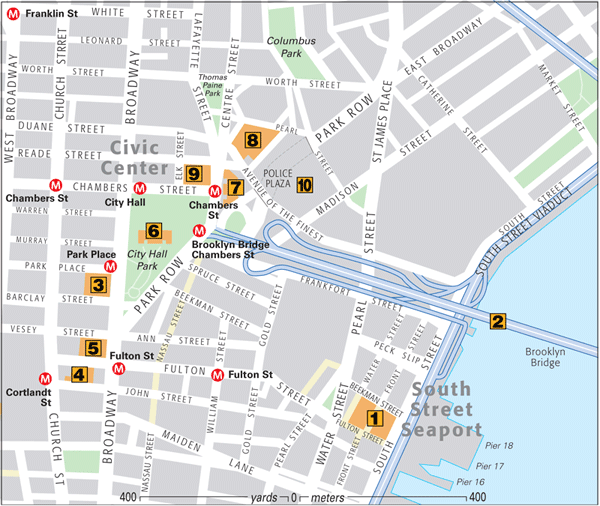
South Street Seaport
The
cobbled streets, buildings, and piers that were the center of New
York’s 19th-century seafaring activity (known as “the street of sails”)
have been restored as a tourist center. There are shops, food stalls,
restaurants, a museum with many seafaring exhibits, a fleet of tall
ships for boarding, and plenty of outdoor entertainment.Museum open Jan–Mar: 10am–5pm Fri–Sun; Apr–Dec: 10am–6pm Tue–Sun

South Street Seaport
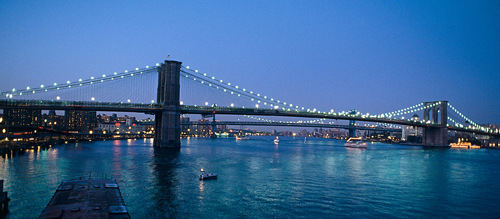
Brooklyn Bridge
When
it was completed in 1883 linking Manhattan and Brooklyn, this was the
largest suspension bridge in the world and the first to be built of
steel. It took 600 workmen and 16 years to build, and claimed 20 lives,
including that of the designing engineer, John A. Roebling. Now a symbol
of New York, those who walk the 1-mile (1.8-km) span are rewarded with
fabulous views of city towers seen through the artistic cablework.(Manhattan side) Park Row near Municipal Building
Free

Brooklyn Bridge
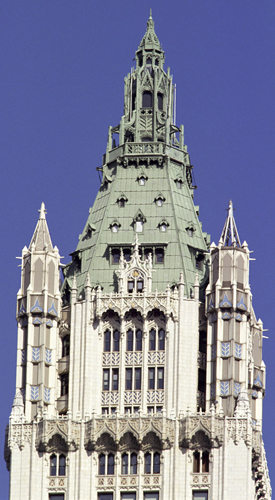
Woolworth Building
Built
in 1913, this has one of New York’s great interiors; marble walls,
bronze filigree, a mosaic ceiling, and stained glass combine to magical
effect. Architect Cass Gilbert also had a sense of humor – sculptures
include Five and Dime mogul Woolworth counting nickels and Gilbert
himself cradling a model of the building. It set the standard for the
skyscrapers that followed in the 1920s and 1930s.

Woolworth Building
Former AT&T Building
Built
in 1922, this is a monument to excess but fun to see nevertheless. In
its day, the façade was said to have more columns than any other
building in the world; the vast lobby is a forest of marble pillars.
Close by at 120 Broadway, the former Equitable Building, built in 1915,
is of note for another excess: its immense bulk was responsible for the
nation’s first skyscraper zoning regulations.195 Broadway
Open office hours
Free
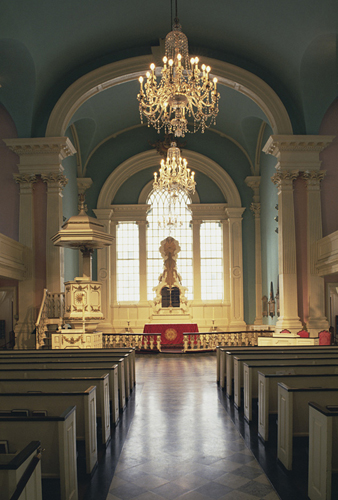
St. Paul’s Chapel
Manhattan’s
oldest church was built in 1766 as an “uptown” chapel for Trinity
Church and took on added importance while Trinity was being rebuilt
after the great fire of 1776. The chapel was modeled after London’s St.
Martin-in-the-Fields. One block from Ground Zero, the church has an
interactive 9/11 exhibit.Episcopal service 8am, 10am Sun, 12:30pm Wed
Concerts 1pm Mon
$2 donation

Interior, St. Paul’s Chapel
City Hall
The
seat of city government since 1812, City Hall is considered one of the
most beautiful early 19th-century public buildings in the U.S. The
design, by architects Mangin and McComb, Jr., won a competition held in
1802. A statue of Justice crowns the structure. The rear of the
building, facing north, was not clad in marble until 1954, since the
architects never expected the city to develop further north.Broadway and Park Row
Open for pre-arranged tours only
call 212 788 2656
Free

City Hall
Municipal Building
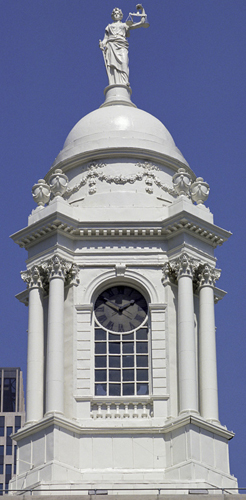
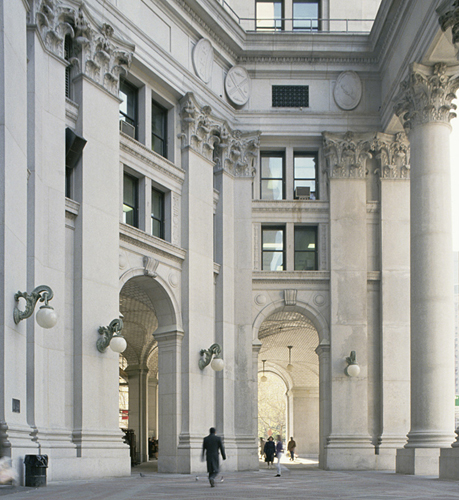
This
building dominating the Civic Center area, straddling Chambers Street,
was the first “skyscraper” by McKim, Mead, and White, a 25-story
structure completed in 1914. The top is a veritable wedding-cake fantasy
of towers and spires topped by Adulph Wienman’s famous statue, Civic
Fame. The intricate terracotta vaulting above the street is modeled on
the entrance of the Palazzo Farnese in Rome, and the subway entrance at
the south end, an arcaded plaza, is a dramatic vault of Guastavino
tiles.1 Center St at Chambers St

Municipal Building
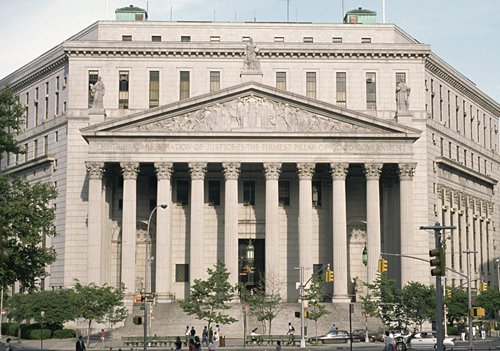
New York County Courthouse
Ascend
the wide staircase of the 1926 New York County Courthouse (adjacent to
the 31-story, pyramid-topped U.S. Courthouse dating from 1933) and enter
to admire the marble columned rotunda with Tiffany lighting fixtures.
Note, too, the ceiling murals depicting Law and Justice. The hexagonal
building has a courtroom in each of its six wings.60 Center St
Open 9am–5pm Mon–Fri
Free

New York County Courthouse
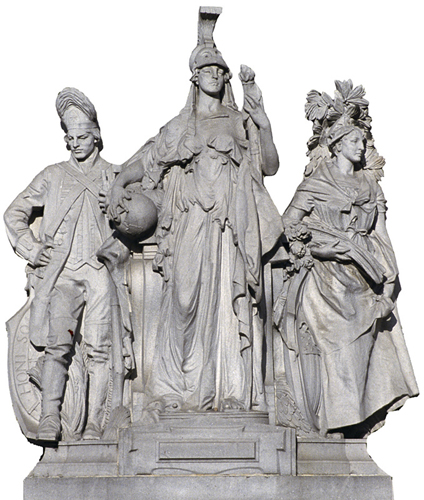
Surrogate’s Court/Hall of Records
With
an interior inspired by the Paris Opéra, this 1907 Beaux Arts beauty
boasts a magnificent central hall with marble stairways and ceiling
mosaics. The façade features statues representing justice, the seasons,
commerce, and notable New Yorkers, as well as figures depicting the
various stages of life.31 Chambers St
Lobby open 9am–5pm Mon–Fri
Free

Surrogate’s Court
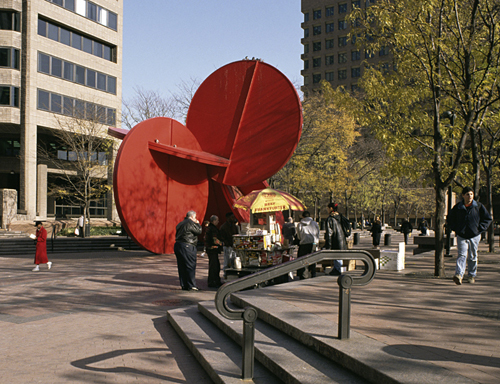
Police Plaza
Constructed
in 1973, the city’s police headquarters can be found on a spacious
pedestrian plaza, a welcome area in a district with very few public
spaces. The Tony Rosenthal abstract sculpture, Five in One, made of five
sloping interlocked discs, symbolizes the city’s five boroughs.Park Row at Pearl St

Police Plaza