Bustling with the business of government, Capitol
Hill is also a destination for shopping, entertainment, food and drink,
or simply strolling its handsome neighborhood streets. Approached from
the west, the area begins with the meticulously landscaped US Capitol
complex, which, in addition to the Capitol itself and its giant staff
office buildings, includes the splendidly renovated US Botanic Garden,
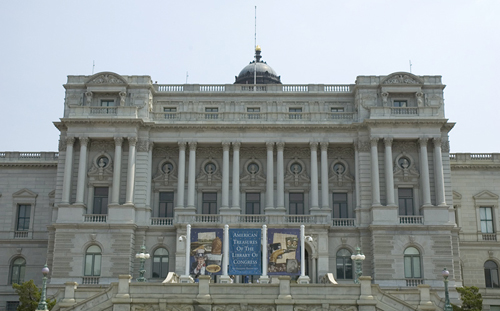
the stately Supreme Court Building, and the three buildings of the
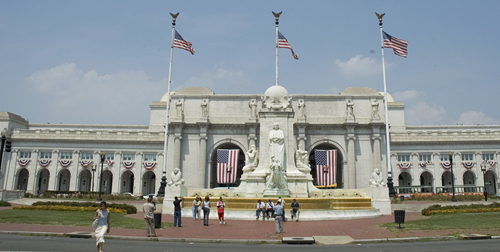
Library of Congress. Union Station, to the north, is filled with diverse
shops and restaurants and is one of the finest railroad terminals in
the world. Farther to the east, beyond the Capitol, lies the residential
area, containing streetfuls of pleasing East Coast domestic
architecture. Eastern Market
on 7th St, SE, serves as a community center, and a pleasant walk
farther to the east leads to Lincoln Park, with its outstanding memorial
statues, beginning at 11th St.
Sights
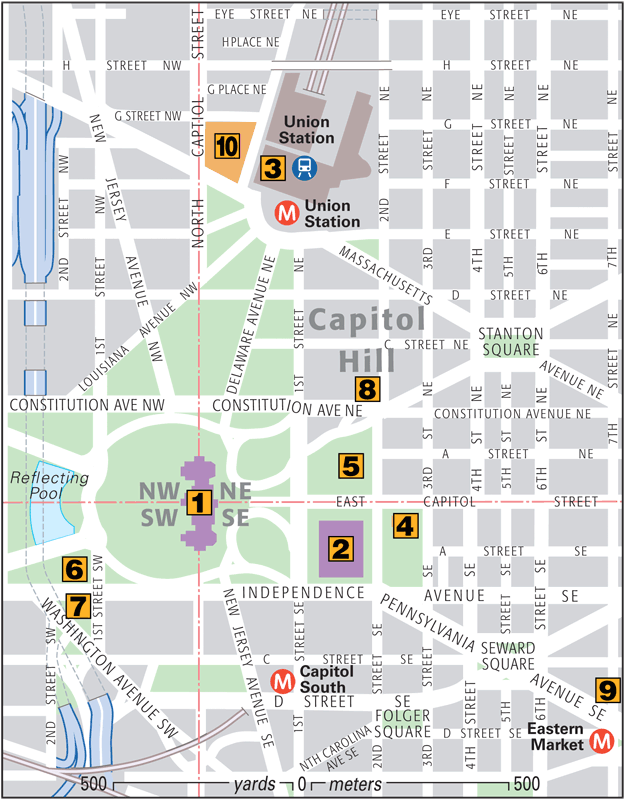
Union Station
Opened
in 1907, this magnificent Beaux Arts building is still a fully
functional transportation hub. The lofty barrel-vaulted concourse,
decorated with 70 lbs (32 kg) of gleaming gold leaf, is one of the great
public spaces in the city – the Washington Monument, laid on its side,
would easily fit within its length. Over 23 million people pass through
the station each year. A $160 million restoration, completed in 1988,
made the terminal an important retail and entertainment center, with
over 130 shops, numerous restaurants, and a 9-screen cinema, as well as
expanding its transportation role.50 Massachusetts Ave, NE
Dis. access

Union Station
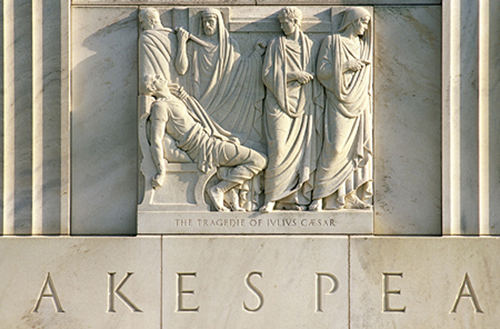
Folger Shakespeare Library and Theater
The
Folger has the world’s largest library of printed editions of
Shakespeare’s works, and fascinating displays give viewers an insight
into Shakespeare and his times. There is also a huge supporting
collection of Renaissance works in other fields, as well as playbills,
musical instruments, and costumes. The elegant Neo-Classical building, a
1929 design by Paul Philippe Cret, is on the National Register of
Historic Places .201 East Capitol St, SE
Open 10am– 4pm Mon–Sat
Dis. access
Free

Folger Shakespeare Library and Theater
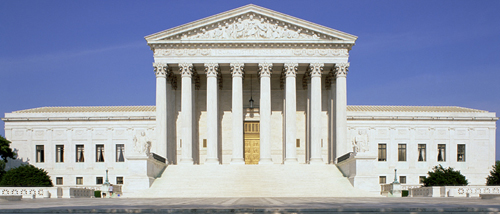
Supreme Court Building
The
home of the highest seat of the judicial branch of the US government is
a solid and handsome Neo-Classical building designed by Cass Gilbert –
the architect of the beautiful Woolworth Building in New York City – and
completed in 1935. On its west pediment, above the marble columns of
the main entrance, is inscribed in bold letters the famous motto “Equal
Justice Under Law”.

Supreme Court Building
US Botanic Garden
Long
valued by Capitol Hill residents as a quiet retreat, the Botanic Garden
conservatory is better than ever after its recent four-year
restoration. The 4,000 living plants here are arranged into themes and
biosystems, such as Plant Exploration, Jungle, Oasis, Medicinal Plants,
and many others. The wedge-shaped National Garden, adjacent to the west,
includes glorious outdoor displays in a water garden, a rose garden,
and a showcase garden .Bartholdi Park and Fountain
Another
oasis for Capitol Hill visitors, this immaculate park is bursting with
flowers and ornamental plants. Its symmetrical design radiates out from
the fine Gilded Age cast-iron Bartholdi Fountain, a three-story high construction of supple human forms, European-style lights, and a non-stop flow of water.Independence Ave at Canal St, SW
Dis. access
Free
Sewall-Belmont House
Built
in 1750 and expanded into its current mansion size in 1800, this house
is one of the most historic in Washington. It is thought that one past
resident, Albert Gallatin, Treasury Secretary for Jefferson and Monroe,
may have worked out the financial details of the Louisiana Purchase –
which nearly doubled the size of the United States – here. The house was
the only private residence burned during the War of 1812 because only
from here did Americans fire on the invading British .
The completely rebuilt home was bought by the National Women’s Party in
1929 and remains their home today. Visitors can see the elaborate but
homey period furnishings of the house’s past, as well as the museum’s
fascinating collection of objects and documents fundamental to the
suffragist and feminist movements in the United States, and the oldest
feminist library in the US .144 Constitution Ave, NE
Open 11am–3pm Tue–Fri, noon–4pm Sat
Donation

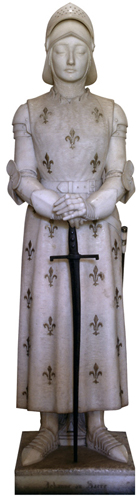
Statue, Sewall-Belmont House

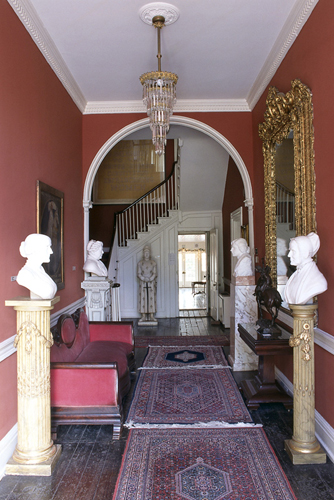
Hallway, Sewall-Belmont House
Eastern Market
Completed in 1873, Eastern Market
has been a key element in Capitol Hill’s history. Designed by a
prominent local architect, Adolph Cluss, the market symbolized the
urbanization of the city at the end of the Civil War. Since then, it has
served as a meeting place for residents, and recently as a focal point
in the revitalization of the area. It has been repeatedly threatened
with closure, and suffered a fire in 2007, but continues to operate.National Postal Museum
The
US Postal Service delivers over 600 million items of mail every day,
and this ingenious museum manages to communicate the human scale of the
system. The vast airmail system, with its thousands of employees, is
shown to be based on individual pilots and airplanes. An interactive
display enables visitors to dive into direct marketing and mail order,
even designing their own advertising piece .2 Massachusetts Ave, NE
Open 10am–5:30pm daily
Dis. access
Free