Toronto is a city of neighborhoods, each with a
distinct identity, many with an ethnic flavor, making it the most
multicultural of North American cities. In Chinatown, wares from
energetic vendors compete with shoppers for sidewalk space, and
restaurants offer everything from take-out buns to sit-down banquets.
The city’s multicultural mix finds its fullest expression in Kensington
Market, where Jamaican patty shops rub shoulders with Portuguese fish
vendors and Latin American empanada stalls. Farther west is the Italian
enclave of Little Italy, centered along College Street. Along with this
heady ethnic mix, the downtown core is home to the upscale shopping area
Yorkville and many fine cultural institutions, such as the Royal
Ontario Museum and the Art Gallery of Ontario.
Sights
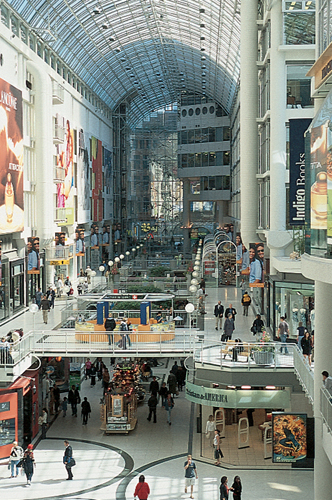
Eaton Centre
While
it might seem strange that a shopping center is the city’s most popular
tourist attraction – according to the numbers, at any rate – this
retail complex is simply a popular place to shop, meet, hang out, and
people-watch. (Crowds of boisterous teenagers attest to this fact.) Its
massive size – more than 300 stores – ensures that you can find
practically anything you would want to buy here. Numerous restaurants,
fast-food counters, and specialty treat shops round out the bill .

Atrium, Eaton Centre
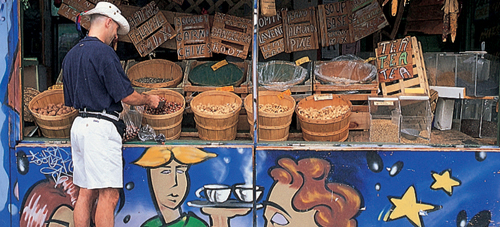
Kensington Market
This
funky neighborhood, in a small pocket west of Spadina, is the heart of
multicultural Toronto – a place where vendors from almost every corner
of the globe have set up shop. Spilling out into the narrow sidewalks
are stores selling an array of fruits, vegetables, and bulk dry goods,
while music blasts from open doors and loudspeakers. Pedestrians jostle
with cyclists and traffic moves at a snail’s pace, everyone vying for
their inch of street space, particularly on Saturdays when the area is
at its liveliest best. Leave the car behind and wander through the
streets, soaking up the atmosphere, perhaps checking out the price of
live lobster at a fish vendor’s or browsing through trinkets and
secondhand clothes in the many eclectic stores at the south end of
Kensington Avenue .

Kensington Market
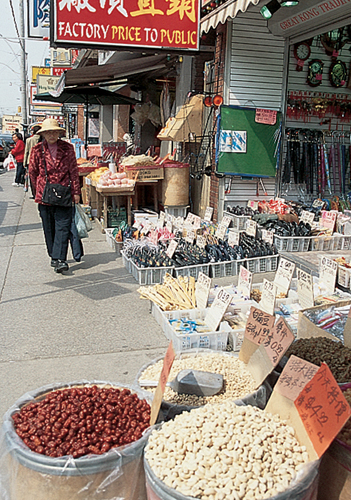
Chinatown
A
steady flow of new Chinese immigrants keeps Toronto’s main Chinatown
one of the most vibrant in North America. Hundreds of authentic
restaurants cater to all tastes and budgets, and there are countless
shops selling Oriental wares. In recent years, Spadina Avenue has
expanded to include many Vietnamese shops and restaurants .

Chinatown
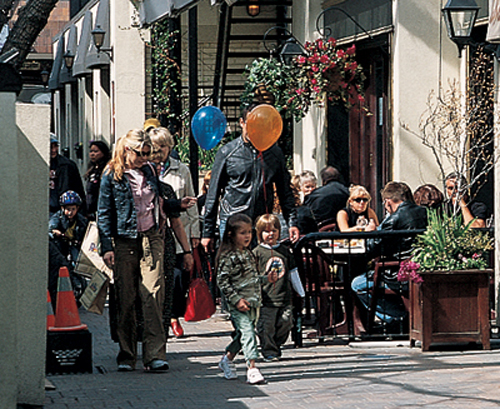
Yorkville
In
the 1960s, it was ground zero for hippies and the youth culture; today,
this neighborhood is ground zero for establishment culture and the
city’s most upscale shopping. Expensive shops on Cumberland St and
Yorkville Ave, between Bay St and Avenue Rd, sell luxury goods such as
cosmetics, jewelry, designer fashions, antiques, and leather luggage.
The area’s numerous restaurants and bars cater to equally refined
palates and wallets. There are also more than 20 fine-art galleries in
the area, exhibiting some of the country’s top names. Sidewalk cafés
provide stylish perches for people-watching .

Yorkville
Styled
like a medieval castle, this grand mansion is a monument to the
singular tastes and vision of Sir Henry Pellatt, a prominent financier
who in 1911 commissioned renowned architect E. J. Lennox to build him a
home. This immense architectural undertaking was on a scale never before
seen in a private Canadian residence, with plans for 98 rooms, 12
baths, 5,000 electric lights, and an elevator. Its $3.5 million cost
helped bankrupt Sir Henry less than 10 years after he and his wife moved
in, but its opulence remains evident in the extravagant, restored rooms
and furnishings.Bata Shoe Museum
This
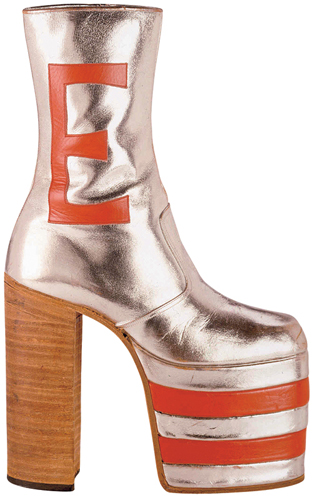
unusual, specialized museum celebrates footwear form and function
throughout the ages and around the world. The building’s playful design,
echoing a stylized shoebox, houses four galleries exhibiting everything
from Roman sandals to Elton John’s platform boots. The exhibit of
Chinese bound-foot shoes is not for the squeamish. Founded by Sonia
Bata, who has scoured the world for shoes of every description, the
museum also holds interesting themed exhibitions .327 Bloor St W
Open 10am–5pm Tue, Wed, Fri–Sat, 10am–8pm Thu, noon–5pm Sun (open Mon Jun–Aug)
Adm

Bata Shoe Museum
Campbell House
The
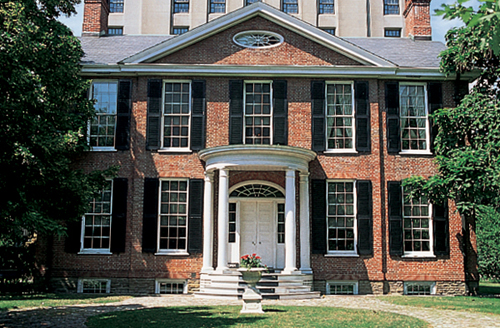
oldest remaining building from the town of York, which in 1834 became
Toronto, this Georgian mansion was built in 1822 for William Campbell,
an Upper Canada judge. In 1972, the 300-ton building was moved from its
original location on Adelaide St to its present location, restored, and
opened to the public. Guided tours are available.160 Queen St W
Open Victoria Day–Thanksgiving: 9:30am–4:30pm Mon–Fri, noon–4:30pm Sat–Sun; Thanksgiving–Victoria Day: 9:30am–4:30pm Mon–Fri
Adm

Campbell House
City Hall
When
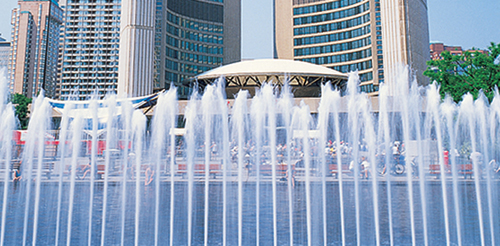
first opened in 1965, the result of an international design competition
won by Finnish architect Viljo Revell, this building was highly
controversial. The two curving towers caused an uproar and possibly even
led to the then mayor losing an election. The building has since become
a prized landmark of the city, and the central plaza, Nathan Phillips
Square, an animated symbol of civic life – a place for political
demonstrations, winter ice skating, a summer farmers’ market, outdoor
concerts, and celebrations. Inside are murals and other fabulous
artworks .

City Hall