Named after the ring of elevated train tracks that
encircle it, this is downtown Chicago’s core, and the city’s financial
and governmental hub. Abuzz with laptop-toting business folk during the
week, the Loop is transformed on weekends when a veritable shopping
frenzy erupts along its famous State Street. Those thirsty for culture
also come flocking to view the area’s many architecturally significant
buildings and notable public art. A recent infusion of corporate dollars
has given the Loop a real boost: the resulting restoration of old
theaters and the promotion of the theater district has lured in more
visitors, and the many great bars and restaurants that have sprung up
mean that the area now offers a burgeoning nightlife.
The Loop’s SculptureSetting a trend for |
|
Sights
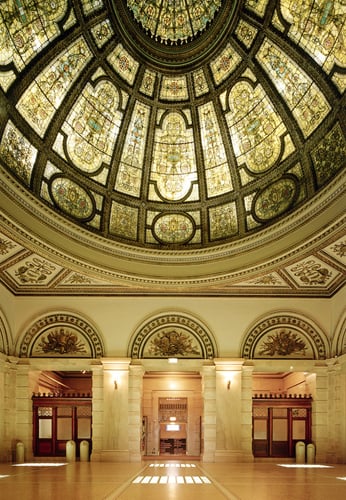
Chicago Cultural Center
Built
in 1897 as the city’s first main library, this magnificent Beaux Arts
building was described at the time as the “people’s palace.” In 1991,
the library moved out, allowing several galleries, performance spaces
and a visitor information center to move in. Guided tours offer a
historical overview of the building, which occupies an entire block and
features one of the world’s largest domes, designed by L. C. Tiffany,
and rooms modeled after the Doge’s Palace in Venice and the Acropolis in
Athens.78 E. Washington St.
312 744 6630
Open 8am–7pm Mon–Thu, 8am–6pm Fri, 9am–6pm Sat, 10am–6pm Sun
Tours 1:15pm Wed, Fri & Sat
Free
DA

Tiffany Dome, Chicago Cultural Center
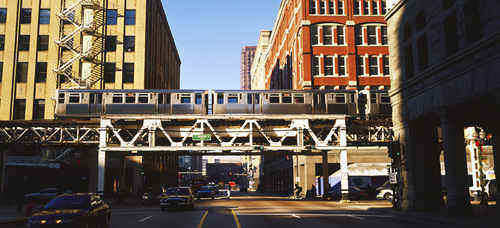
The El
Originally called the Union Loop, this system of elevated trains came about after the 1871 Great Chicago Fire
when the city was rebuilt with such unexpected success that, within 20
years, its streets could no longer handle the influx of people,
streetcars, and horses filling them. Today, three lines ring the
business district – the Orange, Purple, Pink, and Brown lines – with
three others connecting it to destinations farther afield .

Elevated train, The Loop
Harold Washington Library Center
Named after former city Mayor Harold Washington,
Chicago’s first Afro-American mayor
, this is the largest public library building in the country. Its
collections, which include a superlative Blues Archive and a vast
children’s library, fill an incredible 70 miles (110 km) of shelving.
Architects Hammond, Beeby, and Babka incorporated architectural elements
of several Chicago landmarks, such as The Rookery and The Art Institute in the building’s design: don’t miss the ninth-floor Winter Garden atrium, which soars two stories to a spectacular glass dome.400 S. State St.
Open 9am–7pm Mon–Thu, 9am–5pm Fri & Sat, 1–5pm Sun
Free
DA
Chicago Board of Trade
The
Chicago Board of Trade (CBOT) was founded in 1848 to create a central
marketplace in the fast-developing city, and moved to its current
45-story home in 1930. Designed by Holabird and Root, this landmark
building is a stunning example of Art Deco. Capping the majestic
limestone building is a huge statue of Ceres, the Roman goddess of grain
and harvest. A glittering 23-story glass-and-steel addition designed by
Helmut Jahn was completed in 1980.State Street
This
“great street” got its nickname from the 1922 hit song Chicago.
Although it didn’t always live up to this catchy moniker, it has won
back many fans since its multi-million-dollar face-lift in 1996. It now
sports replica Art Deco lampposts and subway entrances, and was listed
on the National Register of Historic Places in 1998. This dynamic
stretch has it all: shopping, history, education, architecture, theater,
and dining. The atmosphere is especially merry during the run up to
Christmas, when the Thanksgiving parade brings Santa to town, and
department stores like Macy’s fill their windows with elaborate and imaginative decorations.From Wacker Dr. to Congress Parkway
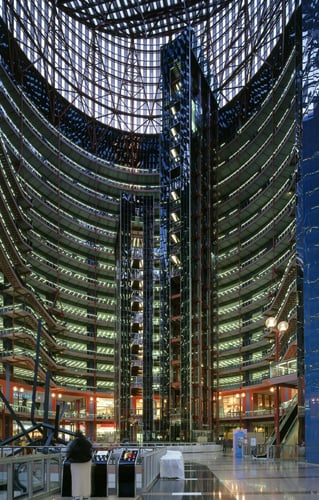
James R. Thompson Center
Also
known as the State of Illinois Center, this striking 17-story, steel
and granite structure shimmers with 24,600 curved glass panels. Helmut
Jahn designed the controversial 1985 building to be a democratic fusion
of government offices and public spaces, such as shops, restaurants, and
art galleries. The soaring skylit atrium is sliced by internal glass
elevator shafts and contains unusual, see-through escalators. Outside,
the plaza features the intriguing 1984 sculpture Monument with Standing Beast by Jean Dubuffet.100 W. Randolph St.
Atrium, shops, & food court open to public: 8:30am–6pm Mon–Fri
Free
DA

State of Illinois Center
The Rookery
This
11-story building, with its rusticated red granite base, was the
country’s largest office building and a precursor to modern skyscrapers
when it was completed in 1888 by Burnham and Root . Its stunning skylit lobby was redesigned in 1907 by Frank Lloyd Wright ,
who added a grand staircase and hanging light fixtures, both of which
carry his signature circle-in-square motif. The building’s unusual name
refers to the rooks that once roosted at the site.209 S. LaSalle St.
Open 9am–5pm Mon–Fri
Free
no DA
Millennium & Grant parks
The modern Millennium Park
is Chicago’s superb new adaptation of its “front yard”. The park is
home to a dynamic Frank Gehry-designed music pavilion and pedestrian
bridge, and a vast sculpture by British artist Anish Kapoor. It also
boasts lush gardens, restaurants, a winter ice rink, peristyle, and an
interactive fountain by Spanish artist Jaume Plensa. The adjoining Grant
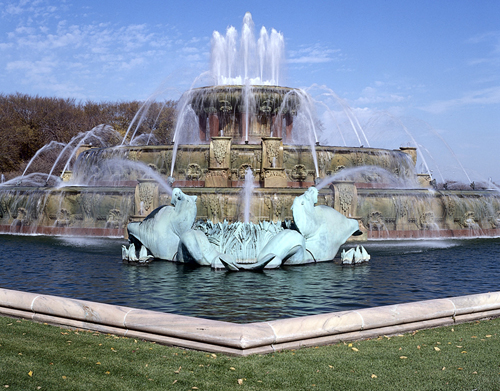
Park hosts many summer festivals including the Taste of Chicago. It is also home to Museum Campus , the Art Institute of Chicago, and the ornate 1927 Buckingham Fountain.Open daily
Free
DA

Buckingham Fountain, Grant Park