Caravaggio’s Deposition
Caravaggio strove to outdo Michelangelo’s Pietà
by making his Mary old and tired. Rather than a slender slip of a
Christ, Caravaggio’s muscular Jesus is so heavy (emphasized by a
diagonal composition) that Nicodemus struggles with his legs and John’s
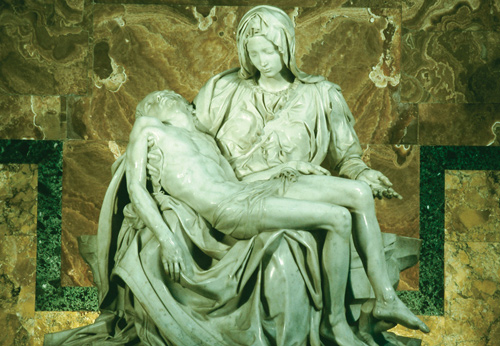
grasp opens Christ’s wound.Michelangelo’s Pietà
The
Renaissance is known for naturalism, but Michelangelo warped this for
artistic effect. Here, Mary is too young, her dead son, achingly thin
and small, laid across her voluminous lap. Hearing the work being
attributed to better known sculptors, the artist crept into the chapel
of St Peter’s one night and carved his name in the band across the
Virgin’s chest .

Michelangelo’s Pietà
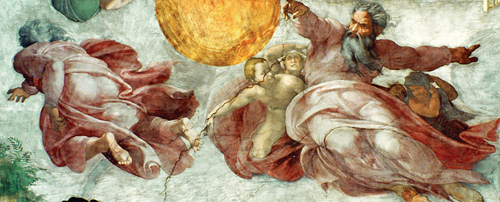
Michelangelo’s Sistine Chapel
Although
he considered himself a sculptor first, Michelangelo managed to turn
this almost flat ceiling into a soaring vault peopled with Old Testament
prophets and ignudi (nude men). He did it virtually alone, firing all of his assistants save one to help him grind pigments .

Ceiling, Sistine Chapel
Leonardo da Vinci’s St Jerome
Barely
sketched out, yet compelling for its anatomical precision and
compositional experimentation. Jerome forms a spiral that starts in the
mountains, runs across the cave entrance and lion’s curve, up the
saint’s outstretched right arm, then wraps along his left arm and hand
into the centre .