St Paul’s Monuments

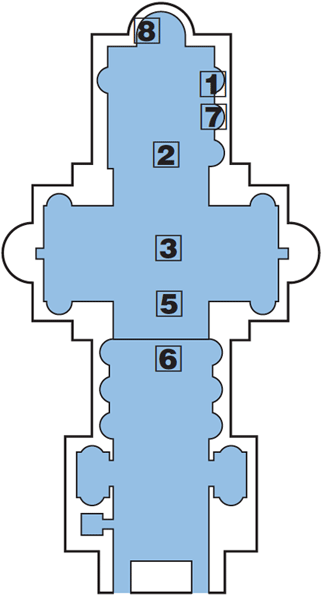
Crypt Floorplan
Tomb of Christopher Wren
St Paul’s architect, Sir Christopher Wren (1632–1723), has a plain tomb in the OBE chapel. Its inscription reads, “Lector, si monumentum requiris, circumspice – Reader, if you seek a monument, look around you”.
Wellington’s Tomb
Britain’s
great military leader and prime minister, Arthur Wellesly, 1st Duke of
Wellington (1769–1852), lies in the crypt. He also has a monument in the
nave.
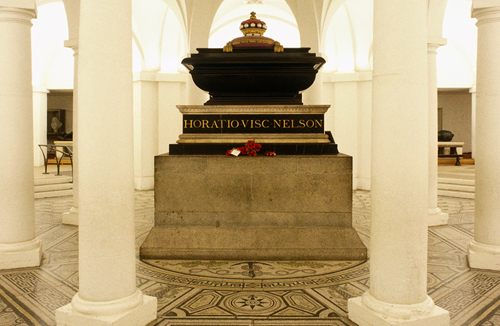
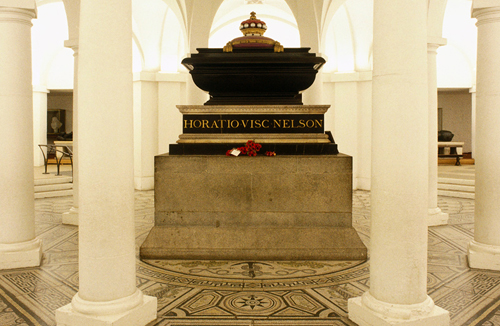
Nelson’s Tomb
Preserved in brandy and brought home from Trafalgar, sea hero Admiral Lord Nelson (1758–1805) is in the centre of the crypt.

Lord Nelson memorial
John Donne’s Memorial
The metaphysical poet John Donne (1572–1631) was made Dean of St Paul’s in 1621. His memorial is in the Dean’s Aisle.
Gallipoli Memorial
One of many war memorials in the cathedral, this one is dedicated to those who died in the 1915 Gallipoli campaign.
Churchill Memorial Screen
This screen commemorates Sir Winston Churchill (1874–1965) who during the Blitz said “at all costs, St Paul’s must be saved”.
The Worshipful Company of Masons Memorial
This City guild’s plaque near Wren’s tomb reads, “Remember the men who made shapely the stones of Saint Paul’s Cathedral”.
Turner’s Tomb
The great landscape painter JMW Turner (1775–1851) is buried in the OBE chapel.
American Memorial
Behind
the High Altar, the American Memorial Chapel’s roll of honour lists the
US servicemen killed while stationed in Britain during World War II.
Fire-Watchers Memorial
In the Nave, this remembers those who saved the church from destruction during the 1940 Blitz.
St Paul’s Role in History
St Paul’s belongs to the
nation and to London. It is run by a Dean and Chapter of five priests,
including the Archdeacon, who is responsible for the City of London’s 30
parishes. Annual services for the City guilds have taken place here for
a thousand years. One of the cathedral’s main functions is as a place
of national mourning and celebration. In the 19th century 13,000 filled
the cathedral for the funeral of the Duke of Wellington. Queen
Victoria’s Jubilee was a spectacular occasion held on the steps of the
cathedral. The Prince of Wales and Lady Diana Spencer chose to be
married here rather than the royal Westminster Abbey to show that they
were the people’s prince and princess.
Top 10 Moments in St Paul’s History
Elizabeth II’s Golden Jubilee (2002).
Prince Charles’ and Lady Diana’s wedding (1981).
Winston Churchill’s funeral (1965).
Martin Luther King Jr preaches (1964).
Festival of Britain launched (1951).
Queen Victoria’s Diamond Jubilee (1897).
Duke of Wellington’s funeral (1852).