Palau de la Música Catalana
Domènech
i Montaner’s magnificent concert hall is a joyous celebration of
Catalan music. Ablaze with mosaic friezes, stained glass, ceramics and
sculptures, it displays the full glory of the
Modernista style. The work of Miquel Blay on the façade is rated as one of the best examples of
Modernista sculpture in Barcelona.Hospital de la Santa Creu i de Sant Pau
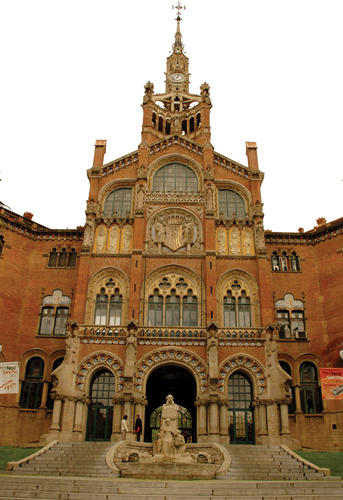
In
defiant contrast to the Eixample’s symmetrical grid-like pattern, this
ambitious project was planned around two avenues running at 45-degree
angles to the Eixample streets. Started by Domènech i Montaner in 1905
and later completed by his son in 1930, the hospital pavilions are
lavishly embellished with mosaics, stained glass and sculptures by
Eusebi Arnau. The octagonal columns with floral capitals are inspired by
those in the Monestir de Santes Creus, to the south of Barcelona.

Fundaciò Tàpies
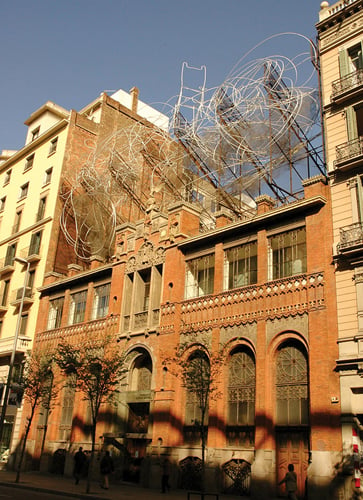
With a rationally plain façade alleviated only by its Mudéjar-style
brick work, this austere building, dating to 1886, was originally home
to the publishing house Montaner i Simon. It bears the distinction of
being the first Modernista
work to be designed by Domènech i Montaner, which explains why it has
so few of the ornate decorative touches that distinguish his later
works. Home to the Fundaciò Tàpies, it is now dominated by an enormous sculpture by the contemporary Catalan artist, Antoni Tàpies.

Casa Batllò
Illustrating Gaudí’s nationalist sentiments, Casa Batllò, on La Mansana de la Discòrdia, represents an allegory of the legend of Sant Jordi.
The roof is the dragon’s back and the balconies, sculpted in the form
of carnival masks, are the skulls of the dragon’s victims. The
polychrome façade reveals Gaudí’s remarkable use of colour and texture.Pg de Gràcia 43
Open 9am–8pm daily
Adm €16.50
DA

Chimneys and rooftop, Casa Batllò
Casa Amatller
The
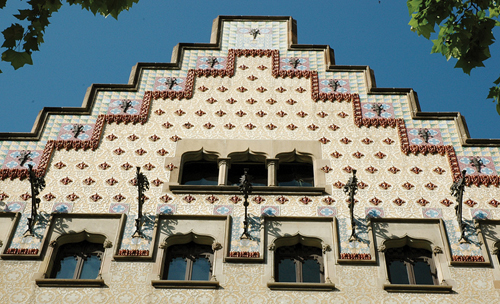
top of Casa Amatller’s ochre-white façade bursts into a brilliant
display of blue, cream and pink ceramics with burgundy florets.
Architect Puig i Cadafalch’s exaggerated decorative use of ceramics is
typical of Modernisme. Tours describe the neo-medieval vestibule, and include a slide show in Amatller’s former photography studio.Casa de les Punxes (Casa Terrades)
Taking Modernisme’s
Gothic and medieval obsessions to extremes that others seldom dared,
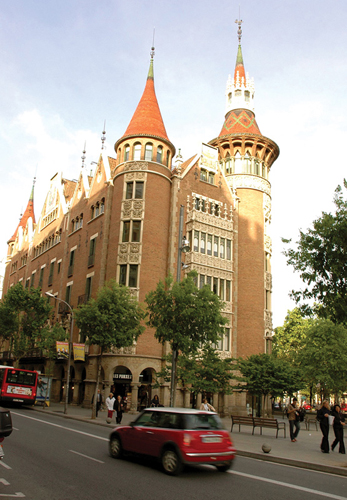
Puig i Cadafalch created this imposing, castle-like structure between
1903 and 1905. Nicknamed the “House of Spines” because of its sharp,
needle-like spires rising up from conical turrets, its true name is Casa
Terrades. The flamboyant spires contrast with a façade that is, by Modernista standards, sparsely decorated.Diagonal 416
Closed to public

Casa de les Punxes
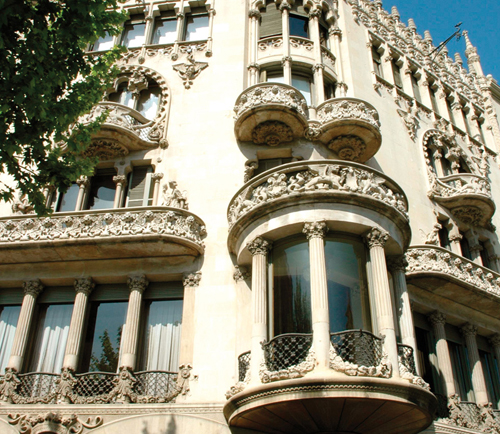
Casa Lleò Morera
Ironwork,
ceramics, sculpture and stained glass come together here in a synthesis
of the decorative and fine arts. The interior of this house, by
Domènech i Montaner, has some superb sculptures by Eusebi Arnau and some
of the finest Modernista furniture in existence.Pg de Gràcia 35
Closed to public

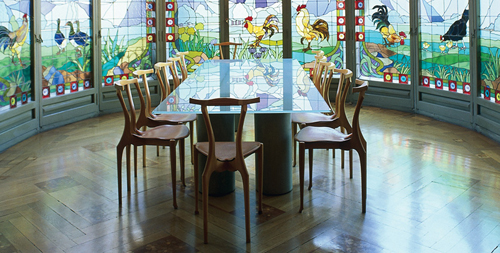
Stained-glass windows, Casa Lleò Morera