Washington, D.C.’s Top 10 : Moments in History – Top 10 Citizen Rights of the Constitution

  1. Foundation of the Federal City

    The
    US Constitution, ratified in 1788, provided for “a District (not
    exceeding ten Miles square) as may, by Cession of Particular States…,
    become the Seat of the Government of the United States.”

  2. Layout and Design

    In
    1790 George Washington selected Pierre Charles L’Enfant, a French
    engineer, to lay out the city. The plan was influenced by Versailles and
    the city of Paris.

  3. War of 1812

    The
    United States declared war on Britain in 1812, seeking freedom of
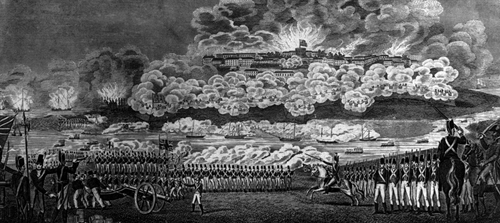
    marine trade and the security of US seamen. In 1814 British troops
    entered the capital and burned government buildings, including the White
    House and the Capitol. If it had not rained, the whole city might have
    burned.


    The British burn Washington, 1814

  4. Expansion

    Thomas
    Jefferson began western expansion by organizing the Lewis and Clark
    expedition in 1803. The C&O Canal and the Baltimore and Ohio
    Railroad provided commerce through the mountains and a period of
    prosperity. New states were added to the Union, and bitter divisions
    arose connected to the issue of slavery.

  5. Civil War

    Conflict
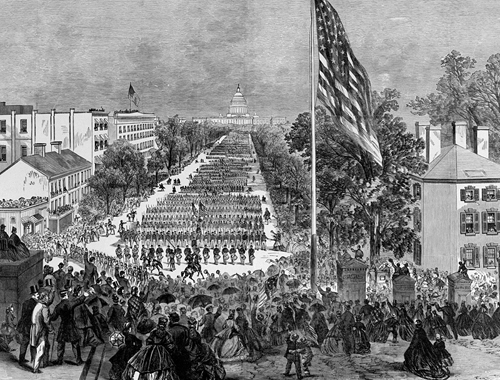
    between the Union and the seceding southern states began on April 12,
    1861, and plunged Washington and the nation into crisis. Union
    supporters, joined by thousands of blacks escaping slavery in the South,
    doubled the city’s population in four years. Although threatened, the
    city was never taken by Confederate troops, and when the war ended in
    1865, Washington was unharmed.


    Civil War victory parade

  6. McMillan Plan

    The
    McMillan Plan of 1901, named for its congressional supporter, Senator
    James McMillan, was the first application of city planning in the US. It
    created much of the layout of the Mall and President’s Park seen today.

  7. New Deal

    The
    Roosevelt era (1933– 1945) brought tremendous growth to the city.
    Efforts to bring the nation out of the Great Depression increased the
    size and number of government agencies, and provided direct funds for
    construction. Most of the buildings in the Federal Triangle, the
    completion of the Supreme Court, and the National Gallery of Art were
    New Deal works.

  8. World War II

    More
    than 10 percent of the US population of approximately 115 million was
    in uniform at the peak of the war, and the central management of these
    troops remained in Washington.

  9. March on Washington

    On
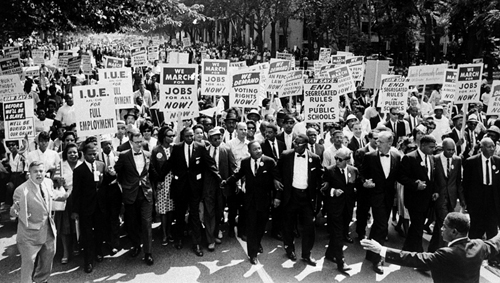
    August 28, 1963, African-American leaders led 250,000 people to rally
    in front of the Lincoln Memorial in support of equal rights. Dr. Martin
    Luther King, Jr.’s eloquence in expressing his dream for America, along
    with the size of the march, gave strong impetus to the struggle for
    justice for all races.


    March on Washington
  10. Home Rule

    The
    federal government’s policy of maintaining full control over the city
    was modified with the Home Rule Charter in 1973. This legislation gave
    the city the power to elect its own mayor, city council, and school
    board.


Top 10 Citizen Rights of the Constitution

  1. Inherent Rights

    Freedom of religion, speech, the press, assembly, and seeking redress of citizen grievances.

  2. Legality of Arms

    The right of the people to keep and bear arms.

  3. Quartering of Soldiers

    Freedom from housing soldiers in private homes in peacetime and in war, except as prescribed by law.

  4. Unjustified Searches

    Freedom from unreasonable search and seizure of people, houses, and effects without a warrant.

  5. Limits on Prosecutors

    A
    grand jury indictment is required before trial; a person cannot be
    tried more than once for the same crime; a person cannot be forced to
    testify against himself; a person’s property cannot be confiscated
    without compensation.

  6. Protection of the Accused

    Accused
    persons will be given a trial by a jury of peers, be informed of the
    charges, be able to confront witnesses, and be represented by counsel.

  7. Civil Case Jury Trial

    In common law, parties have a right to a trial by jury.

  8. Unjust Punishment

    The government cannot require excessive bail, impose excessive fines, or use cruel or unusual punishment.

  9. Limited Scope

    The stated rights do not limit other rights.

  10. State Powers

    All powers not granted to the US government belong to the states.