Further Features of El Escorial

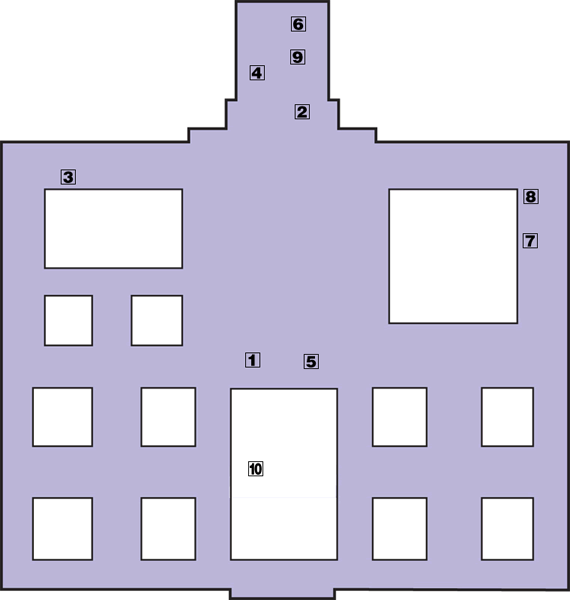
El Escorial Floorplan
Cenotaphs
These
superb bronze sculptures on either side of the high altar are by an
Italian father and son team, Leone and Pompeo Leoni. On the left is
Carlos I (Emperor Charles V), shown with his wife, daughter and sisters;
opposite is Felipe II, three of his wives and his son, Don Carlos.
King’s Deathbed
It
was in this simple canopied bed that Felipe II died on 13 September
1598, it is said as “the seminary children were singing the dawn mass”.
The bed was positioned so that the king could easily see the high altar
of the basilica on one side and the mountains of the Sierra de
Guadarrama on the other.
The Martyrdom of St Maurice and the Theban Legion
This
ethereal work by El Greco (1541–1614) was intended for an altar in the
basilica but Felipe II found the style inappropriate and relegated it to
the sacristy. El Greco never received another royal commission.
Portrait of Felipe II
In
this stately painting by Dutch artist Antonio Moro, the king, then aged
37, is wearing the suit of armour he wore at the battle of St Quentin
in 1557. It was to be Felipe’s only victory on the battlefield.
Cellini Crucifix
Florentine
master craftsman Benvenuto Cellini sculpted this exquisite image of
Christ from a single block of Carrara marble. It was presented to Felipe
II in 1562 by Francisco de Medici, Grand Duke of Tuscany.
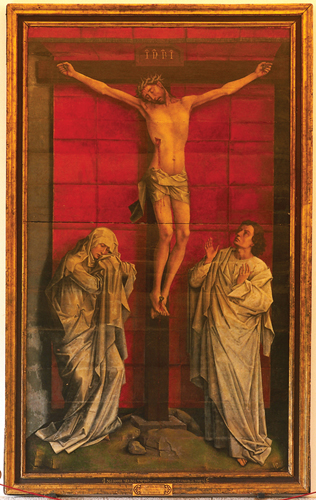
Calvary
This
moving painting is by 15th-century Flemish artist Rogier van der
Weyden. Felipe II knew the Netherlands well and was an avid collector of
Flemish art.

Calvary
Last Supper
Venetian
artist Titian undertook numerous commissions for El Escorial.
Unfortunately this canvas was too big to fit the space assigned to it in
the monks’ refectory and was literally cut down to size.
Inlay Doors
One
of the most striking features of the king’s apartments is the superb
marquetry of the inlay doors. Made by German craftsmen in the 16th
century, they were a gift from Emperor Maximilian II.
King’s Treasures
A cupboard in the royal bedchamber contains more than a dozen priceless objets d’art. They include a 12th-century chest made in Limoges and a 16th-century “peace plate” by Spanish craftsman Luís de Castillo.
Queen’s Room Organ
The
corridors of El Escorial would have resounded to monastic plainchant
but the organ also met with royal approval. This rare hand organ dates
from the 16th century and is decorated with Felipe II’s coat of arms.
King Felipe II
When Felipe II took
over the reins of government from his father Carlos I in 1556, he
inherited not only the Spanish kingdoms of Castile and Aragon, Naples,
Sicily, Milan and the Low Countries, but also the territories of the New
World. Defending this farflung empire embroiled him in constant
warfare. The drain on the royal coffers (despite the prodigious influx
of gold and silver from the Americas) led to unpopular tax increases at
home and eventual bankruptcy Felipe’s enemies, the Protestant Dutch,
their English allies and the Huguenot French, set out to blacken his
reputation, portraying him as a cold and bloodthirsty tyrant. Today’s
historians take a more objective view, revealing him to have been a
conscientious, if rather remote, ruler and a model family man with a wry
sense of humour. On one occasion he startled the monks of El Escorial
by encouraging an Indian elephant to roam the cloisters and invade the
monastic Cells.
Top 10 El Escorial Statistics