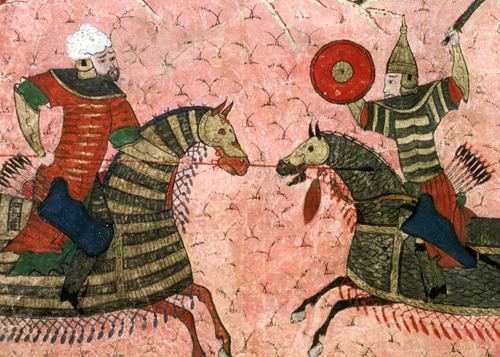
Mongol horsemen
The Science and Technology Museum includes an exhibition of Chinese inventions
500,000 BC: Peking Man hunts and gathers
Unearthed
in the 1920s from a cave at Zhoukoudian, 30 miles (45 km) SW of
Beijing, 40-odd fossilized bones and primitive implements were
identified as the prehistoric remains of Peking Man (Homo erectus Pekinensis), who lived in the vicinity over 500,000 years ago.
1215: Genghis Khan sacks Zhongdu
The
future Beijing was developed as an auxiliary capital under the Liao
(907–1125) and Jin dynasties (1115–1234), at which time it was known as
Zhongdu. In 1215 it was invaded and razed by a Mongol army led by the
fearsome Genghis Khan.
Late 13th century: Marco Polo visits
Under
the first emperor of the Mongol Yuan dynasty, Kublai Khan (r.
1260–1294), the city became known as Khanbalik, and was one of twin
capitals – the other was Yuanshangdu, or Xanadu – of the largest empire
ever known. The Italian traveler Marco Polo was dazzled by the imperial
palace: “The building is altogether so vast and beautiful, that no man
on earth could design anything superior to it.”
1403–25: Construction of the Forbidden City
The
Ming emperor Yongle (r. 1403–24) destroyed the palaces of his Mongol
predecessors in order to rebuild the city, which he renamed Beijing
(Northern Capital). He is credited with laying the foundations for the
city as it is today, and the Forbidden City and Temple of Heaven began
to take shape during his reign.
1900: Boxer Rebellion
Western
powers, frustrated by the reluctance of the Chinese to open up to
foreign trade, put the imperial court under pressure, eventually going
to war to protect their trade in opium. In 1900, championed by the
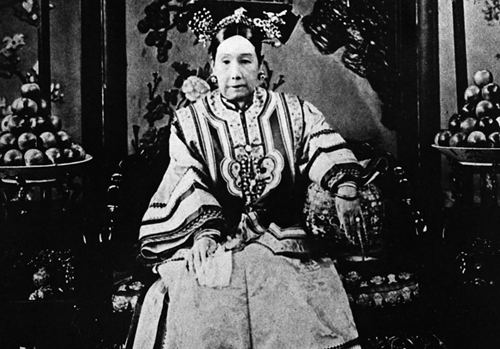
Empress Cixi, a band of rebels from north China known as the Boxers
attacked Beijing’s Foreign Legation Quarter. A joint eight-nation army
had to be sent to lift the siege.

Empress Cixi
1912: The End of Empire
The
last emperor, Pu Yi, ascended the throne at the age of three. Four
years later, in February 1912, his brief reign was brought to a
premature end when he was forced to abdicate by general Yuan Shikai’s
new National Assembly.
1949: Founding of the People’s Republic of China
On
January 31, 1949, Communist forces led by Mao Zedong seized Beijing. On
October 1, Mao proclaimed the foundation of the People’s Republic of
China from the gallery of the Tian’an Men.
1965: Launch of the Cultural Revolution
Having
socialized industry and agriculture, Mao called on the masses to
transform society itself. All distinctions between manual and
intellectual work were to be abolished and the class system was to be
eradicated. The revolution reached its violent peak in 1967, with the
Red Guards spreading fear and havoc.
1976: The death of Mao
On
September 9, 1976 Mao died. The destructive policies of the Cultural
Revolution were abandoned. Mao’s long-time opponent Deng Xiaoping
emerged as leader, implementing reforms that encouraged greater economic
freedom.
2008: Beijing hosts the Olympics
In
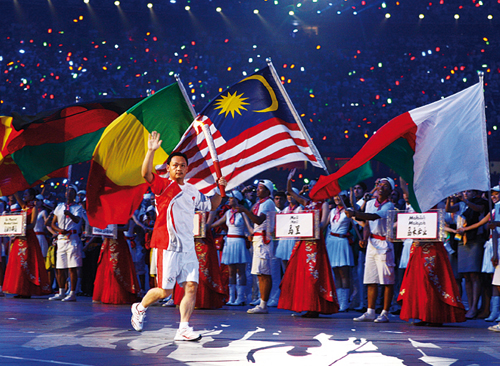
2008, Beijing hosted the most expensive Olympic Games of all time. The
city revamped its infra-structures, and some of the most striking and
innovative buildings were created to house the various competitions .

Opening ceremony of the 2008 Olympics
Top 10 Chinese Inventions
Porcelain
The
Chinese invented porcelain a thousand years before Europe caught on –
and kept production methods secret to protect their competitive
advantage.
Printing
In the 11th century, the Chinese carved individual characters on pieces of clay, inventing movable block type.
Paper money
Developed by Chinese merchants as certificates of exchange. Lighter than coins, bills were soon adopted by the government.
Gunpowder
Stumbled on by Daoist alchemists seeking the elixir of life.
Seismometer
A ball fell from one of four dragon’s mouths to indicate the direction of the quake.
Abacus
Invented during the Yuan dynasty and still in use throughout China today.
Magnetic compass
Developed from an instrument used for feng shui and geomancy, it helped the Chinese explore the world.
Paper
A prototype paper was made from mulberry bark, although bamboo, hemp, linen, and silk were also used to write on.
Crossbow
Better range, accuracy, and penetration than the standard bow.
Decimal system
Developed alongside the writing system and led to mathematical advances.