The Great Wall snakes through the countryside over
deserts, hills, and plains for several thousand miles. At its closest
point it is less than 40 miles (60 km) from Beijing. The wall was
created following the unification of China under Qin Shi Huangdi
(221–210 BC). Despite impressive battlements, it ultimately proved
ineffective; it was breached in the 13th century by the Mongols and
again, in the 17th century, by the Manchus. Today, only select sections
of its crumbling remains have been fully restored, with four main sites
accessible from Beijing: Badaling, Mutianyu, Huanghua Cheng, and
Simatai.
BadalingMutianyuHuanghua ChengSimatai |
Most hotels are able to organize a trip to the wall, usually combined with a visit to the Ming Tombs.
Try to find out whether there are any unwanted diversions to cloisonné
workshops, jade factories, or Chinese medicine clinics. Small groups can
have a more personalized visit, and see the more remote parts of the
wall, by hiring a taxi for the day from Beijing. Hiking clubs in Beijing
offer day trips to lesser-known parts of the wall. |
The area is extremely hot in summer (bring sun cream and lots of water) and bitterly cold in winter. |
|
There are snack kiosks at each of the main four sites, but it’s better to bring your own food. |
|
Top 10 Features
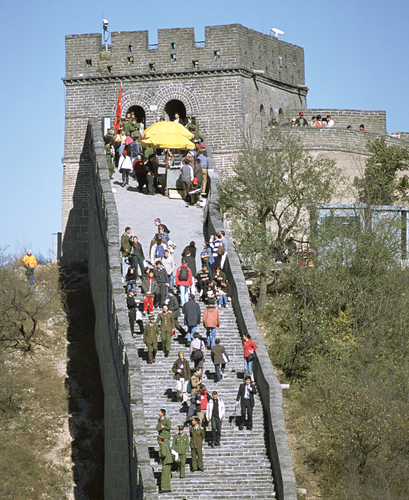
Badaling
The
restored Ming fortification at Badaling is the closest section of the
wall to Beijing. Its accessibility means it is perpetually busy.
However, it is possible to escape the crowds by walking along the wall;
and the views are spectacular.

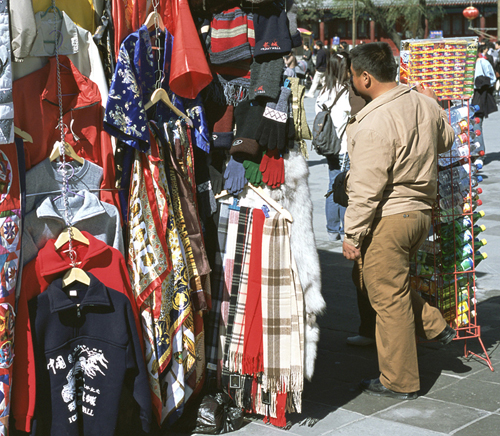
Souvenir stall at Badaling

Great Wall Museum
Housed
in an imitation Qing dynasty building at Badaling, the museum presents
the history of the region from Neolithic times, as well as detailing the
construction of the wall. Admission is covered in the cost of your wall
ticket.
Juyong Guan
This
pass is on the way to Badaling. With unscalable mountains on either
side it is easy to see why the spot was chosen for defence. Early
cannons remain on the ramparts. Also worth seeing are Buddhist carvings
on a stone platform, or “cloud terrace,” in the middle of the pass.
Commune by the Great Wall
Within
sight of the wall at Badaling, the Commune consists of 12 stunning,
contemporary villas, each designed by a different, celebrated Asian
architect. The complex operates as a hotel , but non-guests can drop by the restaurant for lunch.
Mutianyu
Located
in a dramatic hilly setting, and less with a series of watchtowers
along its restored length, the wall here dates from 1368. Village
buildings have been converted into holiday homes and restaurants.
Huanghua Cheng
On
the same stretch of wall as Mutianyu, Huanghua Cheng is an exhilarating
section of Ming fortifications that is far less developed than most
other parts. The great barrier is split into two by a large reservoir.
The crumbling masonry can be uneven and fairly treacherous, so you need
to take care.

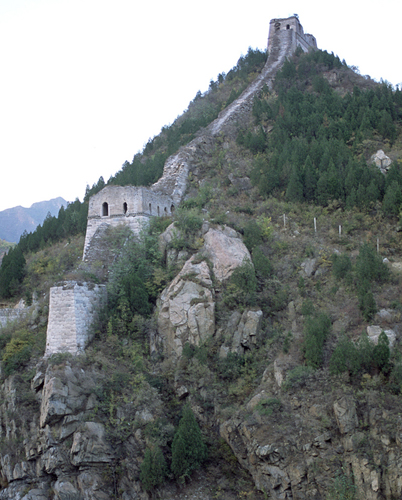
Simatai
The
wall at Simatai has only been partially repaired, and so affords a more
genuine impression of the original wall. It is very steep and hazardous
here in parts, and can even be quite risky to navigate.
Jingshanling
The
starting point for a 6-mile (10-km) trek to Simatai, which because of
the steep and stony trail usually takes around four hours. The views as
the wall winds over sharp peak after sharp peak are fantastic, but you
have to work for them.
Gubeikou
Lying
farther west of Jingshanling, Gubeikou is a heavily fortified pass from
where you can begin a 15-mile (25-km) walk to Simatai. It is, if you
are really fit, possible to do it in one day.
Shanhaiguan
This
is where the wall ends (or begins), at the sea. East of town, the
“First Pass Under Heaven” is a formidable section of wall attached to a
gatehouse. It lies some 218 miles (350 km) east of Beijing but it does
make for a worthwhile overnight trip.