The Reina Sofia’s collection of 20th- and
21st-century Spanish art is exciting and challenging by turns. The
museum, set in a converted hospital, was inaugurated by King Juan Carlos
and Queen Sofía in September 1990 and, besides the permanent
collection, stages outstanding temporary exhibitions from around the
world. The organization is thematic and chronological, beginning with
the Basque and Catalan schools of the early 1900s. While most visitors
home in on the rooms exhibiting the great masters of the interwar period
– Juan Gris, Joan Miró, Salvador Dalí and Pablo Picasso, whose Guernica is the centrepiece of the gallery (see Pablo Picasso’s Guernica)
lesser known Spanish painters and sculptors are worth seeking out.
Works by the European and American avantgarde provide an international
context.
Calle Santa Isabel 52 91 774 1000
www.museoreinasofia.es
Open 10am–9pm Mon, Wed–Sat, 10am–2:30pm Sun; Closed Tue, 1 Jan, 6 Jan, 1 May, 15 May, 9 Nov, 24–25 Dec, 31 Dec Adm €6 (free Sat after 2:30pm & Sun) Paseo de Arte €14.40 Dis. access
|
The entrance to the
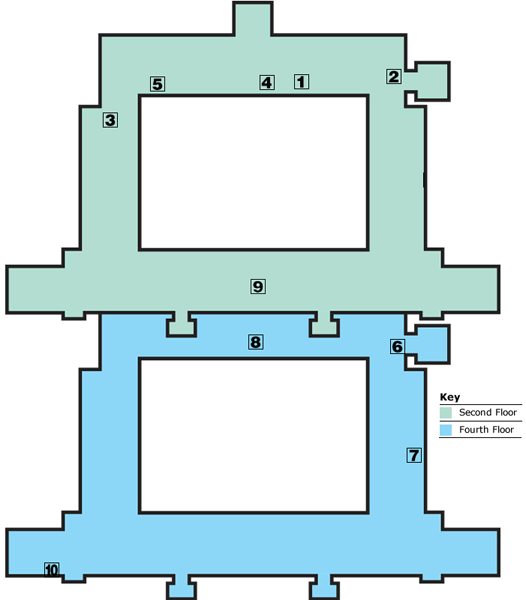
main Sabatini building is in Calle Santa Isabel. Glass lifts take
visitors to the permanent collections on the second, third and fourth
floors. Temporary exhibitions are housed in an adjoining glass building
designed by Jean Nouvel and accessed via the first floor. To the west
and south of a new courtyard are a further two buildings housing a
library of art, restaurant, book shop and an auditorium. |
The Arola Madrid
café-restauratant was designed by Jean Nouvel and can be accessed via
the mu-seum or from Ronda de Atocha street. |
|
The museum shop sells Spanish designer jewellery and ceramics as well as books, slides and posters. |
|
The museum regularly
loans works of art to galleries around the world, so not all works may
be on display at the time of your visit. |
|
Top 10 Paintings
Woman in Blue
This
marvellous Blue-period portrait (1901) by Pablo Picasso (1881–1973) was
painted shortly after his first visit to Paris – he painted the
insolent looking courtesan from memory. When the painting failed to win a
national exhibition, a disgruntled Picasso discarded it. It was
discovered several years later.
Portrait of Sonia de Klamary
Hermengildo Anglada Camarasa (1871–1959) had a sensual style as this evocative painting (c.1913) shows.
The Gathering at Café de Pombo
José
Gutiérrez Solana (1886–1945) loved to record the social life of the
capital, as in this 1920 portrait of a literary group. The painting’s
owner, novelist and poet Ramón Gómez de la Serna, is shown standing in
the centre.
Guitar in Front of the Sea
Juan Gris (1887–1927) became one of Cubism’s leading exponents. This 1925 work is an excellent example.
The Great Masturbator
Catalan
artist Salvador Dalí (1904–89) was a leading exponent of Surrealism,
with its exploration of the subconscious. The figure of the Masturbator
(1929) is derived from a weird rock formation at Cadaqués.
Bulls (Bullfighting)
In this 1933 painting Benjamin Palencia (1894–1980) evokes the arid landscape of La Mancha, while the animals appear symbolic.
Portrait II
Joan
Miró (1893– 1983) encompassed Cubism and Surrealism but he never lost
his extraordinary originality. In this 1938 work the Catalan painter is
more interested in juxtaposing colours rather than revealing the
physical attributes of the sitter.
Animal Head with Apples
This
1939 still life by Luis Fernández (1900–73) harks back to the classical
traditions of 17th-century Spanish painting. Fernández experimented
with abstraction and Surrealism before settling on his own figurative
style.
Superimposition of Grey Matter
Antoní
Tàpies (b.1923) is arguably Spain’s most important postwar artist. His
“matter paintings”, including this 1961 work, explore texture and are
composed by adding layers of mixed media, such as sand, pigment,
powdered marble and paint, onto a pre-varnished canvas.
Painting is like Hitting
This
entertaining 1972 work, in which two suited artists slug it out among
outsized tubes of paint, is by “Equipo Crónica”, aka artists Rafael
Solbes (1940–81) and Manuel Valdés (b.1942). The duo were inspired by
Pop Art.
Sculptures in the Reina Sofía

Escultura (Sculpture)
Born
in Lithuania, Jacques Lipchitz (1891–1973) fell under the spell of
Cubism during his first stay in Paris in 1909. This piece (1915)
suggests the human form although it is very close to pure abstraction.
Great Prophet
Catalan
artist Pablo Gargallo (1881–1934) was one of the most important Spanish
sculptors during the 1920s and 1930s. He spent nearly 30 years planning
this 1933 masterpiece which was sadly only cast after his death.
Portrait of Joella
This
beautiful sculpture painting (1933–4) was the fruit of a collaboration
between Catalan Salvador Dalí and the leading American Surrealist, Man
Ray (1890–1978). Man Ray fashioned the head, leaving Dalí to add the
striking painted dream landscape.
Seated Woman I
Born
in Barcelona, Julio González (1876–1942) became an apprentice welder in
Paris and his training at the forge had a major impact on his work.
This abstract piece from 1935 is very typical of his output.
Man with a Lamb
This
arresting 1943 work by Pablo Picasso is a traditional sculpture in the
manner of Rodin. Picasso’s studies of the period suggest that the lamb
is intended to be a symbol of sacrifice.
Two Figures in the Form of a Leaf
British
sculptor Henry Moore (1898–1986) was a significant influence on Spanish
artists of the 1940s and 1950s, and this 1952 piece is a fine example. A
devotee of Picasso, he later moved away from traditional work to join
the Surrealists.
Metaphysical Box
Jorge
de Oteiza (b.1908) is a highly original Basque sculptor, more
interested in form than in expressing feelings or symbols. This piece
dates from 1958. He made a big impact on the younger painters of Equipo
‘57, also exhibited here.
Artisan Couple
A
prominent member of the Madrid Realist school, Julio López Hernández
(b.1930) is noted for his lifesize human figures, such as this
wonderfully evocative study of a craftsman and his wife at the
workbench, cast in 1965.
Wind Clock
One
of the most important painters of the 20th century, both in Spain and
around the world, Catalan Joan Miró was an equally talented sculptor. In
his later work, when he became engrossed in Surrealism, he was
especially interested in the qualities and workings of simple objects
and materials, such as this 1967 clock.
Toki Egin (Homage to St John of the Cross)
Eduardo
Chillida (1924–2002) is one the most highly regarded sculptors in
Spain. This enormous iron construction (1989–90) weighs 8,000 kg (17,500
lbs) special cranes were needed to install it in the museum. Chillida
was a founding member of Grupo ‘57, an artistic group under the Franco
regime.
Pablo Picasso’s Guernica
On display in Room 6 of
the museum is its most precious and famous work. Commissioned as
propaganda, Guernica instantly transcended its original purpose. In
April 1937, at the height of the Civil War, German bombers devastated
the Basque town of Guernica (Gernika) in support of General Franco’s
Nationalist forces. The attack, almost unprecedented, on a defenceless
civilian population caused international outrage. Picasso completed his
huge canvas in just two months and it was first exhibited at the Paris
World’s Fair. Ever since, the meaning and content of Guernica have been
minutely analysed, to the irritation of the artist. Picasso chose not to
depict the bombardment – there are no aeroplanes, for example – but to
indict war, with all its senselessness and barbarity, conceived in terms
of the artist’s highly individual language of symbols. The preliminary
sketches (also exhibited in Room 6) are a help in understanding the
painting. Picasso tried eight different versions before arriving at his
ultimate vision.
Top 10 Features in Picasso’s Guernica