Since the first artists set up in Da Shan Zi’s newly
vacated 798 factory in 2001, the East German-built industrial compound
has become a world-famous center of contemporary Chinese art. Alongside
the studios and galleries, there are also chic cafés, bars, and
restaurants, not to mention a growing number of designer shops and
showrooms. The area is popular with tourists, who arrive by the
coach-load.
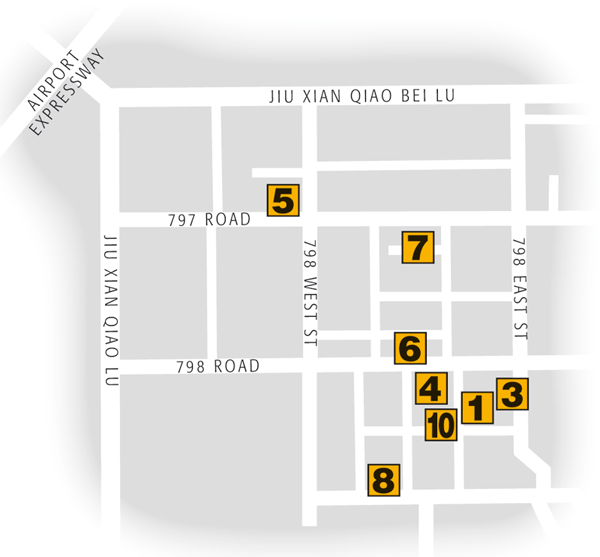
4 Jiu Xian Qiao Lu, Chaoyang district, northeast of the Holiday Inn Lido complex. Bus: 401, 402, 405, 445, 909, 955, 973, 988, 991. To Caochangdi: Bus 418 from Dongzhimen
798 SpaceUCCAGalleria ContinuaIberia |
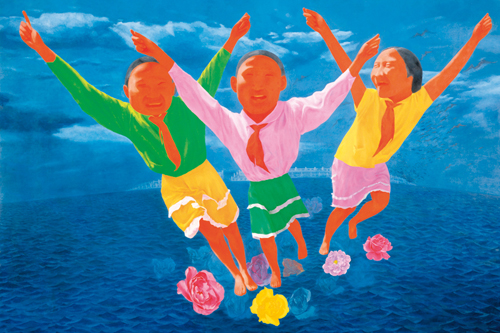
1985 marks the arrival of
the avant garde in Chinese art, with controversial student graduation
shows igniting intense debate in artistic circles. The following year, a
New York gallery introduced the new Chinese art to an international
audience. Today, China’s art market is the third largest in the world. |

The Ullens Center
for Contemporary Art provides free maps of the entire 798 area. Most
galleries are open from around 11am to 7pm, closed on Mondays. |
|
Top 10 Features
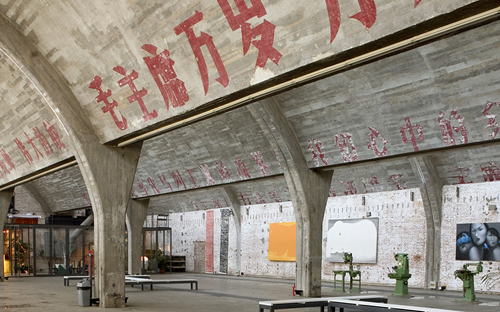
798 Space
The
first gallery to open in Da Shan Zi, 798 Space remains at the heart of
the district. It is worth visiting for the spectacle of the cavernous
main hall with its curious multiple-arched roof.

Maoist graffiti
When
many of the abandoned factory spaces were being converted for use as
galleries, the artists instructed the decorators to leave untouched the
giant Maoist slogans that had been lettered on the walls by the former
workers – as at 798 Space. “Mao Zedong is the red star in our hearts,”
reads one.

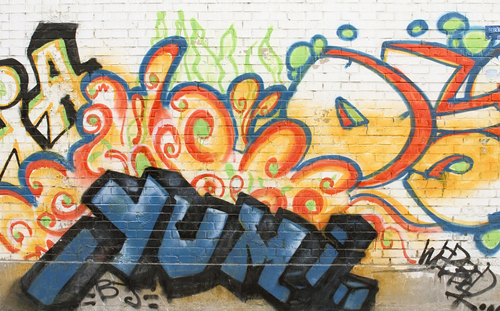
graffiti-daubed wall in the factory compound
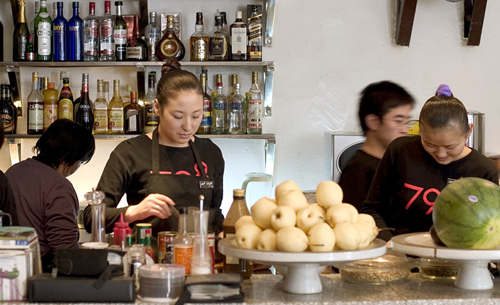
AT Café
A
fashionable café whose notable feature is a bare-brick dividing wall
punctured by massive holes, AT serves as the unofficial canteen for the
artists and gallery staff who work in the area.

UCCA
Founded
by Belgian collectors Guy and Miriam Ullens, the Ullens Center for
Contemporary Art (UCCA) is the largest single venue in the 798 area.
Among the many artists showing here is Fang Lijun. UCCA has an
auditorium for lectures, a library, a store, and a restaurant.

White Space
Foreign
art dealers are already present in numbers in 798. The striking White
Space was one of the first such galleries, a branch of the Berlin-based
Alexander Ochs Gallery.
Timezone 8
Established
in 2001 by Texan Robert Bernell, Timezone 8, which occupies a former
factory canteen, is Beijing’s best art bookshop. It also incorporates a
gallery that specializes in photographic art.

Galleria Continua
Beijing’s
outpost of Italy’s Galleria Continua is located in a former munitions
factory. This gallery, which aims to stimulate cultural exchanges, hosts
shows by renowned international artists such as Chen Zhen, Daniel
Buren, and Anish Kapoor.
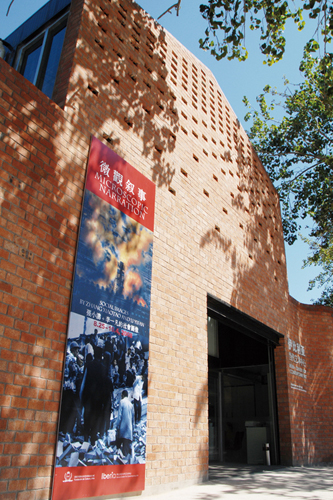
Iberia
The
second major European-funded space in Da Shan Zi, Iberia
(left) is proof of 798’s leap from the local to the international scene.
In addition to an exhibition area, Iberia has a public education
center, a publishing house, and a media archive.

Caochangdi
While
798 is looking more and more like a retail outlet, nearby Caochangdi
has emerged as a truly cutting-edge art district. It is the home of Ai
Weiwei, China’s influential architect, who designed a number of
buildings in the area, including the gallery space for Urs Meile.
798 Photo Gallery
In
addition to often excellent and regularly changing exhibitions of work
by both Chinese and foreign photographers, the gallery also has a couple
of mezzanine levels where a selection of photographic prints for sale
are displayed.