Linderhof & Herrenchiemsee
Linderhof Castle
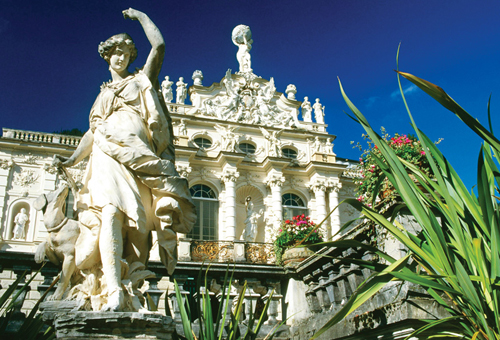
Linderhof’s
history began as a hunting lodge of Maximilian II that Ludwig II had
dismantled and reassembled in the park in 1872. Originally planned as a
second Versailles, the castle turned out to be far more modest in scale,
albeit designed in a delightful and whimsical neo-Rococo style.

Linderhof Castle Park

Castle Park
Set
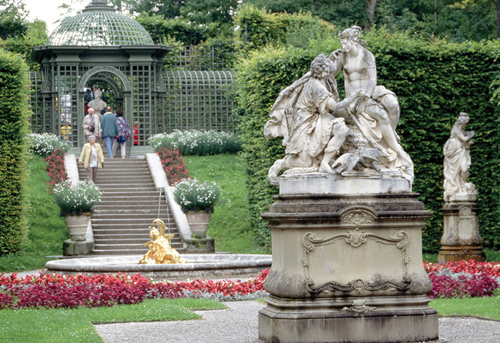
in a landscape garden, the park is a French-style formal garden created
from 1870 onwards using designs by Carl von Effner. Its parterres are
reminiscent of the Baroque style, its terraces of the Renaissance.
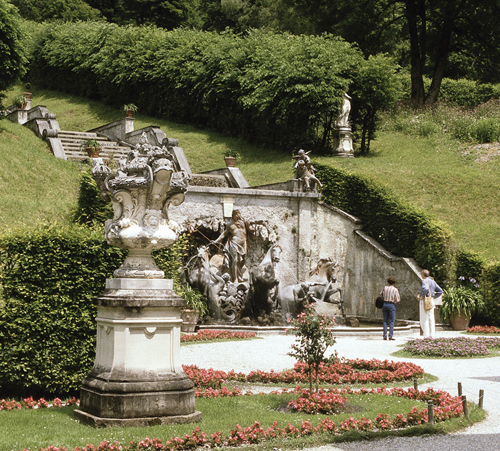
Fountain of Neptune With Cascades
On
the north side of the castle, cascades flow across 30 steps bounded by
the Fountain of Neptune at the bottom and the music pavilion at the top.
Arcades flank the two sides of the waterfall.

Grotto of Venus
Designed
to emulate the Hörselberg in Wagner’s opera, Tannhäuser, this
artificial grotto, complete with stalactites, features a lake on which
the king was rowed about in a gilded barge.
Moorish Kiosk
Created for the Paris World’s Fair in 1867, Ludwig II acquired the pavilion for Linderhof in 1876.
Chapel
This is the oldest structure of the castle complex, built in 1668 as the chapel of St Anna.
Herrenchiemsee Castle
On
the island of Herrenchiemsee in Lake Chiemsee, Ludwig II finally began
to build his “New Versailles” in 1878. Seven years later, he ran out of
funds after completing 20 magnificent rooms, which are open to visitors
today.

Herrenchiemsee Castle
King Ludwig II Museum
The
museum is housed in the south wing of the New Castle and documents the
life of “Kini,” a Bavarian nickname for the king, in a series of 12
rooms.
Hall of Mirrors
With
its 90-m (290-ft) length, the Hall of Mirrors surpasses its predecessor
at Versailles. The lavish ceiling frescoes depict Louis XIV, the French
“Sun King.”
Castle Gardens
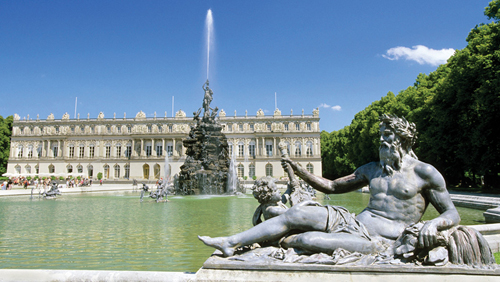
Another
homage to Versailles are the gardens on the west side of the castle,
where water features enchant visitors from May to October. With a
picturesque view of the castle and Lake Chiemsee, this is a wonderful
place for a stroll. Horse-drawn carriages run from the ferry dock to the
castle.
Ludwig II and His Castles
“Kini’s” building mania
began in 1867. At first, he concentrated his efforts in Munich, where he
redesigned his private palace apartments. But he was already planning
his fairy-tale castles. In 1868, he developed the plans for Linderhof –
the only castle to be completed. After work started at Neuschwanstein in
1869, Ludwig focused entirely on the Hohenschwangau region.
Construction on Herrenchiemsee Castle began in 1878; Ludwig spent a mere
nine days there. Projects were planned for Munich, too, including a
festival hall for Wagner operas (of which a smaller version was built in
Bayreuth in 1876). By 1886, Ludwig was in debt by 14 million marks.
With bankruptcy looming, the King was removed from power, and died
shortly thereafter.
Top 10 Events in the Life of Ludwig II
1864: First encounters Richard Wagner
1866: Defeated by the Prussians
1867: Engaged to and unengaged from Sophie
1869: Start of construction at Neuschwanstein
1870–71: Franco-Prussian War
1873: Purchases Herrenchiemsee Island
9 June 1886: Declared unfit to rule
13 June 1886: Drowns in Lake Starnberg