Paintings in the Met
Self-portrait
Rembrandt
(1606–1669) painted a self portrait each decade of his career. In this
moving study from 1660, when he was 54, he portrayed age very honestly.
View of Toledo
Darkening
clouds set an eerie mood for one of El Greco’s (1541–1614) most
memorable paintings, depicting the capital city of the Spanish empire
until 1561.
Young Woman with a Water Pitcher
Painted
between 1660 and 1667, this is a classic example of the subtle and
sensitive use of light that has made Vermeer (1632–75) one of the most
revered Dutch masters.
The Harvesters
One
of five remaining panels of the months of the year, painted in the
1500s, this is Bruegel (1551–1569) at his realistic best, an example of
the use of light and detail that set him apart.
Madame X
Part
of the excellent American art collection, this canvas by John Singer
Sargent (1856–1925) is of an American woman who married a French banker,
becoming a notorious Paris beauty in the 1880s.
Garden at Sainte-Adresse
This
resort town on the English Channel where Monet spent the summer of 1867
is portrayed with sparkling color and intricate brushwork. The work
combines illusion and reality, showing why Monet (1840–1926) was
considered one of the greatest Impressionists.
Gertrude Stein
This
portrait, created when Picasso (1881–1973) was 24 years old shows the
influence of African sculpture and a shift from the slender figures of
his early years to Cubist forms.
The Card Players
Better
known for landscapes and still lifes, Cézanne (1839–1906) was intrigued
by a scene of peasants intent on their card game. This ambitious
project emphasizes the somber concentration of the participants.
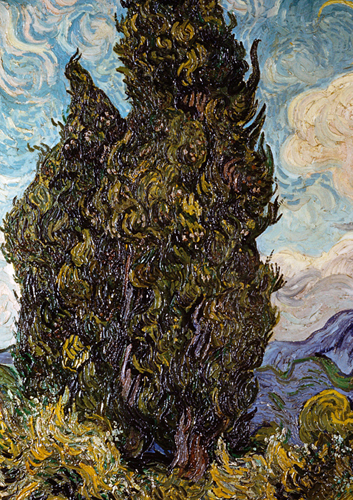
Cypresses
Painted
in 1889, soon after Van Gogh’s (1853–90) voluntary confinement at an
asylum in Saint-Remy, it shows the swirling and heavy brushwork typical
of his work from this period.

Cypresses, 1889
Autumn Rhythm
This
work by Jackson Pollock (1912–1956), the Abstract Expressionist famous
for his drip paintings, is part of the Met’s modern collection.
The Cloisters
In addition to
the medieval treasures in the main building, the Metropolitan oversees a
spectacular branch, The Cloisters, built in medieval architectural
style and set on four acres of land overlooking the Hudson River in Fort
Tryon Park in northern Manhattan. Opened in 1938, the complex consists
of elements from five medieval cloisters and other monastic sites in
southern France. The collections are noted for Romanesque and Gothic
architectural sculptures and include illuminated manuscripts,
tapestries, stained glass, enamels, ivories, and paintings. The
Cloisters’ gardens are a serene escape from the city. John D. Rockefeller, Jr., who gave items from his own collection, is largely responsible for funding the grounds, building, and collections.

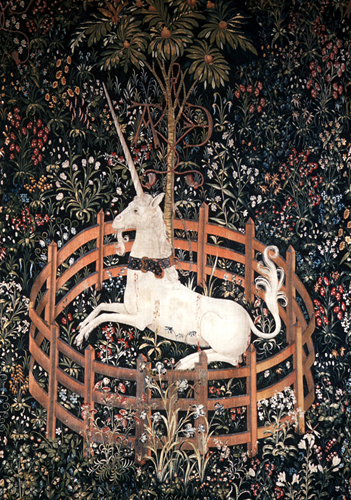
The Unicorn in Captivity, 1495
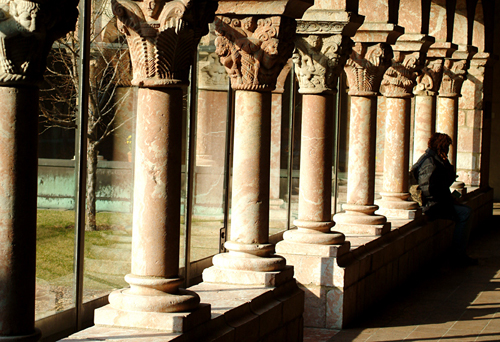
Cloisters Arcades
These arcades are from the Bonnefonten Comminges Cloister in
southern France. They date back to the late 13th and early 14th century.

Top 10 Cloisters Sights
Boppard Room, lives of the saints in stained glass
Merode Triptych, Annunciation altarpiece
Hunt of the Unicorn tapestries
Virgin statue from Strasbourg Cathedral