Today one of the world’s most famous pieces of modern
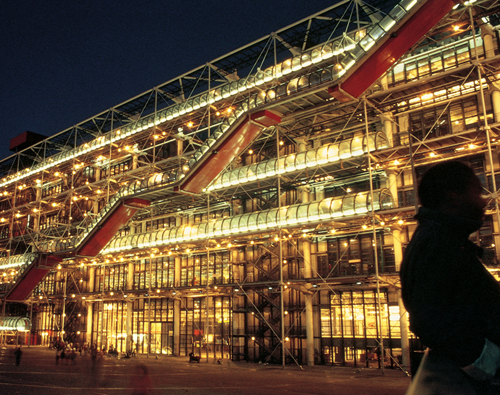
architecture, the Pompidou Centre opened in 1977, when architects
Richard Rogers and Renzo Piano startled everyone by turning the building
“inside out”, with brightly coloured pipes displayed on the façade.
Designed as a cross-cultural arts complex, it houses the excellent Musée
National d’Art Moderne (Modern Art Museum) as well as a cinema,
library, shops and performance space. The outside forecourt is a popular
gathering-spot for tourists and locals alike.
Place Georges Pompidou 75004
www.centrepompidou.fr
01 44 78 12 33 Open 11am–10pm Wed–Mon (11pm Thu); closed 1 May Adm
(museum) €8–12; Brancusi’s Studio free (open 2–6pm Wed–Mon). Free 1st
Sun of the month, under 18s free, under 26s free (EU only).
|
The Centre is home to
various institutions. The Museum of Modern Art (MNAM) is on levels 4 and
5, the cinema on level 1. Check at the information desk or on the
website for details about the temporary shows, rehangs of works on level
5 and the contemporary art “happenings”. Displays at the MNAM often
change and some works may move to the sister institution in Metz. |

Centre Georges Pompidou façade
The centre’s café is pleasant and has free WiFi access. For something grander, head to Georges, the roof-top brasserie.
|
|
Buy tickets online to avoid the queues. |
|
Top 10 Features
Escalator
One
of the building’s most striking and popular features is the external
escalator, which climbs, snake-like, up the front of the centre in its
plexi-glass tube. The view gets better and better as you rise high above
the activity in the Centre’s forecourt, before arriving at the top for
the best view of all.

Top-Floor View
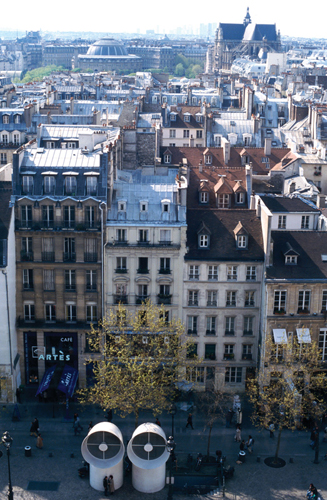
The
view from the top of the Pompidou Centre is spectacular. The Eiffel
Tower is visible, as is Montmartre in the north and the Tour
Montparnasse to the south. On clear days views can stretch as far as La Défense.

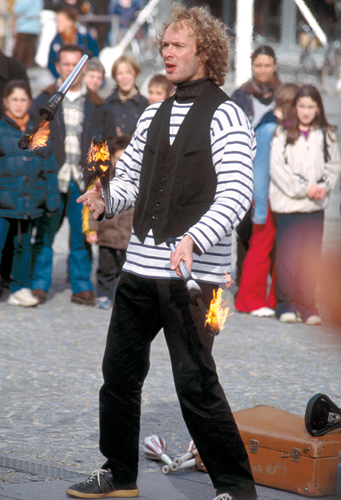
The Forum
Visitors
and locals gather in the open space in front of the Centre to enjoy the
variety of street performers and changing installations of monumental
sculptures, which are often related to shows at the Centre.

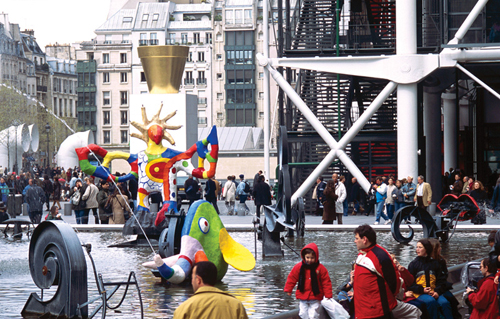
Stravinsky Fountain
This
colourful fountain in Place Igor Stravinsky was designed by Niki de
Saint-Phalle and Jean Tinguely as part of the Pompidou Centre
development. Inspired by composer Stravinsky’s ballet The Firebird (1910), the bird spins and sprays water!

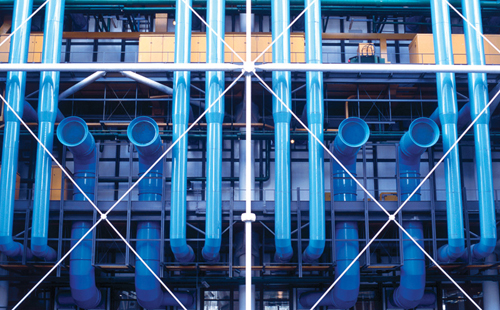
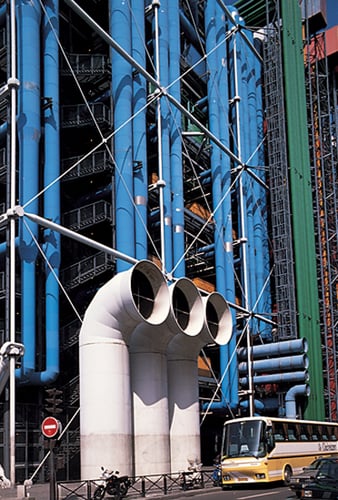
Pipes
Part
of the shock factor of the Pompidou Centre is that the utility pipes
are outside the building. Not only that, they are vividly coloured:
bright green for water, yellow for electricity and blue for
air-conditioning.

Bookshop
The
ground-floor bookshop sells a range of postcards, posters of major
works in the Modern Art Museum and books on artists associated with
Paris.
Brancusi’s Studio
The
studio of revolutionary Romanian sculptor Constantin Brancusi
(1876–1957) is to the north of the centre, displaying his abstract
works.
Man with a Guitar
Within
the Modern Art Museum, this 1914 work by artist Georges Braque
(1882–1963) is one of the most striking of the Cubist Movement.
Violinist at the Window
French
artist Henri Matisse (1869–1964) was one of the proponents of the
short-lived Fauvist Movement, which advocated the use of bold, strong
colours. Violinist at the Window was painted in 1917–18 and can be interpreted as a self-portrait.
La Baigneuse
Joan Miró (1893–1983) was born in Barcelona but moved to Paris in 1920. His simplistic yet evocative La Baigneuse (The Swimmer) (1924) depicts a woman lost in serpentine waves.La Sieste (The Siesta) (1925) comes from his “dream pictures” period and is an example of his contribution to Surrealism.