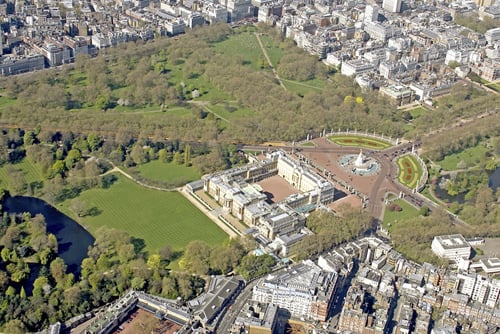
London’s most famous residence, and one of its best
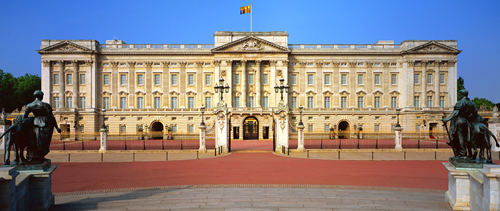
recognized landmarks, Buckingham Palace was built as a town house for
the first Duke of Buckingham in 1705. Between 1824 and 1831, George IV
commissioned John Nash to extend the house into a substantial palace,
which was first occupied by Queen Victoria in 1837. The extensive front
of the building was completed by Sir Aston Webb in 1913. The Palace is
now home to the present Queen and the State Rooms are open to the public
during summer. Many royal parks and gardens in London are also
accessible to the public .
State ApartmentsRoyal MewsQueen’s Gallery |
The official business
of the monarchy takes place in the Palace, which has a staff of around
300. The Duke of Edinburgh, Duke of York, Prince Edward and the Princess
Royal all have offices here. The most senior member of the Royal
Household is the Lord Chamberlain. The Master of the Household and 200
domestic staff organize many functions in the Palace every year,
including around 25 Investitures for recipients of awards which are
given by The Queen. |


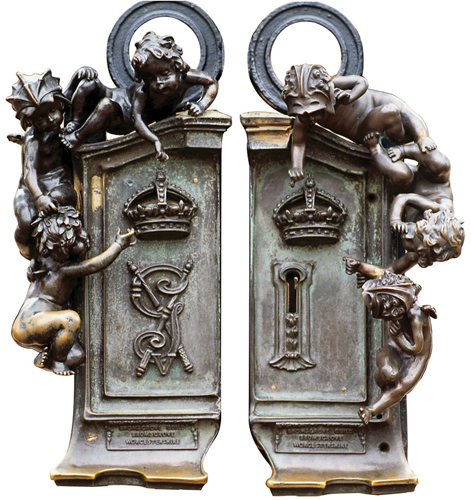
Decorative lock on Palace gates

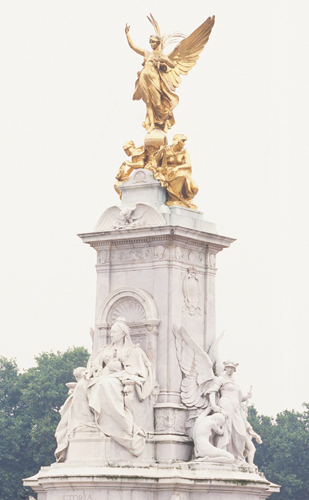
Victoria Monument
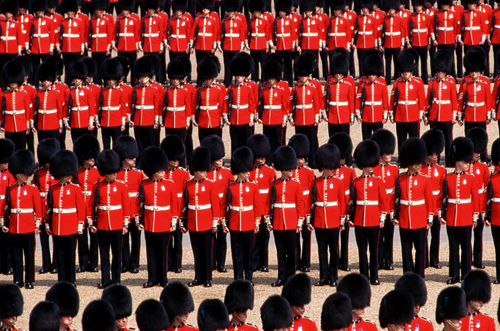
Time your visit to coincide with the Changing of the Guard. |
|
Top 10 Highlights
Changing of the Guard
The
Palace guards, in their familiar red tunics and tall bearskin hats, are
changed at 11am each morning (10am on Sundays, and alternate days in
winter). The guards march to the Palace from the nearby Wellington
Barracks.

The Balcony
On
special occasions, the Queen and other members of the Royal Family step
on to the Palace balcony to wave to the crowds gathered below.
Queen’s Gallery
The
gallery hosts a changing programme of exhibitions of the Royal
Collection’s masterpieces, including works by artists such as Johannes
Vermeer and Leonardo da Vinci.
Grand Staircase
The
Ambassadors’ Entrance leads into the Grand Hall. From here the
magnificent Grand Staircase, with gilded balustrades, rises to the first
floor where the State Rooms are found.
Throne Room
This
houses the thrones of Queen Elizabeth and Prince Philip used for the
coronation. Designed by John Nash, the room has a highly ornamented
ceiling and magnificent chandeliers.
Picture Gallery
The
largest room in the Palace has a barrel-vaulted glass ceiling and
contains a number of paintings from the Royal Collection, including
works by Rembrandt, Rubens and Van Dyck.
State Ballroom
Banquets
for visiting heads of state are held here. The most glittering social
event of the year is in November, when 1,200 members of the Diplomatic
Corps arrive in full court dress.
Royal Mews
Caring
for 34 horses, including the Windsor Greys, which pull the royal coach
on state occasions, these are the finest working stables in Britain. The
collection of coaches, landaus and carriages includes the magnificent
Gold State Coach, which was built in c.1760.

Palace Garden
The
extensive Palace garden is an oasis for wildlife and includes a
four-acre lake. There are at least three Royal garden parties each year,
to which over 30,000 people attend.

Brougham
Every
day a horse-drawn Brougham carriage sets out to collect and deliver
royal packages around London, including the Palace’s weekly copy of Country Life.