Madrid’s Top 10 : Museo Thyssen Bornemisza

One of the most important art collections in the
world, the Thyssen Bornemisza focuses on European painting from the 13th
to the 20th centuries and is the perfect complement to the Prado and Reina Sofía.
Wealthy industrialist Baron Heinrich Thyssen Bornemisza began acquiring
Old Masters in the 1920s for his villa in Switzerland. After the
baron’s death in 1947 his son, Hans Heinrich, added modern masterpieces,
including French Impressionists, German Expressionists and the pick of
the Russian Avant Garde (see Modern Paintings in the Thyssen),
to the collection. In 1993 the state bought the collection for the
knock-down price of $350 million (the true value being estimated at
nearer $1 billion). In spring 2004 a new extension opened, displaying
Baroness Carmen Thyssen Bornemisza’s collection, which includes
important Impressionist works.
  • Paseo del Prado 8

  • 91 369 0151; for advance tickets call 90 248 8488


  • www.museothyssen.org

  • Open 10am–7pm Tue–Sun (Jul–Aug: to midnight Tue–Sat); closed 1 Jan, 1 May, 25 Dec

  • Adm €6 (or €9 for both the permanent & temporary collections)

  • Dis. access


Museum Guide

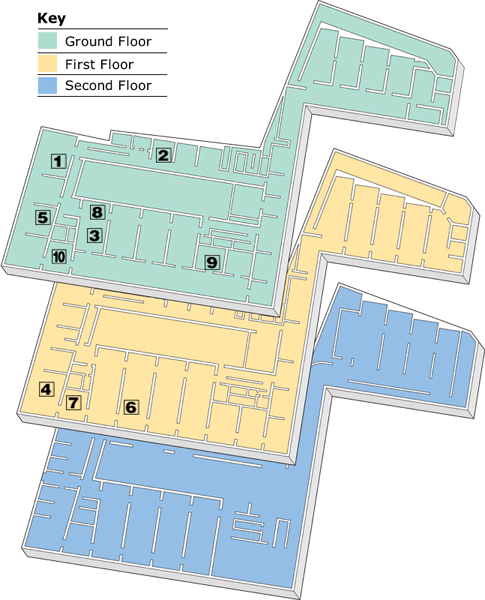
The main entrance is
through the courtyard where there is a shop and cloakrooms. The
collection is organized chronologically, starting with the galleries on
the top floor. Visitors following the official route will trace the
history of western art, starting with the Italian Primitives and ending
with 20th- century abstract and Pop Art. The Carmen Thyssen Collection
occupies the first and second floors of the new extension. Temporary
exhibitions are held on the ground floor and there is a viewing terrace
on the fifth floor.


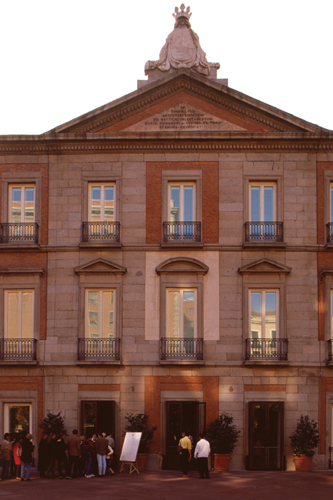
Façade

The café-restaurant has magnificent views of the garden.


The Thyssen opens for evening showings in summer, when you can dine at the garden restaurant.


Top 10 Paintings

  1. Christ and Woman of Samaria at the Well

    Outstanding
    among the collection of Italian Primitives is this work (1310–11) by
    Sienese master Duccio di Buoninsegna (c.1278–1319). The painting’s
    lifelike quality reveals Duccio’s interest in accuracy and looks forward
    to the Renaissance.

  2. Self Portrait

    This
    selfportrait (c.1643) by Rembrandt (1606–69) is one of more than 60
    such works by the great Dutch artist. It reveals Rembrandt’s view of
    himself as isolated genius.

  3. Young Knight in a Landscape

    Vittore
    Carpaccio (c.1460– 1525) is an important representative of the Venetian
    school. This intriguing work (1510) shows a courtly knight amid
    symbolic and animals and plants.

  4. View of Alkmaar from the Sea

    Dutch
    artist Salomon van Ruysdael’s (1600–70) evocative seascape (c.1650) is
    one of the finest examples of the genre, for its effortless mastery of
    colour and perspective.

  5. The Virgin of the Dry Tree

    This
    devotional painting (c.1450) by Dutch artist Petrus Christus
    (c.1410–72), was inspired by an Old Testament metaphor in which God
    brings the dry tree (the chosen people) to life. The “A”s hanging from
    the tree stand for Ave Maria and were meditational.

  6. Expulsion, Moon and Firelight

    This
    haunting work (c.1828) is by the influential American artist, Thomas
    Cole, founder of the Hudson River School. Cole idealized the untramelled
    American landscape as a new Garden of Eden.

  7. Still Life with Cat and Rayfish

    This
    witty still life (c.1728) in the Dutch style is by French artist, Jean
    Baptiste Siméon Chardin (1699–1779). Its companion piece, Still Life with Cat and Fish, is in Room 27.

  8. Portrait of a Young Man

    The
    subject of this painting (c.1515) by Raphael (1484–1520), one of the
    great artists of the High Renaissance, is thought to be Alessandro de
    Medici, nephew of Pope Clement VII. This haughty youth later became a
    tyrant and was murdered by his cousin in 1537.

  9. The Annunciation

    Distorted
    figures, swirling lines and bold colours are typical of the Mannerist
    style which El Greco (1541– 1614) mastered in Venice, where he was
    influenced by Titian and Tintoretto, both masters of the High
    Renaissance. This intensely spiritual painting (c.1567–1577) reveals the
    Cretan artist’s development following his move to Toledo, Spain, in
    1577.

  10. Portrait of Giovanna Tornabuoni

    This
    sublime portrait (1488) by Florentine painter Domenico Ghirlandaio
    (1449–94), was the last Baron Thyssen’s favourite. It was commissioned
    to celebrate the marriage of Giovanna degli Albizzi to Lorenzo
    Tornabuoni – a union of two powerful families. Tragically, Giovanna died
    in child birth shortly afterwards.


Modern Paintings in the Thyssen
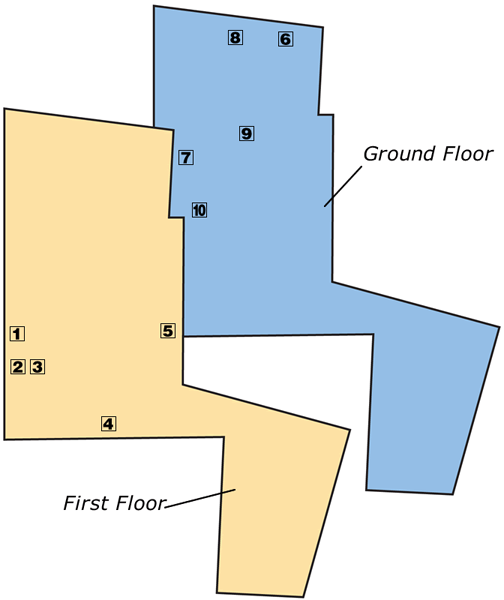


Modern Paintings Floorplan

  1. Woman with a Parasol in a Garden

    This
    Impressionist painting of a garden bathed in sunlight (c.1873) is by
    one of the founders of the influential movement, Pierre Auguste Renoir
    (1841–1920). Renoir was apprenticed for four years as a porcelain
    painter, and later attributed his technical brilliance in handling
    surface and texture to his early training.

  2. Swaying Dancer

    This
    exquisite study of a dancer in performance (1877–9) by French artist
    Edgar Degas (1834–1917) is one of a series of his works devoted to the
    ballet. Unlike some Impressionist painters, Degas placed great emphasis
    on the importance of drawing, as the superb draughts manship of this
    pastel clearly shows.

  3. Les Vessenots

    Vincent
    Van Gogh (1853–90) painted this dazzling landscape (1890) during the
    last year of his troubled life. He worked feverishly while staying at
    Les Vessenots, near Auvers in France, producing more than 80 canvases in
    less than three months.

  4. Fränzi in Front of a Carved Chair

    Ernst Ludwig Kirchner (1880– 1938) was an important figure in German Expressionism and a member of the group known as Die Brücke
    (The Bridge), which began the movement in Dresden. These artists were
    more interested in expressing feelings through their work, and
    encouraging emotional responses from their audience, rather than
    portraying outward reality. Fränzi, seen in this lovely 1910 work, was
    one of their favourite models.

  5. The Dream

    A founder member, with Wassily Kandinsky, of the influential Blaue Reiter
    (Blue Rider) group, German artist Franz Marc (1880–1916) took
    Expressionism in a new, spiritual direction. Colours, as in this 1912
    work, are used symbolically, as are the animals in his paintings, which
    represent truth, beauty and other ideals.

  6. Still Life with Instruments

    Liubov
    Popova (1889–1924) was one of the most innovative artists working in
    Russia on the eve of the Revolution. This Cubist painting (1915),
    completed after a period of study in Paris, paves the way for her Painterly Architectonic, an even bolder abstract work exhibited in Room 41.

  7. Hotel Room

    In
    this moving 1931 painting by American artist Edward Hopper (1882–1967)
    the bare furnishings, discarded suitcase and disconsolate posture of the
    woman holding the railway timetable masterfully suggest loneliness and
    dislocation – a subject the artist returned to time and again. Hopper is
    the most important representative of the American social realist
    school, created in the wake of the Wall Street Crash of 1929 and the
    Great Depression which followed.

  8. New York City, New York

    Piet
    Mondrian (1872–1944) was one of the most influential abstract artists
    of the 20th century. Born in The Netherlands, he moved to New York after
    the outbreak of World War II. The simple geometrical forms and bold
    colours of this abstract painting (1940–42) celebrate the energy and
    dynamism of his adopted home.

  9. Brown and Silver I

    Famous
    for his “action paintings” – randomly throwing or pouring paint onto
    the canvas in an effort to create spontaneity – Jackson Pollock
    (1912–56) made a huge impact on postwar art in America. This painting
    (c.1951) is typical of his revolutionary approach.

  10. Portrait of Baron H.H. Thyssen Bornemisza

    This
    revealing study of the museum’s benefactor (1981–2) is the work of
    Britain’s most distinguished portrait artist, Lucian Freud (b.1922). In
    the background is Pierrot Content by Jean Antoine Watteau (1684–1721), which visitors will find in Room 28.