Henry the Lion transformed Marienplatz into the
centre of Munich – and it remains the heart of the city today. This is
where the Neues Rathaus (New Town Hall) stands, major public transit
lines meet, and locals and visitors alike stroll past street
entertainers, or sit at the restaurant and café patios lining the
square. A pedestrian zone begins at the western end of the square; the
elegant Weinstraße and Theatinerstraße lead off from the north; toward
the east are the Isartor and Maximilianstraße, and to the south the
Viktualienmarkt.
Neues RathausMarienplatz 8 Tower: Open 9am–7pm Mon– Fri, 10am–7pm Sat, Sun & hols (Nov–Apr:10am–5pm Mon–Fri, 10am–7pm Sat, Sun & hols)
www.muenchen.de
FrauenkircheFrauenplatz 1 Tower (South tower, West Entrance), there are a few stairs to the elevator Open Apr–Oct: 10am–5pm Mon–Sat Adm
Peterskirche |
Perched atop the Town Hall
tower, grasping the gospel in its left hand and its right hand raised in
a gesture of benediction, the Münchner Kindl in its monk’s habit is a
reminder of the city’s monkish origins. Dressed in black and yellow, the
colours of the city, it accompanies all official processions –
including the Oktoberfest – on horseback. It is also found on postcards,
beer bottles, and even sewer covers. The “child’s” gender remains a
mystery. The live stand-in is always a woman. |

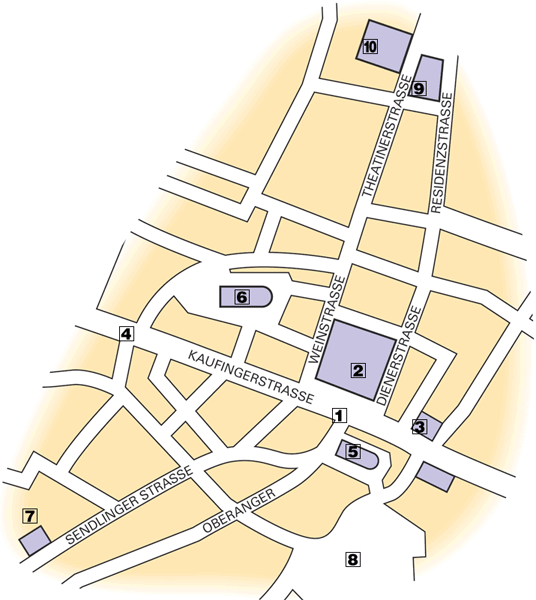
Plan of Marienplatz
There are numerous cafés and restaurants on and around Marienplatz. |
|
For excellent views visit the Neues Rathaus tower, the Peterskirche tower, or the south tower of the Frauenkirche. |
|
The Schrannenhalle was once located on the southern end of the Viktualienmarkt. It was saved and has been reconstructed. |
|
Marienplatz
Dominated
by the Neues Rathaus, the square features a golden statue of the Virgin
Mary from 1638, and the 19th-century Fischbrunnen (Fish Fountain). On
Ash Wednesday, the mayor and town councillors wash their wallets there
so that the city’s coffers will always be full.

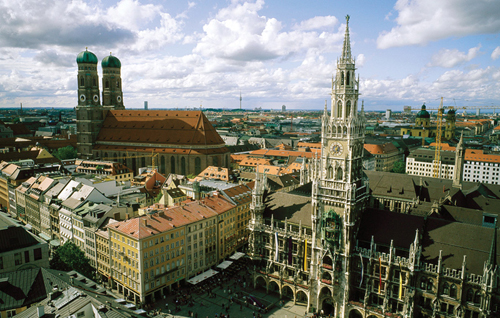
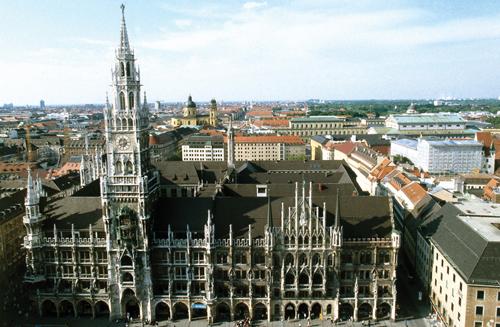
Neues Rathaus
Built
between 1867 and 1908, the Neo-Gothic Neues Rathaus (New Town Hall) is
topped by the Münchner Kindl (Munich Child), the city’s symbol. At 11am,
noon, and, from May to October, also at 5pm, people gather on
Marienplatz to enjoy the town hall’s famous Glockenspiel – a chiming
clock with dancing figures.

Façade of the Neues Rathaus
Altes Rathaus
Now
home to a toy museum, the Gothic Altes Rathaus (Old Town Hall) of 1474
has been rebuilt often, but the hall on the ground floor and the tower,
once a city gate, are original.

Pedestrian Zone
Munich’s
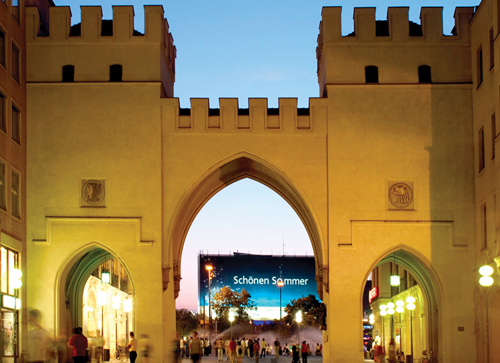
most popular traffic-free shopping zone begins at the western end of
the square and stretches to Karlsplatz. Be sure to see the late
Renaissance Michaelskirche.

Peterskirche
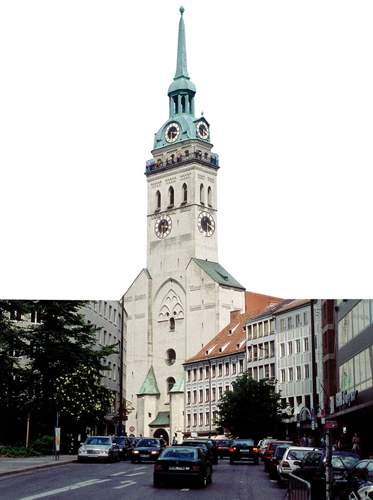
At
the highest point of the Old Town stands the 13th-century St Peter’s,
Munich’s oldest parish church. Its tower, affectionately called Old
Peter , commands a fine view.

Frauenkirche
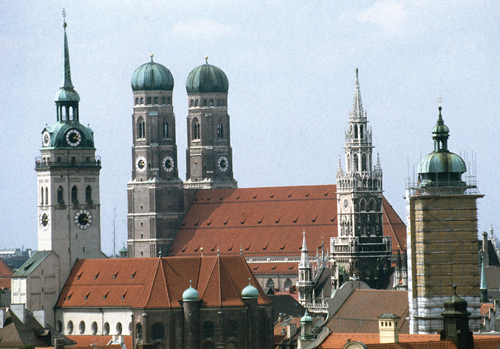
Topped
by onion domes, the Frauenkirche is Munich’s best-known symbol. Built
in record time (1468–88), the church is the largest Gothic basilica in
southern Germany. Highlights include choir figures by Erasmus Grasser
and the tomb of Ludwig IV of Bavaria.

Asamkirche
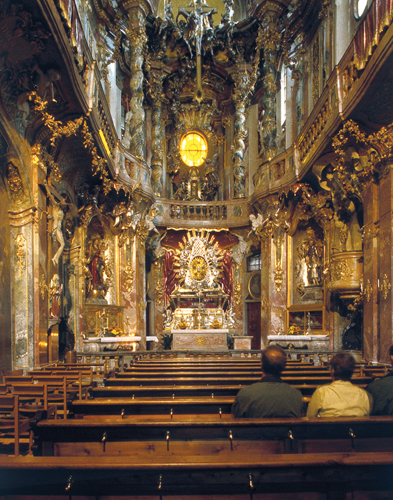
Bequeathed
to the city by the Asam brothers, this church (1733–46) is a jewel of
the late Baroque – a soaring natural stone façade on the outside and an
exquisitely ornamented grotto on the inside. Egid Quirin Asam paid for
the church, which was built near his home.

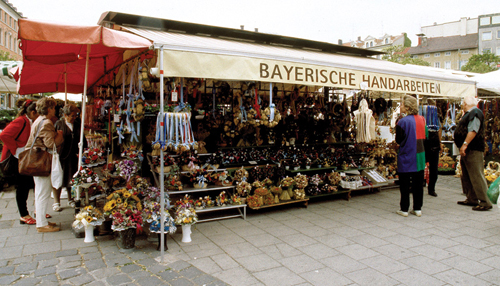
Viktualienmarkt
Since 1807, this colourful food market has thrived here. A stroll past the 140 market stalls is a treat not to be missed.

Feldherrnhalle
Modelled
on Loggia dei Lanzi in Florence, Friedrich von Gärtner built the
Feldherrnhalle in 1844 as a monument to Bavaria’s military heroes. It
marks the boundary between Old Town and Schwabing.

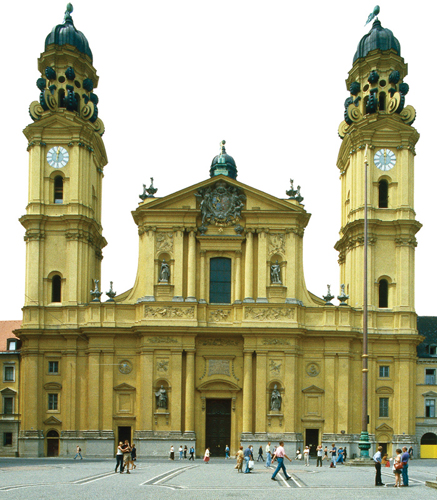
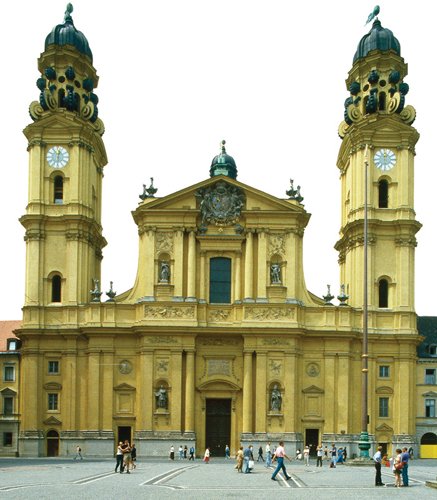
Theatinerkirche
Munich’s
“Italian mile” begins with the Theatinerkirche (1663–1768) – an
exuberant blend of large Baroque domes, flowing volutes, a gigantic
cupola, and Rococo façades.