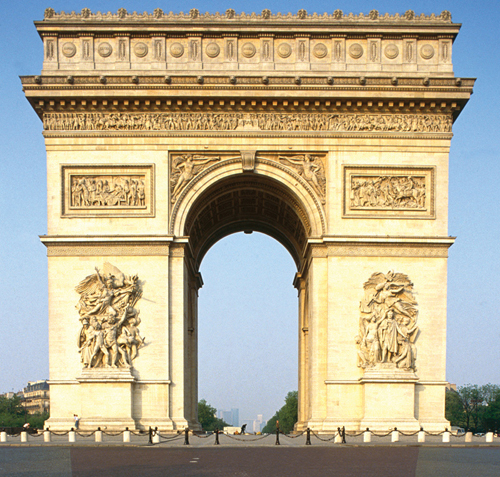
The best day to visit the world’s most familiar
triumphal arch is 2 December, the date that marks Napoleon’s victory at
the Battle of Austerlitz in 1805, when the sun sets in line with the
Champs-Elysées and the Arc de Triomphe, creating a spectacular halo
around the building. Work began on the 50-m (164-ft) arch in 1806 but
was not completed until 1836, due, in part, to Napoleon’s fall from
power. Four years later, Napoleon’s funeral procession passed beneath
it, on its way to his burial in Les Invalides. Today the arch is a focal point for numerous public events.
Place du Général-de-Gaulle, 75008 01 55 37 73 77 (enquiries), 01 55 37 73 78 (tours)
http://arc-de-triomphe.monuments-nationaux.fr
Open Apr–Sep: 10am–11pm daily; Oct–Mar: 10am–0:30pm daily closed 1 Jan, 1 May, 8 May (am), 14 Jul (am), 11 Nov, 25 Dec and for major events Admission €9.00
|
The Arc de Triomphe is at the
centre of three arches and together they create a grand vision of which
even Napoleon would have been proud. The emperor was responsible for
the first two, placing the Arc de Triomphe directly in line with the Arc
de Triomphe du Carrousel in front of the Louvre,
which also celebrates the 1805 victory at Austerlitz. In 1989, the trio
was completed with the Grande Arche at La Défense. The 8km-long
(5-mile) Grand Axe (Great Axis) runs from here to the Glass Pyramid at the Louvre. |

Arc de Triomphe pediment
Try to get here early, as the morning light shows the golden tone of the stonework at its best. |
|
Enjoy a coffee and the old-world charm of Le Fouquet (99 ave des Champs-Elysées) – expensive, but worth the treat. |
|
Top 10 Features
Viewing Platform
Taking
the elevator or climbing the 284 steps to the top of the Arc de
Triomphe gives visitors a sublime view of Paris. To the east is the
magnificent Champs-Elysées and to the west is the Grande Arche of La Défense. Note that after the lift there are still some 40 steps to climb.
Tomb of the Unknown Soldier
In
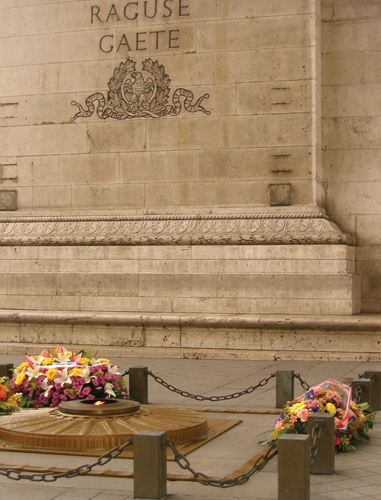
the centre of the arch flickers the eternal flame on the Tomb of the
Unknown Soldier, a victim of World War I buried on 11 November 1920. It
is symbolically reignited every day at 6:30pm.

Museum
Within
the arch is a small but interesting museum which tells the history of
its construction and gives details of various celebrations and funerals
that the arch has seen over the years. The more recent of these are
shown in a short video.
Departure of the Volunteers in 1792
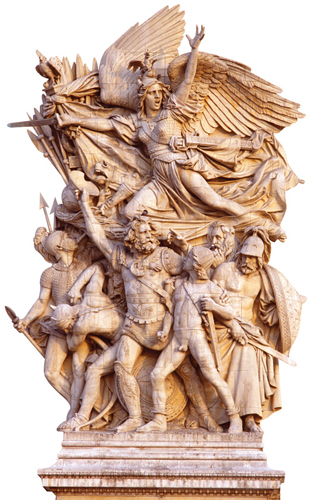
One
of the most striking sculptures is on the front right base. It shows
French citizens leaving to defend their nation against Austria and
Prussia.

Frieze
A frieze running around the arch shows French troops departing for battle (east) and their victorious return (west).
Triumph of Napoleon
As you look at the arch from the Champs-Elysées, the relief on the left base shows the Triumph of Napoleon. This celebrates the Treaty of Vienna peace agreement signed in 1810, when Napoleon’s empire was in its heyday.
Battle of Austerlitz
Another
battle victory is shown on a frieze on the arch’s northern side. It
depicts Napoleon’s heavily outnumbered troops breaking the ice on Lake
Satschan in Austria, a tactic which drowned thousands of enemy troops.
Battle of Aboukir
Above the Triumph of Napoleon
carving is this scene showing Napoleonic victory over the Turks in
1799. The same victory was commemorated on canvas in 1806 by the French
painter Antoine Gros and is now on display at the palace of Versailles .
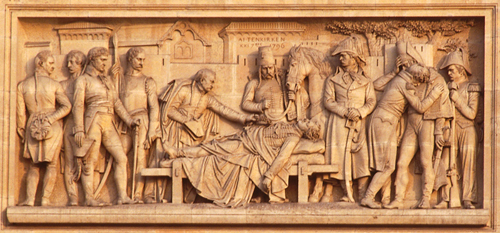
General Marceau’s Funeral
Marceau
died in battle against the Austrian army in 1796, after a famous
victory against them only the previous year. His funeral is depicted in
this frieze, which is located above the Departure of the Volunteers in 1792.

Thirty Shields
Immediately below the top of the arch runs a row of 30 shields, each carrying the name of a Napoleonic victory.