There are some 70 million specimens in the Natural
History Museum’s fascinating collections. Originally the repository for
items brought home by Charles Darwin and Captain Cook’s botanist, Joseph
Banks, among others, the museum combines traditional displays with
innovative, hands-on exhibits. With kid-pleasers such as the impressive
dinosaur collection, it remains one of London’s most popular museums.
Still a hot-house of research, the museum employs 300 scientists and
librarians.
The Natural History
Museum is divided into four distinct sections: the blue zone, which
includes the dinosaur gallery; the green zone, which includes the
ecology and creepy-crawlies galleries; the orange zone, which includes a
wildlife garden; and the red zone, which incorporates the geological
displays.
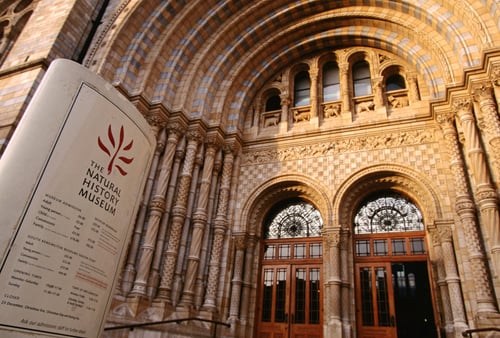
The ornately embellished Cromwell Road entrance leads to the imposing central hall with its grand staircase.
An additional entrance on Exhibition Road leads to the red zone. |


Main entrance
Try the restaurant in the green zone, or the other two cafés and snack bars. |
|
A number of different
tours are available, including a visit to the outdoor Wildlife Garden.
Details at the Central Hall information desk. |
|
There are free guided tours of the Darwin Centre at 3pm & 4pm Mon–Fri (4pm only on Wed). |
|
Top 10 Exhibits
The Vault
The museum’s
extensive collection of gemstones, rocks and minerals includes brilliant
red Rhodochrosite from the USA. The displays of glittering and
colourful stones and rocks include descriptions of how we depend on
them.
Earthquake Simulator
The
Power Within looks at volcanoes and earthquakes. Experience a
simulation of the 1995 Kobe earthquake in a Japanese supermarket.
Journey Through the Globe
Approach
the red zone by an escalator that travels through a giant globe. The
model is made of iron, zinc and copper to symbolize the Earth’s
composition.
No. 1 Crawley House
Perhaps
the most hair-raising display is housed in No. 1 Crawley House, an
exhibit which shows just how many of the 1.3 million known kinds of
arthropods, or creepy-crawlies, share our homes.
Model Baby
A
giant model of an unborn baby in the Human Biology galleries
demonstrates sounds heard in the womb. Other hands-on exhibits test
abilities and reactions and show how physical characteristics are
inherited.
Water Cycle Video Wall
A
semi-spherical video wall in the Ecology Gallery shows the water cycle
and how it links all life on the planet. A walk-through leaf shows how
plants make oxygen.
Fossils
Marine reptiles that lived at the time of the dinosaurs have survived in some remarkable fossils, such as the pregnant female Ichthyosaur, found in a Dorset garden, which lived 187–178 million years ago.
Blue Whale
The
Mammal gallery houses this fascinating exhibit, where both modern
mammals and their fossil relatives are dwarfed in comparison to the
astounding life-sized model of a blue whale, the largest mammal in the
world.
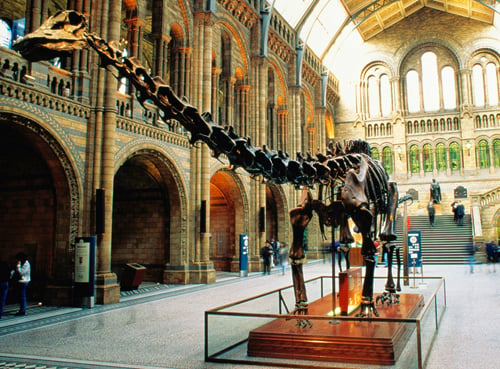
Dinosaurs
T. Rex,
one of the museum’s impressively life-like animatronic models, lurches
and roars in this hugely popular gallery. More traditional exhibits of
fossilized skeletons and eggs are also on display.

Darwin Centre
The
centre features an eight-storey concrete structure in the shape of a
cocoon, which is home to over 200 scientists, and provides protection to
millions of insects and plant specimens.