Palace Rooms

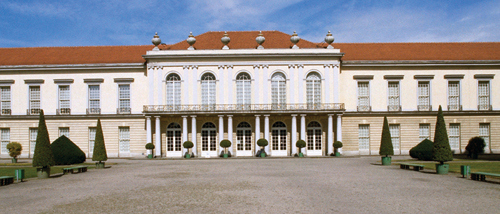
The new wing

Neuer Pavillon
Goldene Galerie
The
festival salon in the Neuer Flügel, 42 m (138 ft) long, was designed,
in the Rococo style, by G W von Knobelsdorff for Frederick the Great.
The richly ornamented room has a cheerful appearance.
Eichengalerie
The wooden panelling of the so-called oak gallery is carved with preciously gilded portraits of the Hohenzollern ancestors.
Gris-de-Lin-Kammer
This
small chamber in Friedrich’s second palace apartment is decorated with
paintings, including some by his favourite artist, Antoine Watteau. The
room was named after its violet-coloured damask (gris-de-lin in French) wall coverings.
Schlafzimmer Königin Luise
Queen
Luise’s bedchamber, designed in 1810 by Karl Friedrich Schinkel,
features the clear lines typical of the Neo-Classical style. The walls
are clad in silk fabrics and wallpaper.
Winterkammern
Friedrich Wilhelm II’s early Neo-Classical rooms contain fine paintings, wall carpets and superb furniture of the time.
Bibliothek
Frederick the Great’s small library has outstanding elegant bookcases and an unusual, light green colour scheme.
Konzertkammer
Furniture
and gilded panelling in the concert hall have been faithfully recreated
as during Frederick the Great’s time. Here hangs Gersaint’s Shop Sign, which the king bought directly from the artist Watteau and is considered to be one of the artist’s most important works.
Grünes Zimmer
The
green room in Queen Elisabeth’s quarters gives an excellent impression
of royal chambers furnished in the 19th-century Biedermeier style.
Rote Kammer
The elegant chamber, decorated entirely in red and gold, is adorned by portraits of King Friedrich I and Sophie Charlotte.
Friedrich I’s Audienzkammer
The
ceiling paintings and Belgian tapestries in Friedrich I’s reception
chamber depict allegorical figures symbolizing the fine arts and the
sciences. There are also magnificent lacquered cabinets, modelled on
Asian originals.
The Hohenzollern and Berlin
In 1412, the Hohenzollern
dynasty, not originally resident in the Berlin area, was asked by the
Luxemburg King Sigismund to liberate the province of Brandenburg from
the men ace of robber barons. Burggraf Friedrich of Hohenzollern from
Nuremberg was so successful in this enterprise that he was made an
Elector in 1415 – this is where the histories of the Hohenzollerns and
Berlin first became entwined, a relationship that was to last for 500
years. Right from the start, the family attempted to limit the powers of
the town. Culture flourished under its rulers, especially under the
Great Elector, who brought 20,000 Huguenot craftsmen to Berlin, as well
as founding an art gallery and several schools. Friedrich Wilhelm I,
father of Frederick the Great, transformed Berlin into a military camp,
with parade grounds and garrisons, and scoured the town for tall men to
join his body guard. In the 19th century, however, relations between
Berlin and the Hohenzollerns became decidedly less cordial.

The Altes Schloss, designed in 1695 by Johann Arnold Nering
Top 10 Hohenzollern rulers
Friedrich Wilhelm (the Great Elector, 1620–88)
Friedrich Wilhelm I (1688–1740)
Friedrich II (the Great) (1712–86)
Friedrich Wilhelm II (1744–97)
Friedrich Wilhelm III (1770–1840)
Friedrich Wilhelm IV (1795–1861)