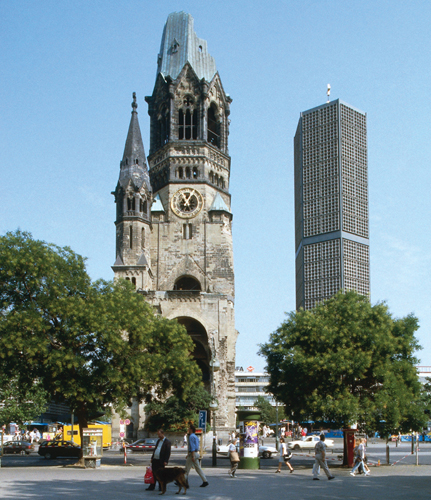
One of the most haunting symbols of Berlin, the ruins
of the memorial church in the heart of the city’s West End, have been
irreverently nicknamed “the hollow tooth”. The Neo-Romanesque church was
given the name of Kaiser Wilhelm Memorial Church in 1895, to honour
Wilhelm I. Following damage by severe bombing raids in 1943, the ruins
of the tower were left standing as a memorial. Next to it, Egon Eiermann
erected a new church in 1957–63. Religious services are now conducted
here.
Breitscheidplatz
www.gedaechtniskirche.com
030 218 50 23 Church 9am–7pm, memorial hall 10am–4pm Mon–Sat Services 10am and 6pm Sun Admission free
|
The
Kaiser-Wilhelm-Gedächtnis-Kirche has the Berliners to thank for its
preservation: in 1947, the Senate had planned to demolish the Tower
Ruins for safety reasons. In a referendum only about ten years later,
however, one in two Berliners voted for its preservation. And so the
idea came about to build a new church next to the ruin and to preserve
the vestibule of the old church as a striking memorial hall to the
horrors of war. |
There are fantastic views of the church from the Mövenpick Café in the Europa-Center opposite. |
|
If possible, visit the
interior of the new church on a sunny day around lunchtime, when the
blue glass window is at its most impressive. |
|
Top 10 Sights
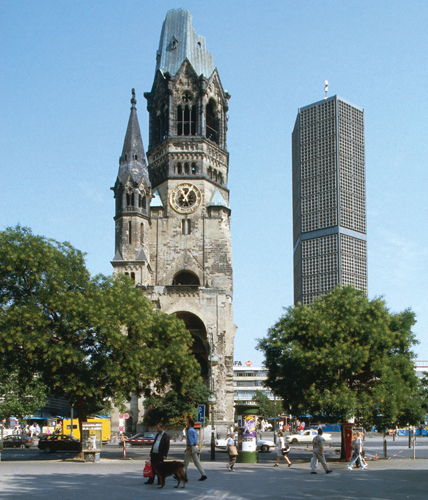
Tower Ruins
Only
the tower of the memorial church survived the destruction of World War
II that razed much of Berlin to the ground. Today only 63 m (206 ft)
high, it once rose to 113 m (370 ft). The hole in the tower’s roof has a
ragged edge, hence the nickname “hollow tooth”. The tower underwent
restoration during 2009.


The “hollow tooth” – the Tower Ruins
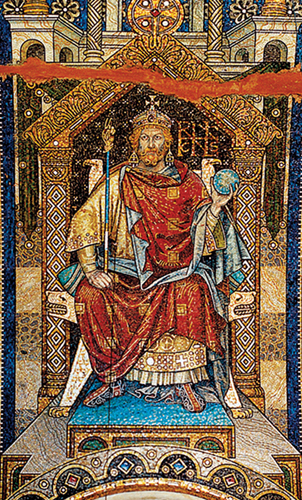
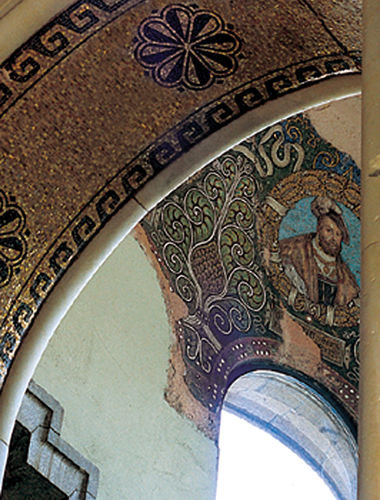
Kaiser’s Mosaic
One
of the mosaics that have been preserved depicts Emperor Heinrich I on
his throne, with imperial orb and sceptre. Originally decorated
throughout with scenes from German imperial history, the church interior
was meant to place the Hohenzollerns within this tradition.

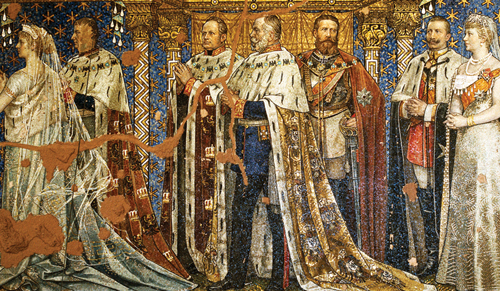
Mosaic of the Hohenzollerns
The
surprisingly coloured mosaic of the Hohenzollerns adorns the vestibule
of the church ruins. It depicts Emperor Wilhelm I together with Queen
Luise of Prussia and her entourage.

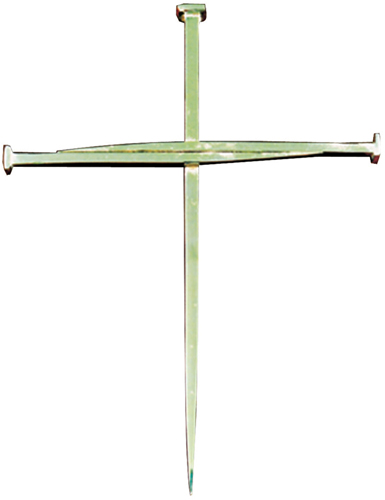
Coventry Crucifix
This
small crucifix was forged from old nails that were found in the ruins
of Coventry Cathedral. It commemorates the bombing of Coventry, England,
by the German Luftwaffe in 1940.

New Bell Tower
The new hexagonal bell tower rises 53 m (174 ft) high next to the tower ruins, on the site of the old church’s main nave.
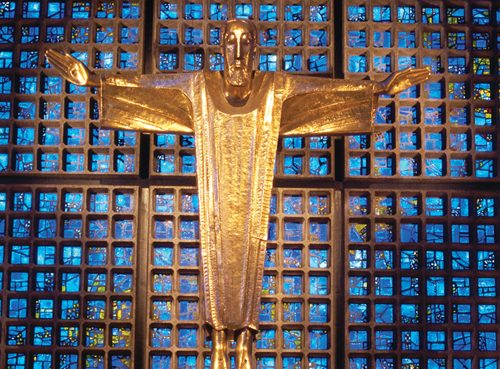
Main Altar
The
golden figure of Christ created by Karl Hemmeter is suspended above the
modern main altar in the new church. In the evening light, the windows
behind the altar glow an overwhelming dark blue.

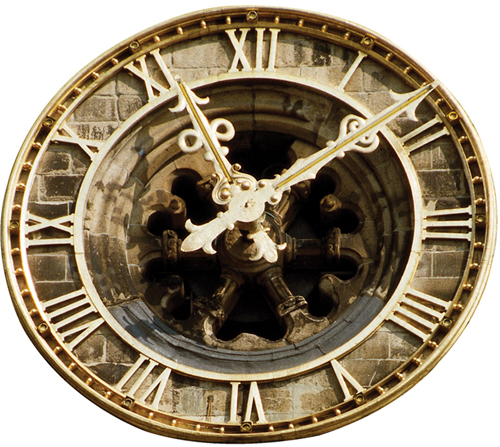
Tower Clock
The
tower bears a clock based on a Classical design, with Roman numerals.
At night, it is lit in blue by modern light-emitting diodes to match the
lighting inside the new church.

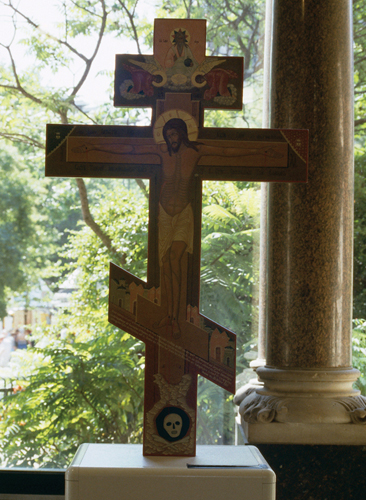
The Orthodox Cross
A gift from the Russian Orthodox bishops of Volokolomsk and Yuruyev, this cross was given in memory of the victims of Nazism.

Original Mosaics
Mosaics showing Prussian dukes are preserved on the walls and ceilings all along the stairways.

Figure of Christ
Miraculously, the vast, plain sculpture of Christ, which is suspended from the ceiling, survived the bombing of the church.