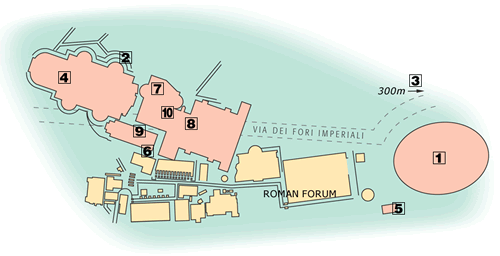
This rich archaeological zone, rudely intruded upon
by Mussolini’s Via dei Fori Imperiali, contains some of the most
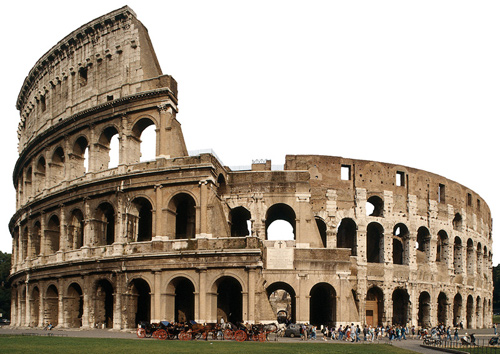
grandiose and noteworthy of Rome’s ancient remains. Dominating the area
is the mighty shell of the Colosseum, constructed in AD 72–80 under the
Flavian emperors and originally known as the Flavian Amphitheatre. The
quarter also holds other imperial wonders, such as the Arch of
Constantine, the gigantic fora of various emperors, most notably
Trajan’s, and the 1st century AD folly of Nero’s Golden House, now a
subterranean revelation of Roman interior design. Plans are under way to
turn the area into one great archaeological park, and the broad
thoroughfare crossing the zone is more and more frequently closed to
traffic, as those aims are gradually realized.
ColosseumTrajan’s MarketsVia IV Novembre 06 6978 0532 Open 9am–7pm Tue–Sun Adm €6.50
Nero’s Golden HouseMamertine Prison |
Expect to take three
hours to see everything. There are likely to be queues for the Colosseum
and for Nero’s Golden House; a guided tour is mandatory, with only 30
people at a time, so booking is advised. Use the Via IV Novembre
entrance to Trajan’s Markets. The other fora are viewed from Via dei
Fori Imperiali. |

Original Plan of the Imperial Fora

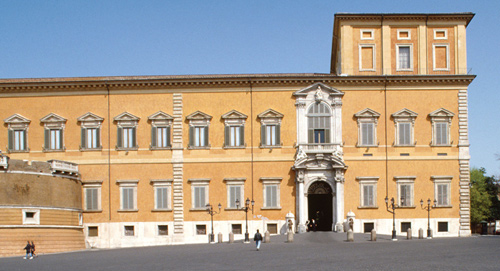
Loggia, House of the Knights of Rhodes
One of the friendliest places for a light meal is Caffé Valorani, at Largo Corrado Ricci 30. |
|
At the Colosseum, use one of the student guides – they work for tips and really bring the place to life. |
|
Top 10 Sights
Colosseum
Here
the imperial passion for bloody spectacle reached its peak of excess.
When Emperor Titus inaugurated the amphitheatrein AD 80, he declared 100
days of celebratory games, some involving the massacre of 5,000 wild
beasts. All such slaughter-as-sport was legal until AD 523 .

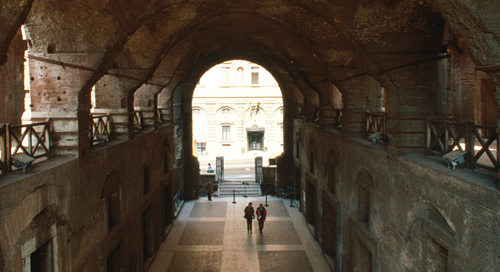
Trajan’s Markets
The
emperor and his visionary architect, Apollodorus of Damascus, built
this attractive, very modern looking shopping and office mall in the
early 2nd century AD. There were 150 spaces in all, the top floor
utilized by welfare offices, the lower levels by shops of all kinds.

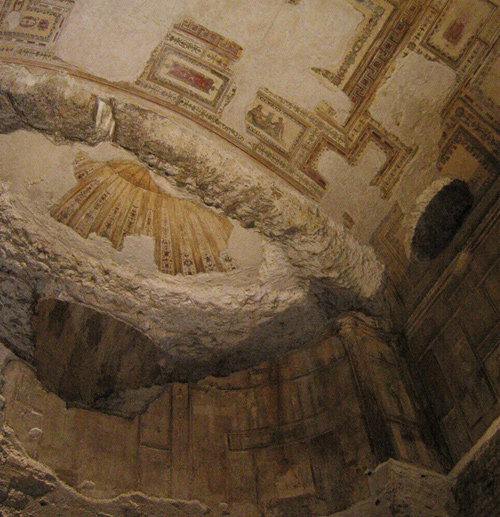
Nero’s Golden House (Domus Aurea)
This
mad emperor’s self-indulgence resulted in the largest, most sumptuous
palace Rome ever saw, yet it was meant only for amusement. In its heyday
it covered several acres and boasted every luxury, including its own
forest .

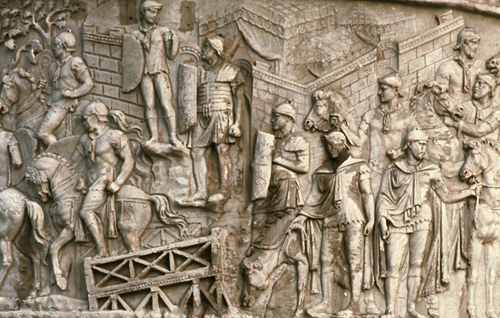
Trajan’s Forum and Column
Trajan’s
Forum was so splendid that it left all who beheld it awed by its
nobility. Now cut off by modern streets, all that stands out is the
magnificent column, commemorating in fine graphic detail the emperor’s
victories in what is now Romania. Access to part of it is through
Trajan’s Market.

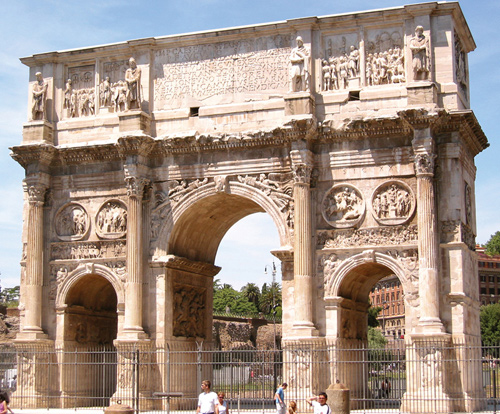
Arch of Constantine
This arch marks the victory of the first Christian emperor over his rival emperor Maxentius .
Yet it is mostly a pastiche of pagan elements taken from several
earlier monuments – the beautiful hunt-scene roundels come from a temple
dedicated to Emperor Hadrian’s male lover, Antinous.

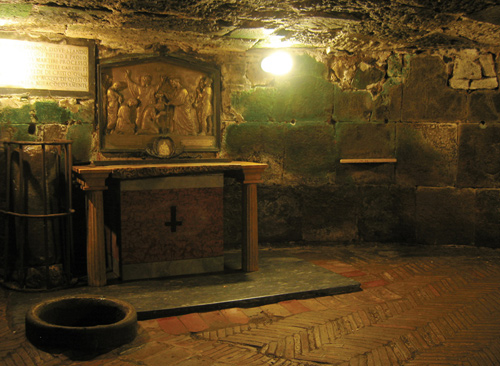
Mamertine Prison
Legend
holds that St Peter was imprisoned here. Prisoners were originally
dropped down through a hole in the floor and the only exit was death.

House of the Knights of Rhodes
This
12th-century priory was owned by the crusading order of the Knights of
Rhodes. Inside are the original portico, three shops and the Chapel of
St John.
Forum of Nerva
If
Pope Paul V hadn’t stripped it to build the Acqua Paola fountain in the
17th century, the main attraction here would have been the Temple of
Minerva. Two Corinthian columns remain, and a frieze above, depicting
the myth of Arachne.
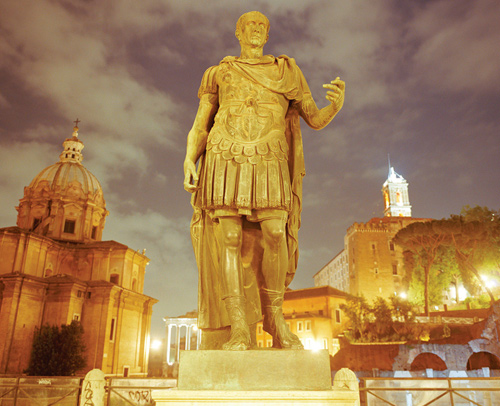
Forum of Julius Caesar
The
first of Rome’s Imperial Forums. Caesar’s line, the Julians, traced
their ancestry back to Venus herself, so he erected the Temple of Venus
Genetrix (46 BC) and placed there statues of himself and Cleopatra, his
great love.

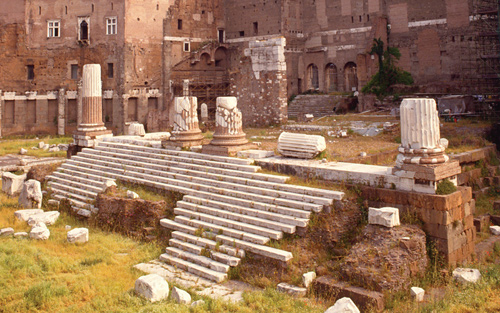
Forum of Augustus
Julius Caesar’s successor made the focus of his forum the Temple of Mars the Avenger, identified by the broad staircase and four Corinthian columns.