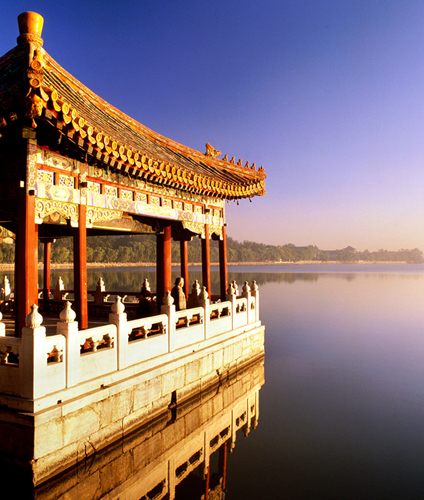
An imperial garden for more than a thousand years,
Bei Hai was opened to the public in 1925. Filled with artificial hills,
pavilions, and temples, it is associated with Kublai Khan, who
redesigned it during the Mongol Yuan dynasty. These days, it is a fine
place for a leisurely afternoon stroll, and perhaps a bit of boating on
the lake.
1 Wenjin Jie, Xicheng 6403 3225 Buses: 5, 101, 103, 107, 109, 111, and others Open: Apr–Oct 6am–10pm daily. Nov–Mar 6:30am–9pm. All buildings close at 5pm Apr–Oct, 4pm Nov–Mar Admission: Apr–Oct ¥20. Nov–Mar ¥10
www.beihaipark.com.cn
|
Beijing’s parks
double as recreation centers, particularly for the city’s elderly
citizens. As soon as the parks open in the morning they gather to
perform communal tai ji quan (tai chi) exercises. Many then spend the rest of the day in the park playing cards, dominos or mahjong, engaging in yang ge (fan dancing) or ballroom dancing, or simply reading the newspaper and talking with friends. |

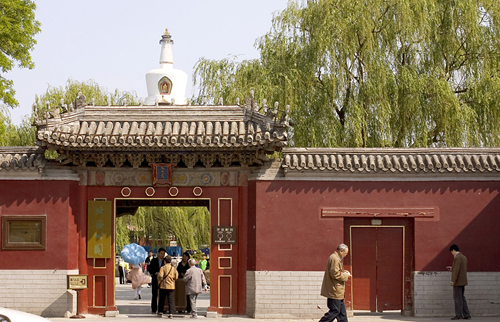
Park gate
Aside from the famous Fangshan Restaurant, there are also small snack kiosks in the park. |
|
There are four gates to
the park: the most convenient is the south gate, close to the northwest
corner of the Forbidden City; the north gate exits across the road from
Hou Hai, where there are good eating and drinking options. |
|
Top 10 Features
Round City
Bei
Hai was the site of Beijing’s earliest imperial palace, although
nothing remains other than a small pavilion on a site known as the Round
City, and a large jade wine vessel said to have belonged to Kublai
Khan.
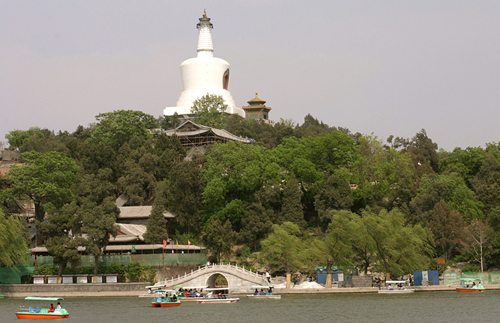
Jade Island
Accessed
by bridge from the south gate or by boat from the north gate, Bei Hai’s
willow-lined island was created from the earth excavated to form the
lake.

White Dagoba
Topping
Jade Island, the 118-ft (36-m) high White Dagoba is a Tibetan-style
stupa built to honor the visit of the fifth Dalai Lama in 1651. It has
been rebuilt twice since.
Yongan Temple
Beneath
the Dagoba, the temple comprises a series of ascending halls, including
the Hall of the Wheel of Law with its central effigy of the Buddha
Sakyamuni.
Fangshan Restaurant
Founded
in 1926 by chefs of the imperial household, the restaurant bases its
menus on court cuisine. Standards have slipped but the lakeside setting
still has great appeal.

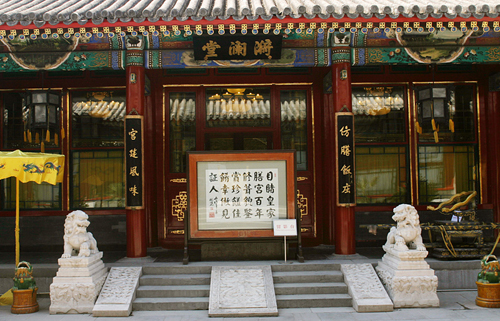
Pavilion of Calligraphy
A
crescent-shaped hall on Jade Island contains nearly 500 stone tablets
engraved with the work of famous Chinese calligraphers. If the exhibits
are less than enthralling the walkways that lead to the pavilion are
enchanting.
The Place of Serenity
In
the northwest corner of the park is this beautiful garden, created in
the mid-18th century by the Qianlong emperor, with rockeries, pavilions,
and ornate bridges over goldfish-filled pools.

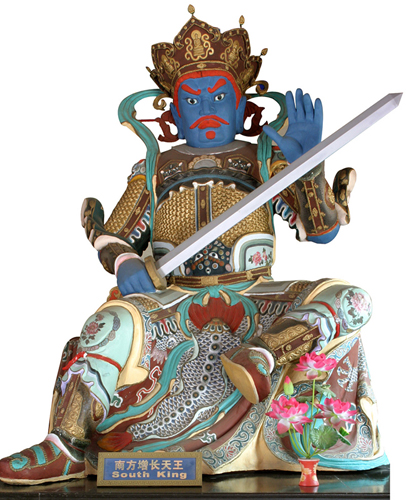
Xiao Xitian Temple
Near
the Place of Serenity is a trio of small temple buildings – the
Pavilion of 10,000 Buddhas, the Glazed Pavilion, which is covered with
green and yellow ceramic Buddhas, and the Xiao Xitian (Small Western
Sky) Temple filled with fearsome-looking idols.

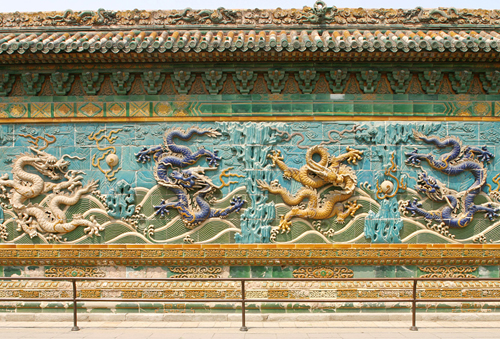
Nine Dragon Screen
Bei
Hai’s most striking sight is an 89-ft (27-m) long, free-standing wall
made of colorful glazed ceramic tiles and depicting nine intertwined
dragons. The Chinese dragon is a beneficent beast offering protection
and good luck. The wall was designed to obstruct the passage of evil
spirits, who are only able to travel in straight lines.

Zhong Nan Hai
Bei
Hai means North Lake; the Middle (Zhong) and South (Nan) Lakes are part
of an area occupied by China’s political leaders and are off- limits to
all except government officials. Zhong Nan Hai is regarded as the new
Forbidden City.